
Every Sunday, some of your people simply can’t be in the room: the sick, the elderly, the traveling, and the not-quite-ready. A live stream turns those empty seats into an open door. This Startup Guide for Churches shows you how to build that door, even with a small team and a tight budget.
Getting started is easier and more affordable than ever. Think of this as your complete church live streaming setup guide: why streaming matters, which gear to buy at every budget, how to go live step by step, which platforms to use, and the habits that keep your online congregation coming back week after week.
- Around three in four U.S. congregations now offer online worship, so streaming is part of everyday ministry.
- You can start with one good camera, a clean audio feed from your soundboard, and a wired internet connection, then grow from there.
- Audio matters more than video. A direct feed from your mixer beats any camera microphone.
- Multistreaming lets you reach Facebook, YouTube, your church website, and more at the same time while sending only one stream from your building.
- Facebook now removes live videos after 30 days, so always keep your own recording of every service.
Why Live Stream Church Services in 2026?
The numbers make the case clearly. The Hartford Institute for Religion Research found that about 75% of U.S. congregations offer online or virtual worship, up from roughly 45% before the pandemic. Pew Research Center reports that 27% of U.S. adults regularly watch religious services online or on TV, and church technology surveys from Pushpay and Barna show close to nine in ten churches still streaming in 2026.
In short, live streaming church services in 2026 is about meeting people where they already are. Here's what a consistent stream does for your ministry:
Benefits of Live Streaming Your Church Services
- Connectivity: Keep members connected when they travel, move away, or work on Sundays.
- Inclusivity: Serve the sick, the elderly, new parents, and anyone who can't attend in person.
- Pastoral reach: Extend teaching, prayer, and care to members wherever they live.
- Outreach: Give curious newcomers a low-pressure way to "visit" before walking through your doors.
- Community strengthening: Let members share services with friends and family in a single tap.
- Growth opportunities: Every recorded sermon becomes a resource people can find and revisit.
- Generosity: Make it simple for online viewers to give while they worship.
Church Livestream Equipment List: The Gear You Actually Need
You don't need a broadcast truck to stream a great service. Most churches only need five church broadcast gear essentials: a camera, a way to switch or capture video, clean audio, a reliable internet connection, and streaming software. Start simple, then upgrade one piece at a time as your team gains confidence.
1. Cameras: Capturing the Essence of Worship
The camera is the window your online congregation looks through. Choose one that outputs a clean HDMI or SDI signal and can run for a full service without overheating or stopping.
- Mirrorless cameras: The Sony ZV-E10 II or Sony a6700 and the Panasonic Lumix GH7 (which replaces the GH5) give a rich, cinematic look with reliable autofocus.
- PTZ cameras: Pan-tilt-zoom cameras such as the PTZOptics Move SE 20x can be mounted on a wall and controlled by one volunteer. Built-in auto-tracking follows the pastor across the stage.
- Budget option: A simple camcorder or even a recent smartphone on a sturdy tripod works well for small churches and church plants.
- Multiple angles: Plan for a wide shot of the stage and a closer shot of the speaker. Two cameras instantly make a stream feel more professional.
2. Audio Equipment: Crystal-Clear Sound
Viewers will forgive a slightly soft image. They won't forgive muddy or distorted sound. For church streaming, audio is the most important piece of the setup.
- Use a direct feed from your soundboard: Send a dedicated stream mix from your mixer instead of relying on a camera microphone.
- Wireless mics for the pastor: A headset or lavalier system such as the Shure SLX-D+ series keeps the sermon clear while the pastor moves freely. The SLX-D+ line is the updated version of Shure's popular SLX-D digital wireless.
- Studio mic for announcements or podcasts: The Shure SM7dB, an updated SM7B with a built-in preamp, is ideal for desk segments, announcements, and sermon podcasts.
- Digital mixer: The Behringer X32 remains a dependable church workhorse, while newer consoles such as the Behringer WING Compact give you more channels and easier routing for a separate online mix.
- Room mics: Add one or two ambient microphones so online viewers can hear the congregation singing, not just the stage.
3. Internet Connection and Network Setup: The Backbone of Streaming
A stable connection matters more than a fast one. Test your real upload speed during a Sunday service, because building Wi-Fi gets crowded when the room is full.
- Go wired: Run an Ethernet cable from your router to the streaming computer. Avoid Wi-Fi range extenders for your main stream.
- Plan for headroom: Aim for an upload speed of at least 1.5 times your stream's bitrate. For a 1080p stream, a dedicated upload of 15 to 20 Mbps gives you a comfortable margin.
- Separate your network: Put streaming gear on its own network or VLAN so guest Wi-Fi doesn't slow it down.
- Have a backup: Keep a mobile hotspot ready, and use a streaming service that supports a backup stream key so the broadcast keeps going if the main connection drops.
4. Lighting: The Most Overlooked Upgrade
Sanctuary lighting is designed for people in the room, not for cameras. Faces often look dark or washed out on screen.
- Add two soft LED panels aimed at the pulpit to light the speaker's face evenly.
- Keep the color temperature of all lights the same to avoid orange or blue skin tones.
- Avoid placing the speaker in front of bright windows or screens.
5. Encoding and Streaming Software: Seamless Integration
Most social platforms let you stream for free, but only to one destination at a time and with limited control over branding. Streaming software gives you scenes, overlays, and lower thirds, and a multistreaming service sends your service everywhere at once.
- Free and flexible: OBS Studio is free, works on Windows, Mac, and Linux, and is powerful enough for most churches.
- Multistream through OneStream Live: Send one stream from your favorite encoder to OneStream Live, and choose where your service goes from 45+ platforms, including social media, your church website, and custom RTMP destinations.
- Works with your existing tools: OneStream Live supports OBS Studio, vMix, Wirecast, Zoom, Ecamm Live, Streamlabs, XSplit, and hardware encoders, using RTMP, RTMPS, SRT, or WHIP.
- Less strain on your building's internet: Because your encoder only sends one feed and the multistreaming happens in the cloud, you don't need extra upload speed for each platform.
| Setup Level | Who It's For | Typical Gear | Approx. Budget |
|---|---|---|---|
| Starter | Small churches and church plants | One camera or smartphone, soundboard audio feed, OneStream Live Studio or OBS Studio, wired internet | $300 to $1,000 |
| Growing | Mid-size churches streaming every week | Two PTZ or mirrorless cameras, wireless pastor mic, separate stream mix, LED panels | $1,500 to $5,000 |
| Established | Larger churches with a media team | Three or more PTZ cameras, digital console, dedicated network, backup internet connection | $5,000 and up |
Don't buy everything at once. Start with clean audio and one well-placed camera, stream for a month, and then spend your next budget on whatever your viewers and volunteers notice most.
How to Live Stream Church Services: A Step-by-Step Tutorial
If you're wondering how to start church livestreaming without overwhelming your team, follow this church livestreaming tutorial step by step. Each step builds on the last, so even first-time volunteers can run a reliable stream.
1
Set your goal and audience. Decide whether you're mainly serving existing members, reaching newcomers, or both. This shapes your platforms and schedule.
2
Check your music licensing. Confirm your church holds the right streaming license for the worship songs you perform.
3
Choose your platforms. Pick where you'll stream, such as YouTube, Facebook, and your church website, and connect them to your multistreaming account.
4
Set up your camera and audio. Position the camera for a clear view of the pulpit and run a dedicated audio feed from your soundboard.
5
Connect your encoder or studio. Use streaming software, a hardware switcher, or a browser-based studio, and add your church logo, lower thirds, and lyric overlays.
6
Schedule the stream and promote it. Create the event a few days in advance so followers get reminders, and share the link in your newsletter and social posts.
7
Run a test broadcast. Go live privately or to a test destination at least 30 minutes before the service to check audio levels, video, and chat.
8
Go live and engage. Assign one volunteer to welcome viewers in the chat, share sermon notes, and answer prayer requests.
9
Save and repurpose the recording. Download the full service, post it on your website, and cut short clips for social media during the week.
Enhance Worship: OneStream Live Features for Churches
If you want to multistream your virtual church services across several platforms, OneStream Live brings together the tools churches need in one browser-based dashboard. Here are the features that make the biggest difference for worship teams.
Multistream to Reach Diverse Audiences
Broadcast your service to 45+ social platforms and websites at the same time, including YouTube, Facebook, LinkedIn, Twitch, and custom RTMP destinations. Your members can watch wherever they already spend time.
Live Studio for Services Without Extra Software
The browser-based OneStream Live Studio lets you produce a polished service straight from your browser. Invite guest speakers, missionaries, or worship leaders from anywhere, share your screen and media, switch layouts, and use a built-in teleprompter for announcements. A studio lobby lets guests wait comfortably before they appear on stream.
Multi-Camera Streaming
Bring several camera angles into one stream so viewers see both the stage and the speaker up close. Switching between shots makes your service look more professional and keeps viewers engaged.
Recording and Pre-recorded Services
Record your live service and download it for your website, sermon archive, or podcast. You can also schedule pre-recorded services for holidays, midweek devotionals, or times when your team needs a break.
24/7 Streaming and Scheduled Broadcasts
Loop sermons, worship sets, or scripture readings on YouTube around the clock so your channel always has something to offer. Schedule streams in advance to keep a consistent rhythm your congregation can rely on.
Captions and Scripture on Screen
Add captions and subtitles to make services accessible to deaf and hard-of-hearing viewers, and place scripture verses on screen as text overlays so everyone can follow along.
Customizable Branding
Match your stream to your church's identity with overlays, lower thirds, backgrounds, and your church logo design. Consistent branding helps viewers recognize your services instantly.
Read More: How to Brand Your Live Streams
Unified Chat for Real-Time Fellowship
Read and reply to comments from supported platforms in one place with Unified Chat. Lead small group discussions, welcome first-time viewers, and respond to prayer requests without switching between apps.
Online Giving with Live Sales
Use the Live Sales feature in the Studio to display giving links and QR codes during the service, so viewers can support your church or a mission project in a few taps.
Your Own Church Streaming Website
Host your service on a branded page with OneStream Live Custom Websites, or embed the live player on your existing church website. Viewers can watch without a social media account, which matters for the many older members who aren't on Facebook.
Read More: Live Stream on Your Custom Webpage
Other Church Streaming Software Worth Knowing
Every church has different needs, budgets, and volunteer skills. Many of these tools work alongside OneStream Live as your encoder, while others are all-in-one church platforms.
| Software | Best For | Notes |
|---|---|---|
| OBS Studio | Churches on a tight budget | Free and open source; Windows, Mac, and Linux |
| vMix | Advanced multi-camera production | Windows only; powerful but has a learning curve |
| Wirecast | Professional live production | Windows and Mac; strong graphics and replay tools |
| Ecamm Live | Mac-based churches | Easy to learn; great for smaller teams |
| XSplit Broadcaster | Windows users who want simple scenes | Free and paid versions |
| BoxCast | Hardware plus hosting in one package | Church-focused, with dedicated encoders |
| Resi | Churches that need very reliable delivery | Church-focused, with resilient streaming technology |
| Castr | Hosting and multistreaming with video storage | General-purpose streaming platform |
| StreamingChurch.tv | Small churches wanting full-service help | Church-focused hosting and support |
Choosing the Best Platforms for Church Live Streaming
Where you stream is just as important as how you stream. The best platforms for church live streaming are usually a mix of social media for reach and your own website for ownership. Here's how each option fits.
1. Facebook Live: Connecting with Your Community
Facebook remains a natural home for many congregations, especially for members who already follow your church page. Comments, reactions, and shares make it easy for people to invite friends. Keep in mind that Facebook now deletes live videos 30 days after they air, so you'll need to save your recordings elsewhere.
- Schedule your live streams in advance so followers get notified.
- Create a Facebook Event for special services such as Easter and Christmas.
- Encourage members to share the stream to their own timelines.
- Download each service or keep a recording through your streaming service before the 30 days are up.
2. YouTube Live: Expanding Your Reach
YouTube has the widest reach of any major platform. Pew Research Center reports that 84% of U.S. adults use YouTube, and anyone can watch without logging in. Your services also stay available as a searchable sermon library.
- Write clear titles and descriptions with the sermon topic, scripture, and date.
- Use YouTube Analytics to see when viewers drop off and what they rewatch.
- Encourage viewers to subscribe and turn on notifications.
- Turn sermon highlights into YouTube Shorts during the week.
3. Instagram Live: Engaging a Younger Audience
Instagram suits youth ministry, behind-the-scenes moments, and informal Q&A sessions with your pastor. Its vertical format feels personal and casual.
- Use Instagram Stories with countdown stickers to promote upcoming services.
- Add a link sticker to Stories to send viewers to your full service or giving page (link stickers replaced the old "Swipe Up" feature).
- Use relevant hashtags to help new people find you.
- Stream in portrait mode so the video fills the phone screen.
4. Twitch: Interacting with Younger, Tech-Savvy Viewers
While Twitch is best known for gaming, it now hosts music, talk shows, and faith content. It can be a great way for churches to reach a younger, highly interactive audience.
- Create a dedicated channel and keep a regular streaming schedule.
- Use Twitch chat for real-time prayer requests and discussion.
- Try youth group game nights or casual Q&A streams to build relationships.
5. Church-Specific Platforms: Tailoring to Your Audience
Platforms built for ministry offer features social media can't, such as private prayer chat, salvation responses, and giving tools. Examples include the free Church Online Platform from Life.Church, Resi, BoxCast, and Subsplash.
- Look for features such as one-on-one prayer rooms, sermon notes, and digital bulletins.
- Make sure the platform matches your church's branding and mission.
- Check how easily it connects to your existing streaming software.
6. Your Church's Website: Centralizing Your Online Presence
Your website is the one place you fully control. According to Pew Research Center, around 29% of U.S. adults and 42% of adults aged 65 and older don't use Facebook, so a website stream helps you reach people a social-only stream would miss.
- Place the live player on your homepage so it's the first thing visitors see.
- Add service times, sermon notes, and upcoming events next to the stream.
- Make sure the player works well on phones, tablets, and smart TVs.
Pro Tip: Multistream to YouTube, Facebook, and your website at the same time, so every member can watch where they feel most comfortable.
Church Streaming Setup Checklist
Use this church streaming setup checklist before every service. Print it and keep it at the media desk so any volunteer can run it in under 15 minutes.
Pre-Service Checklist
- Streaming computer restarted and unnecessary apps closed
- Ethernet connected and upload speed tested
- Cameras powered, framed, focused, and white balanced
- Stream audio mix checked with headphones
- Lyrics, scripture overlays, and lower thirds loaded
- Stream scheduled with the correct title, description, and thumbnail
- Giving link or QR code ready on screen
- Chat moderator assigned and logged in
- Recording turned on as a backup
- Test broadcast completed 30 minutes before the service
Top 10 Church Live Streaming Tips for Beginners
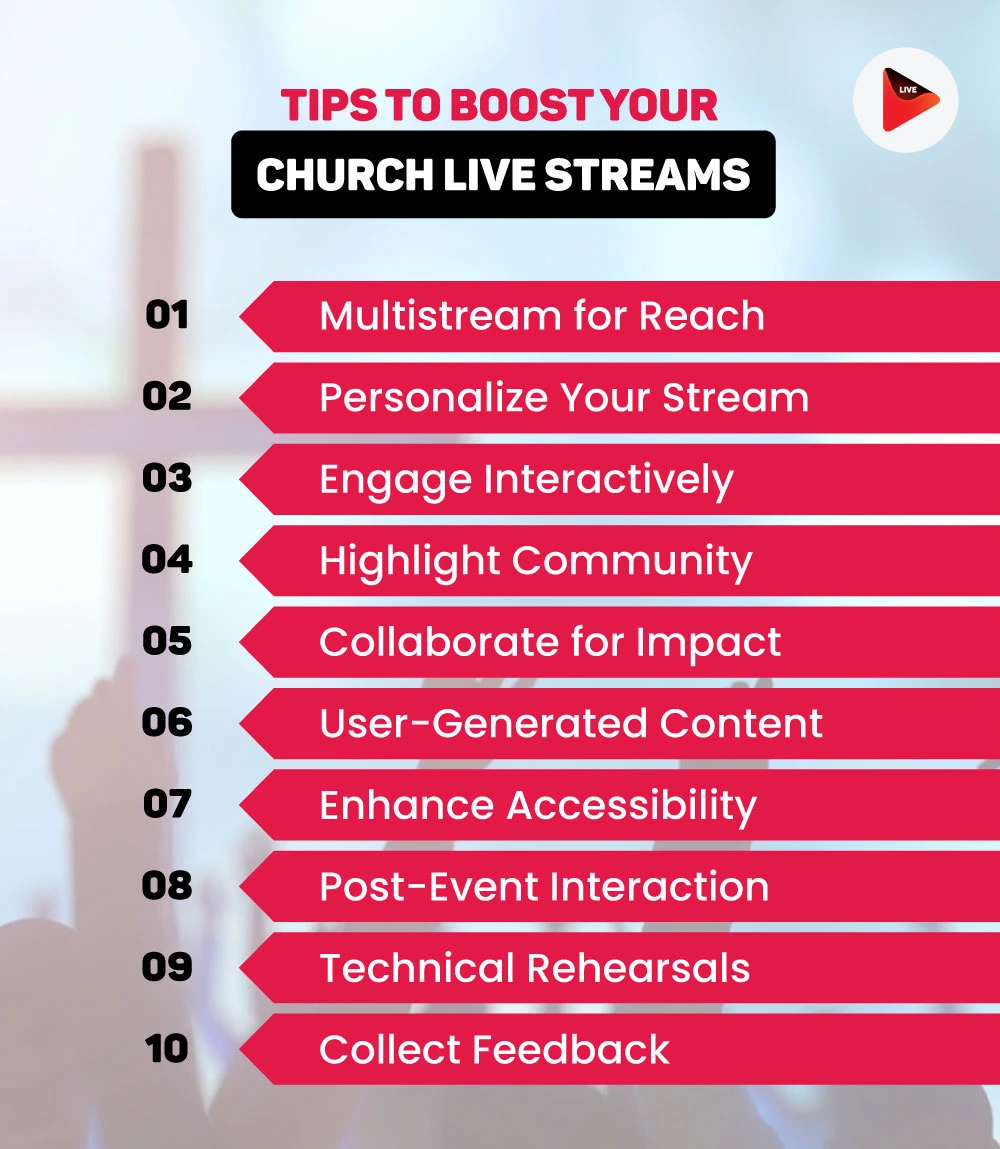
These church live streaming tips for beginners will help your online services feel less like a broadcast and more like a real gathering.
1. Multistream for Reach
Stream to several platforms at once to reach members and newcomers on YouTube, Facebook, Twitch, and your website. You'll grow your audience without doubling your team's work.
Pro Tip: Use OneStream Live to multistream your service to 45+ social destinations at the same time.
2. Personalize Your Stream
Customize overlays, graphics, and backgrounds to reflect your church's identity. A consistent look helps viewers recognize your services and feel at home.
3. Engage Interactively
Invite participation through live chat, polls, and Q&A. Ask viewers to share where they're watching from and to post prayer requests, so they feel part of the service.
4. Highlight Community
Show the warmth of your church family. Include member shout-outs, celebrate baptisms and milestones, and share short testimonies so online viewers feel a sense of belonging.
5. Collaborate for Impact
Partner with other churches, ministries, and community leaders. Guest speakers, joint worship nights, and shared outreach events bring fresh voices and new viewers to your stream.
6. User-Generated Content
Invite your congregation to contribute. Feature member testimonies, special music, or short reflections recorded at home to make your online service more personal and inclusive.
7. Enhance Accessibility
Add closed captions for deaf and hard-of-hearing viewers, use high-contrast text for lyrics and scripture, and consider sign language interpretation for key services.
8. Post-Event Interaction
Keep the conversation going after the service. Reply to comments, post sermon clips and quotes during the week, and invite viewers to join small groups or visit in person.
9. Technical Rehearsals
Run a full test before every service. Check audio levels, camera shots, overlays, and chat so small problems are fixed before anyone is watching. For big services like Easter, rehearse a few days ahead.
Read More: How to Stream Easter Sunday: Guide for Churches & Creators
10. Collect Feedback
Ask your online viewers what's working. Use short surveys, social media polls, or a simple follow-up email, and keep building stronger relationships with your congregation by acting on what they tell you.
Final Words: Uniting Virtually, Growing Spiritually
Live streaming opens a new door for your church to connect, care, and reach people far beyond your building. By choosing the right platforms, starting with solid audio and video, and building simple habits around interaction and follow-up, your online services can feel just as welcoming as your Sunday morning gathering.
This Startup Guide for Churches has given you the gear, steps, and strategies you need to start or improve your church stream in 2026. Remember that the heart of church streaming isn't the technology. It's the community you build through it. May your church's online presence shine as brightly as its physical one.
Happy Church Live Streaming! ✝️
Frequently Asked Questions
How do I start church livestreaming on a small budget?
Start with one camera or a recent smartphone, a direct audio feed from your soundboard, a wired internet connection, and free software such as OBS Studio or a browser-based studio. You can stream your first service for a few hundred dollars and upgrade as your ministry grows.
What equipment do I need to live stream a church service?
At minimum, you need a camera, an audio feed, a computer or hardware encoder, a stable internet connection, and a streaming platform. As you grow, add a video switcher, extra cameras, wireless microphones, and lighting.
What internet speed do I need for church live streaming?
Plan for an upload speed of at least 1.5 times your stream's bitrate. For a 1080p service, a dedicated upload of 15 to 20 Mbps is a safe target. Always use a wired connection and test your speed during a busy service, not on an empty weekday.
Do churches need a license to stream worship music?
Yes, in most cases. Performing copyrighted worship songs online usually requires a streaming license, such as the CCLI Streaming License. If you use backing tracks or multitracks, you may need the Streaming Plus license as well.
Can I stream to Facebook, YouTube, and my website at the same time?
Yes. With a multistreaming service like OneStream Live, you send one stream from your church and it goes to YouTube, Facebook, your website, and 45+ other destinations at the same time.
OneStream Live is a cloud-based live streaming solution to create, schedule, and multistream professional-looking live streams across 45+ social media platforms and the web simultaneously. For content-related queries and feedback, write to us at [email protected]. If you have a story to share about your live streaming experience with OneStream Live, we would be glad to feature it. You’re also welcome to Write for Us!