
Most leadership advice sounds the same. Be confident. Communicate well. Lead by example. You have heard it a hundred times.
But what does modern leadership actually look like when you have negotiated million-dollar deals at Meta, built a company from scratch, and spent years researching why employees quietly check out? That is a different conversation entirely.
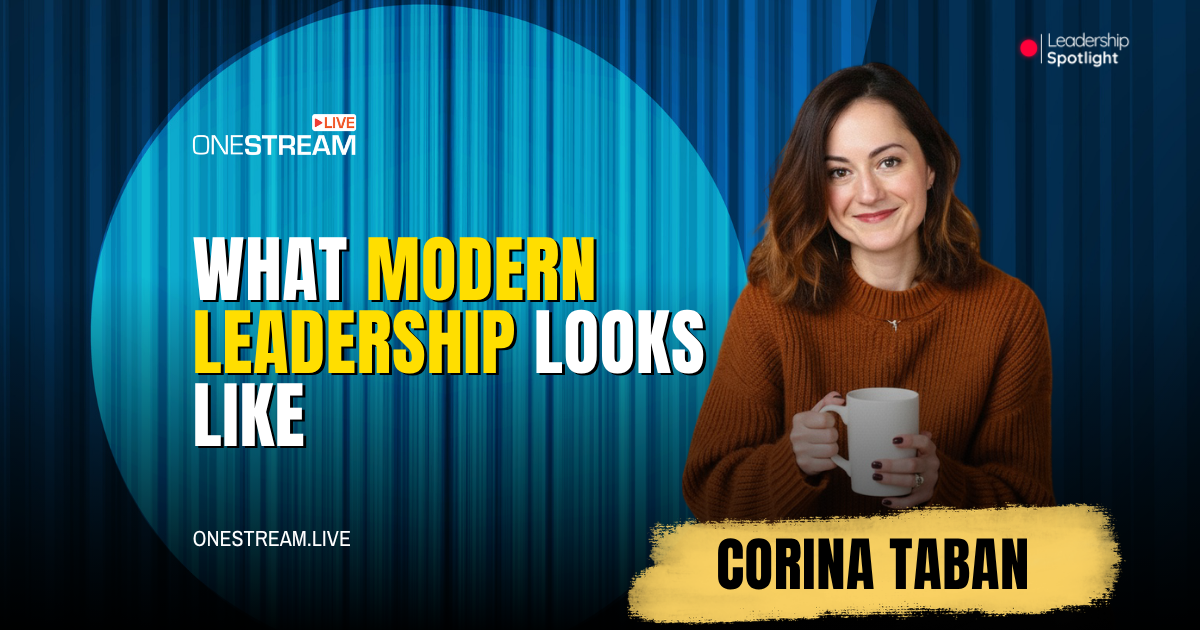
Corina Taban, founder of 934 Leadership Advisory and former Microsoft and Meta executive, joined the Leadership Spotlight podcast powered by OneStream Live to share what great leaders today are doing differently and what most people in leadership positions are still getting wrong.
Here is everything worth taking away.
What Modern Leadership Actually Requires
Modern leadership in 2026 is not what it was ten years ago.
Teams are dealing with AI, remote work, and constant uncertainty. The old model, where authority came from your title and technical skills carried you to the top, is losing ground fast.
Corina puts it simply. The skills coming back into focus are the ones that make us human.
“What makes you different is your emotional intelligence and your capacity to interact with others,” she says. “In the past, IQ and technical skills were considered the most important. Now we are seeing that change.”
Collaboration, communication, and the ability to influence people are not soft skills anymore. They are the competitive edge. Contemporary leaders who invest in these human skills now are the ones who will stand out.
The Psychological Contract: Why Employees Quietly Check Out
Corina’s doctorate focuses on something most modern leaders have never heard of but are living with every day: the psychological contract.
It is not the contract you sign when you take a job. It is everything on top of it. Every expectation you bring to a role, every unspoken promise your employer makes, every assumption about how you will be treated. None of it is written down, but all of it matters.
“In today’s complex business world, it is virtually impossible not to have some unmet expectations,” Corina explains. “But if you show genuine care for your employees, a small breach is forgivable. What people cannot tolerate is feeling like they are giving more than they are getting back.”
When that imbalance builds, people do not always quit. They quiet quit. They disengage. They give you less because the relationship stopped feeling fair.
What modern leaders need to do differently:
- Make people feel genuinely wanted from day one
- Give back as much as you ask for in recognition, flexibility, and support
- Do not hire someone by offering the minimum because you can. They will take it, but they will remember how it felt
- Check in regularly on whether people feel the relationship is fair, not just whether the work is getting done
AI at Work: Why It Is Creating More Problems Than It Solves
Everyone was promised AI would reduce workload. For most teams, that is not what is happening.
Corina points to a growing problem she calls work slop. People using AI to produce output that looks polished on the surface but has no real substance underneath. Then their colleagues spend hours analyzing that output with their own AI tools. Two systems talking to each other while humans lose sight of what actually matters.
“We moved too fast and did not take people along for the ride at the same speed,” she says.
The root cause is not the technology. It is a lack of AI literacy and shared direction inside organizations. This is one of the defining challenges of modern leadership styles today: bringing people through disruption instead of just deploying new tools and hoping for the best.
If you are leading a team right now, this is your responsibility:
- Train your people on where AI genuinely adds value and where it does not
- Create a clear internal code of conduct around how AI should be used
- Help your team understand the difference between using AI to think better and using it to avoid thinking altogether
- Set shared expectations so no one is left to figure it out alone
Executive Presence: What It Really Is and How to Build It
You have seven seconds to make a first impression as a leader.
If you are wondering what it takes to be a leader people genuinely follow, presence is a big part of the answer. And Corina is clear: it can be trained by anyone willing to put in the work.
She also pushes back on the idea that executive presence looks one particular way.
“We gave only one definition and one mental model to what it means to have authority and credibility,” she says. “We need to develop other ways of leading and other ways of showing up.“
Corina draws a useful distinction between charisma and executive presence. Charisma is about being inspiring. Executive presence is about authority and credibility. Both can be developed and neither belongs to one type of person.
In practice, presence shows up in:
- How you speak, the pace, clarity, and confidence in your words
- How you pause, giving yourself and others space to think
- How you listen, fully, not just waiting for your turn to talk
- How you carry yourself before you say a single word
What the Research Says About Gender and Leadership
Corina is direct here: there is no such thing as female leadership. There is just leadership.
“We never refer to male leadership,” she says. “So we should not call it female leadership either.”
That said, research does show consistent patterns worth knowing. On average, women tend to use power in more pro-social ways. They invest more in team morale and lean toward transformational and servant leadership, two of the most effective modern leadership styles for building engaged teams.
“I think male leaders should look at these behaviors and adopt some of them,” Corina says. “Because these are exactly what companies need right now.”
She also names the real challenge women face. They are expected to be confident and assertive while also being warm and collaborative. Too much of one and you are seen as cold. Too much of the other and you are not taken seriously. That double standard costs real energy every single day.
The bigger point is simple. Expanding what we accept as strong leadership means we stop overlooking the talent that does not fit the traditional mold.
How to Develop Leadership Skills That Actually Stick
When asked about her own approach, Corina keeps it grounded.
High standards. Strong ethics. Clear direction. Then she gets out of the way.
“I give the direction and then I enable the people I work with to do the work the way they want to, not the way I want to,” she says. “That is how you get the best out of people today.“
She also makes a case for humor as a leadership tool, which does not get enough credit.
When teams are learning and sometimes failing, a leader who brings lightness to the process creates an environment where people feel safe to try. And feeling safe to try is where the best work comes from.
Her core principles in practice:
- Set high standards and hold yourself to them first
- Give clear direction then trust people to find their own path there
- Enable people to work the way that brings out their best
- Use humor to make uncertainty feel less heavy
The Mindset Shift Every Modern Day Leader Needs
Corina closes with something that cuts through everything else.
Most people treat success like a fixed pie. If you win, someone else loses. If you give more, you get less. That thinking produces small, defensive leadership that closes off the collaboration needed for real growth.
“In most real-world scenarios, the pie can expand,” she says. “If people start asking how we can generate more value for everybody instead of how I can get more than you, we could produce so much more innovative work.“
The shift from control to contribution, from authority to alignment, this is what separates good leaders from great leaders today.
Frequently Asked Questions
Modern leadership is less about authority and more about clarity, adaptability, and the ability to align people around a shared purpose in fast-changing conditions.
Unlike traditional top-down control, modern leadership thrives on collaboration, transparency, and empowering teams to make decisions closer to the work.
The strongest leaders today combine emotional intelligence, strategic thinking, and the ability to communicate simply in complex environments.
It leans heavily on trust, async communication, and clear outcomes rather than constant supervision or physical presence.
The biggest mistake is clinging to outdated, control-based habits rather than evolving into a coach-like mindset that fosters autonomy and accountability.
OneStream Live is a cloud-based live streaming solution to create, schedule, and multistream professional-looking live streams across 45+ social media platforms and the web simultaneously. For content-related queries and feedback, write to us at [email protected]. You’re also welcome to Write for Us!