
Most viral games arrive on Twitch and then work out their relationship with streamers afterward. Meccha Chameleon did it the other way round. The paint-and-hide multiplayer game shipped with a lobby system that lets anyone drop into a broadcaster’s match, and a store page that tells streamers exactly how the developer wants the game covered.
That design decision explains a lot about the category’s shape. The audience-participation format, where viewers stop watching and start playing inside the same round, is one of the harder things to pull off on Twitch. Meccha Chameleon makes it close to the default.
- Meccha Chameleon is still actively streamed on Twitch more than two months after launch, and the category isn’t dominated by a handful of big channels.
- The game ships with public lobbies that any viewer can join, which is what makes viewer-participation rounds practical.
- The developer permits streaming and asks only that broadcasters put the game name in the stream title.
- Host connection quality, not player skill, decides whether a viewer lobby holds together.
- More channels stream the game on weekends than on weekdays, so weekday slots face less competition.

What Meccha Chameleon Actually Is
Meccha Chameleon is an online hide-and-seek game where rounds split players into Hiders and Seekers. Hiders start as plain white figures and use a brush and color picker to paint themselves to match a wall, a crate, or a piece of furniture, then hold a pose while Seekers sweep the room.
The twist that separates it from older prop hunt formats is the scoring. Points come from being in a Seeker’s sightline and going unnoticed, not from finding a quiet corner. That produces the beat of tension and release that clips well, which is why the game spread across Twitch and short-form video faster than its player count alone would suggest.
The Twitch Numbers
The category appeared on Twitch on 10 June 2026 and climbed fast. TwitchTracker logs a peak of 238,207 concurrent viewers on 23 June, with channel counts peaking three days later at 2,624 broadcasters live at once. Other trackers record slightly different peaks depending on sampling method and time zone, so treat the figure as an order of magnitude rather than a precise ceiling.
More useful than the peak is where the game sits now, and the honest answer is that the spike has passed. Across the seven days to 16 August it averaged roughly 2,600 viewers against 130 channels, drawing around 440,000 hours watched and sitting at #94 on Twitch’s most-watched list. That is a steep fall from June, but it still puts the game ahead of most of the catalogue, and the audience that remains is the one that stuck around after the novelty wore off.
Two details in that data matter for scheduling. Viewers per channel sit around 20, low enough that a small channel is not competing against a wall of established broadcasters. And the game is streamed by roughly 41 percent more channels on weekends than on weekdays, so weekend slots are the crowded ones and a weekday session faces less competition for the same audience.
Why the Lobby System Suits Audience Participation
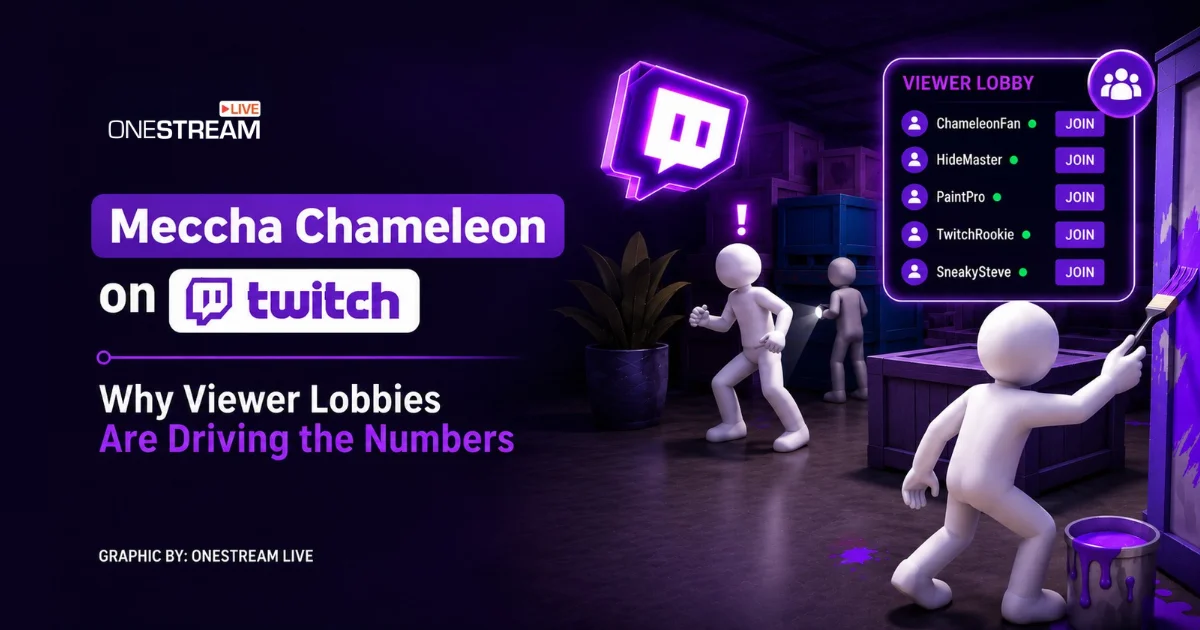
Meccha Chameleon has no dedicated servers and no automatic matchmaking. One player creates a room and everyone else joins it, which puts the broadcaster in charge of who gets in.
Public Rooms
The Steam store page states that streamers can easily host viewer participation games, and that any server left off the private setting is open to anyone. It also confirms the practical shape of a session: 2 to 10 players is the recommended range, with the real ceiling depending on the host’s network.
The same page carries the developer’s streaming terms, which require the game name in the stream title and treat a link to the store page as optional. Reception has held up even as viewership cooled, with more than 84,000 user reviews on Steam and a Very Positive rating.
Private Rooms
Switching a room to private turns it into an invite-only session behind a password. Broadcasters use this for structured segments, sharing the room name and password on stream so a controlled group joins rather than whoever refreshes the browser fastest.
What to Sort Out Before You Open a Lobby
Because the room runs on the host’s machine, a broadcaster hosting a viewer lobby is carrying both the encode and the server. That is a heavier load than a normal solo stream, and it is worth checking bitrate stability before going live rather than discovering the ceiling mid-round. Going out to more than one platform adds a third job to the same connection. OneStream Live keeps that to one outgoing feed while your stream goes out to Twitch, YouTube and other platforms at the same time.
A few practical points:
- Host on a wired connection where possible, since the session ends if the host drops.
- Everyone in the room needs the same game version, which is the most common reason a viewer cannot join.
- Explain the rules in chat before sharing a password, particularly the scoring, which surprises players who expect classic prop hunt logic.
- Keep the lobby inside the recommended range. Larger rooms are technically possible and usually read worse on camera.
Playing the Format Without Buying In
Not everyone in chat owns a copy, and Meccha Chameleon is a paid, Windows-only Steam release. If you want to run the format on stream without buying in, an alternative is a site like Poki, which collects four browser hide-and-seek titles including Hide and Paint, and offers games similar to Meccha Chameleon for free.
Final Thoughts
The reason Meccha Chameleon works on Twitch is not the painting mechanic on its own. It is that the developer built a lobby system a broadcaster can open to an audience and then wrote permission to stream directly into the store page. Streamers running the format should treat it as a hosting job as much as a gameplay one, and plan the connection accordingly.
If you are running viewer lobbies across more than one platform, sending a single stream through OneStream Live to Twitch, YouTube and elsewhere removes the upload cost of broadcasting each one separately.
Frequently Asked Questions
Can viewers join a streamer’s Meccha Chameleon lobby?
Yes. If the host leaves the server out of private mode, anyone can join freely. The Steam page describes viewer participation as an intended use of the game.
How many players fit in a Meccha Chameleon lobby?
The developer recommends 2 to 10 players. The maximum depends on the host’s network environment rather than a fixed cap.
Is streaming Meccha Chameleon allowed?
Yes. The developer asks that the game name appears in the stream title. Including the store page link in the description is optional.
Why can my viewers not find my private room?
Almost always a version mismatch or a filter setting. Everyone needs the same game build, and server browsers often hide password-protected rooms unless searched by name.
Does Meccha Chameleon have console or mobile versions?
No. It is a Windows PC release on Steam, so console and mobile viewers cannot join a lobby directly.
OneStream Live is a cloud-based live streaming solution to create, schedule, and multistream professional-looking live streams across 45+ social media platforms and the web simultaneously. For content-related queries and feedback, write to us at [email protected]. You’re also welcome to Write for Us!