
Hybrid event production has a problem. Many teams still treat the livestream as an extra, focusing on the event in the room and adding a camera at the last minute. People watching from home notice right away, because they get one fixed camera, sound that is hard to hear, and a chat that nobody reads.
Here is the truth: understanding what a hybrid event is isn’t the hard part anymore. Running one well is. Hybrid events are now smaller and more carefully planned, and the teams that do them well treat the stream as its own show.
We studied the 2026 data on hybrid events to see where they are growing, where teams still struggle, and what makes an event feel like one shared experience. This post covers the big ideas. The full story, with every number and source, lives in our new whitepaper, The Hybrid Event Playbook.
- Hybrid event production works best when the stream is planned as its own show, not added at the last minute.
- Only 4% of events on Bizzabo’s platform were hybrid in 2026, so teams now choose hybrid on purpose.
- Many organizers still find it hard to prove their events pay off, and hybrid adds a second audience to track.
- 81% of trade show and conference attendees can make buying decisions, and a weak stream can lose them.
- People watching online now compare your stream to TV, not to a basic webcam video.
What Is Hybrid Event Production?
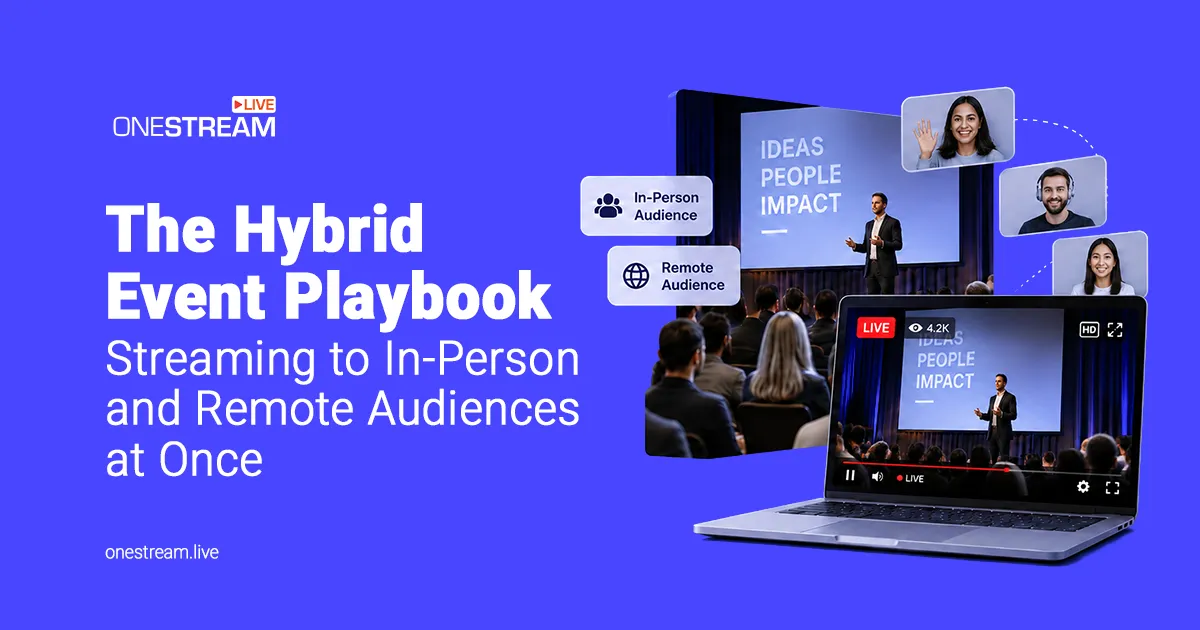
Hybrid event production means running one event as two experiences at the same time. One is for the people in the room. The other is for the people watching online. It covers cameras, sound, slides, remote speakers, and chat. Strong hybrid event production gives online viewers a real show, not just a camera pointed at a stage.
The old way was to film the stage and hope for the best, and that approach is failing. Online viewers just sit and watch while the people in the room get the real experience.
Viewers also expect more now. In an interview with MarketScale, Britt Yenser, who runs event technology at Moravian University, said people who watch online expect the same quality they see on TV. That is the standard your stream has to meet.
Here is a quick look at how the old way compares with the better way:
- Cameras: The old way uses one fixed wide shot. The better way mixes wide shots, close ups, and crowd reactions.
- Sound: The old way relies on one room mic to pick up what it can. The better way sets up and tests microphones first.
Remote speakers and online chat need the same kind of rethink. The playbook walks through both, so nothing about the online experience is left to chance.
Hybrid Events Are Now Smaller and More Planned
Hybrid isn’t going away. Instead, teams now pick it on purpose, for the events where it makes the most sense.
Bizzabo’s 2026 event data shows that 63% of events on its platform were fully in person, 33% were fully online, and only 4% were hybrid. This doesn’t mean hybrid is dying. Instead, organizers use it when reaching more people matters more than keeping an event small.
So which events are worth making hybrid? The answer depends on your industry and your goals. The whitepaper looks at six industries, from real estate to nonprofits, and shows where hybrid pays off most.
Why Teams Still Hold Back on Hybrid Event Planning
Most teams that hold back on hybrid share the same problem: too many separate tools.
When streaming, sign ups, and reports each live in a different place, it gets hard to prove an event paid off. Hybrid adds a second audience on top of that, which means even more data to track. It’s no surprise that many organizers are planning to change their event software soon.
There is one more number in the whitepaper that most organizers read as a weakness. Look a little closer, and it turns out to be one of the strongest reasons to go hybrid.
Why the Stream Can't Be an Afterthought
Your online audience isn’t just people clicking around. It often includes the decision makers your business most wants to reach.
Research from CEIR, gathered by MVP Visuals, found that 81% of trade show attendees can make buying decisions. These are the people you least want to lose.
A blurry video or a messy chat doesn’t just look bad. It quietly pushes away your most interested viewers, the people most likely to act on what they see.
And the value of your stream doesn’t stop when the event ends. The playbook explains why the smartest teams plan the recording from day one.
Five Basics of Hybrid Event Management
Good hybrid event management comes down to five production basics. Skip them, and your stream will quickly feel like an extra.
- Use more than one camera so online viewers feel like they are in the room.
- Keep the delay short so live questions still work.
- Put sound first, because viewers forgive a soft picture far more easily than bad audio.
- Make every screen match, in the room and on the stream.
- Give remote speakers a backstage to get ready before they go live.
Each of these sounds simple, but each has a few details that make or break it. The whitepaper covers what to get right for every one, so you can walk into your next event with a clear plan.
How OneStream Live Works as Your Hybrid Event Platform
OneStream Live puts every part of a two audience event into one hybrid event platform, so you don’t have to connect five different tools.
- Encoder Streaming connects your professional camera and sound gear straight to the stream.
- Studio lets you switch between cameras and scenes and add graphics fast.
- Lobby gives remote speakers a waiting room, so the prep happens off camera.
- Custom Websites turn your event into a branded page with password protection and viewer data.
- Stream Players let you show the live stream on your own website.
- Unified Chat lets you manage the online chat and block unwanted messages.
Want to reach more people? You can multistream the same event to 45+ platforms at once, which gives sponsors and partners far more exposure than one website alone.
Get the Full Hybrid Event Playbook
Hybrid events aren’t going away, but they aren’t becoming the default, either. Teams now choose them on purpose, and the stakes are higher than ever. The stream has to look like TV and keep your most valuable viewers watching.
Get hybrid event production right, and one venue, one team, and one set of speakers can reach people who could never travel to your event. Get it wrong, and your online audience quietly leaves.
What you’ve read here is the short version. The Hybrid Event Playbook fills in the rest: the full 2026 data with sources, the industries where hybrid works best, the details behind each production basic, the money side of going hybrid, and four tips for your next event. It’s a quick read, and it’s free.
Frequently Asked Questions
What is the difference between a virtual event and a hybrid event?
A virtual event happens completely online, with no physical venue. A hybrid event mixes a live, in person event with a live online event, so two audiences share the same event at the same time. One group sits in the room, while the other watches and takes part from home.
Is hybrid event production expensive?
The cost of hybrid event production depends on the size of your event. The basics are several cameras, clear sound, and a steady encoder setup, and none of these need a TV sized budget. For most teams, the bigger cost is paying for separate tools for streaming, sign ups, and reports.
What percentage of events are hybrid in 2026?
Bizzabo’s 2026 data shows that about 4% of events on its platform were hybrid. By comparison, 63% were fully in person and 33% were fully online. This means organizers choose hybrid for specific goals, usually when reaching more people matters more than keeping an event small.
Why do hybrid events still struggle with ROI measurement?
About 40% of organizers say it is hard to prove their events pay off in 2026. A big reason is using too many separate tools. When streaming, sign ups, and reports live in different places, it gets harder to link event results to business results.
What software do I need to run a hybrid event?
You need an encoder to bring your in room event online, a steady hybrid event platform that can stream to many places, and a way to manage remote speakers before they go live. Platforms like OneStream Live combine these in one place instead of several separate tools.
OneStream Live is a cloud-based live streaming solution to create, schedule, and multistream professional-looking live streams across 45+ social media platforms and the web simultaneously. For content-related queries and feedback, write to us at [email protected]. If you have a story to share about your live streaming experience with OneStream Live, we would be glad to feature it. You’re also welcome to Write for Us!