
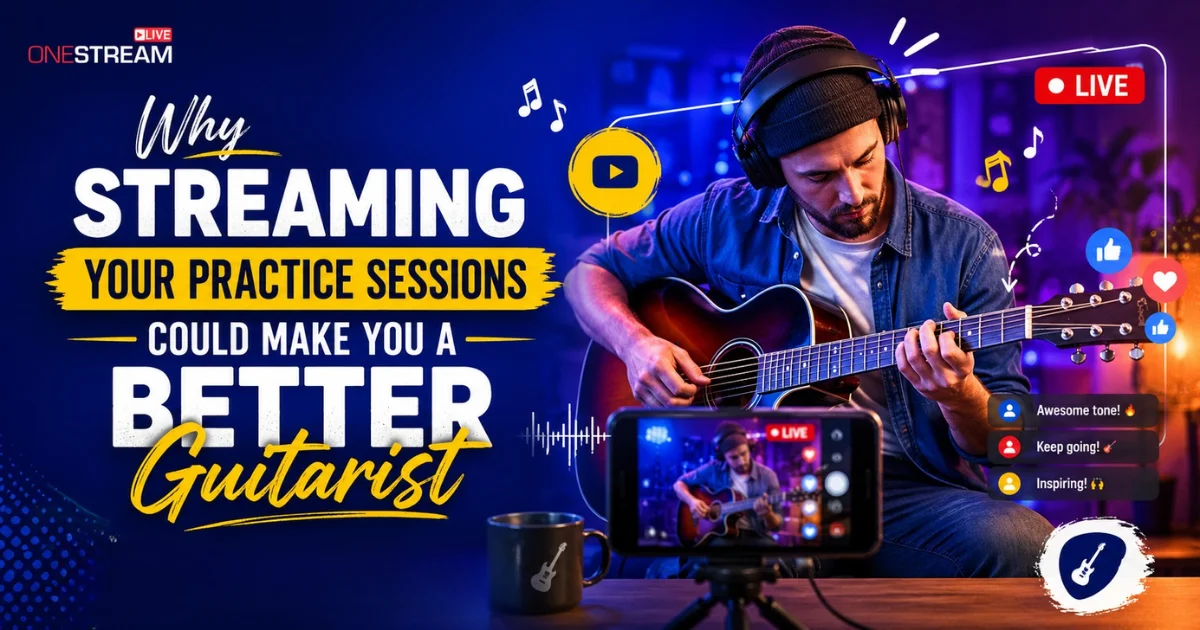
Most guitarists practice in private, which feels natural and comfortable, but removes one of the most powerful development tools available. The decision to stream practice sessions, whether to a live audience or simply to a recording for later review, changes the psychological and technical conditions of practice in ways that significantly accelerate development. Regardless of the guitar you are playing, a Fender Stratocaster or a Gibson, recording or online guitar practice can have a significant impact on your growth as a player.
The Benefits of Online Guitar Practice
Most guitarists practice alone, and that is completely fine, but it also means missing out on one of the most effective ways to grow. Online guitar practice through recording or streaming your sessions shifts something in the way you play. You become more focused, more honest about your weaknesses, and more consistent over time.
The Observer Effect in Musical Practice
Playing for an audience, even a small or virtual audience, creates a different state of mind than playing alone. Being aware of being watched increases focus, reduces the likelihood of distraction by familiar material, and creates a moderate pressure that mimics the conditions most guitarists aim for during performance.
This observer effect is more than just a source of psychological distress to be controlled. It’s a positive developmental state that accelerates the transition from the practice room to performance readiness.
Read More: A Beginner’s Guide To Live Streaming Music
Identifying Habits That Private Practice Conceals
Seeing yourself play in a video reveals habits you can’t see while you’re playing. Excessive tension in the fret hand, pick angles that aren’t uniform, a tendency to rush certain chord transitions, or a hesitation before a certain chord position change are all obvious when listening back but not during performance.
In private practice, these habits continue without being considered, as the focus is on what is happening inside the player rather than on what is happening outside. A recorded or streamed session provides an external perspective on which habits or issues you truly need to address.
Accountability and the Consistency it Builds
Regularly scheduled sessions establish an accountability system that is not usually found in solitary practice. Knowing that a session will be viewed, even by a small audience, will lead to better preparation, execution, and engagement than a session judged only by the player. This external accountability develops the internal standard that, over time, leads to consistent practice without external pressure. But the exterior form is actually useful even when the interior discipline is not yet formed.

Feedback From Other Players
When you play for other guitarists, you get feedback from that audience that you don’t get from a practice partner or teacher. Tools like OneStream Live make this easier by letting you stream your music sessions across multiple platforms at once, so feedback comes in from a wider and more varied audience.
People with varying degrees of experience and musical backgrounds see different things, and the total of their observations often raises specific technical or musical points that one teacher might not be focusing on. If a viewer mentions that your vibrato is always sharp, or that your rhythmic playing tightens when chords change, the viewer is giving you valuable developmental feedback you can use directly.
Practicing Communication as Well as Technique
Describing what you are doing, why it is difficult, and how you are working on it creates a metacognitive bond with your own practice that silent, solitary sessions cannot create. Describing what you’re doing requires a clarity of intention you won’t find in a “drifting” through a practice routine. Guitarists who practice regularly, even with a small group, will find they become more deliberate and self-aware during practice sessions, resulting in more focused and productive use of their available practice time.
Read Later: How to Turn AI Music Ideas Into Live Shows, Premieres, and 24/7 Streams
Managing Performance Anxiety Through Graduated Exposure
Many guitarists experience a lot of stage fright, and this is not always commensurate with the importance of the situation. This anxiety is minimized over time because of repeated exposure in the form of streaming practice sessions.
The experience of playing in front of a smaller audience is less stressful than performing in front of a larger audience, but more stressful than performing privately, making it a good way to build the confidence needed to perform in front of others. This middle ground is what regular exposure helps normalize: the presence of an audience that only an exclusive private practice can’t build.
The Archive as a Development Record
Practice records form a historical timeline of development that may be hidden in day-to-day practice. When you look at a session in the past and one in the present, you can see improvements that you cannot see when you are in the session.
This is a very motivating outlook when the developing guitarist hits the plateau stage and feels like they are not making any progress at all, as there is proof that they are making progress even if it doesn’t seem that way right now. It’s also useful to know that the archive can identify recurring issues that have persisted for months and months.
Starting Without Pressure
The start is less daunting than it seems when it comes to online guitar practice. All that is needed is a phone on a music stand, a basic recording app, and the determination to play a practice session as if someone were watching. The number of audience members may be zero. The production quality may be very poor. The value lies only in the altered psychological state of the session and the external record it leaves.
When you are ready to take it further and stream to a real audience, OneStream Live makes it simple to go live across multiple platforms at once. All it takes is the willingness to be seen by the camera, whether or not anyone is watching on the other side.

Frequently Asked Questions
Not at all. Even streaming to zero viewers helps. The simple act of knowing the camera is on changes how you focus and play, which is where most of the benefit comes from.
Private practice keeps you comfortable but rarely challenges you. Online practice introduces accountability, an external perspective, and real feedback that solo sessions simply cannot replicate.
Yes. Watching yourself play back reveals technical habits, timing issues, and tension that you cannot notice while you are playing. It gives you an honest view of where you really are.
A smartphone, a basic recording app, and your guitar are enough to get started. You do not need professional gear to gain the benefits.
Consistency matters more than frequency. Even once or twice a week is enough to build accountability, track progress, and start noticing improvements over time.
OneStream Live is a cloud-based live streaming solution to create, schedule, and multistream professional-looking live streams across 45+ social media platforms and the web simultaneously. For content-related queries and feedback, write to us at [email protected]. You’re also welcome to Write for Us!