
What would you do with the hours you spend staring at a blank caption box after every stream? If you're like most streamers, going live is the fun part. The writing around it, the script, the title, the recap post, is what quietly eats your week. That's exactly the work AI writing tools handle best.
They help you plan what to say before you hit Go Live, keep you on track during the show, and turn the replay into posts, emails, and blog drafts afterward. You stay the voice. The AI does the heavy lifting.
This guide shows you where AI fits into a streamer's week, which tools to use for each job, and how to keep every word sounding like you.
Key Takeaways:
- AI writing tools save streamers the most time on prep and repurposing: scripts, talking points, titles, descriptions, and posts built from a stream's transcript.
- An AI script generator gives you structure, not a speech, so you hit every key point and still sound natural on camera.
- One stream transcript can become a blog draft, an email, social captions, and short clip scripts in a single AI session.
- Google's guidance calls it critical to manually fact-check AI-generated content, including titles and meta descriptions, before you publish.
- Saved brand voice instructions keep AI writing assistant drafts consistent across a team, but a human should always make the final edit.
What Are AI Writing Tools, and How Do Streamers Use Them?
AI writing tools are apps that draft, edit, and rewrite text from a simple prompt. Streamers use them to plan scripts and talking points before going live, then turn the replay into titles, descriptions, captions, and blog posts. Think of an AI writing assistant as a fast first drafter: it writes, you decide.
You're in good company if you already use one. Adobe's Creators' Toolkit Report, a survey of 16,000 creators, found that 86% of creators now use creative generative AI, and 48% use it for ideation and brainstorming.
Where AI content creation tools fit into a streaming week:
- Before the stream: outlines, scripts, talking points, poll questions, and Q&A prompts.
- During the stream: a script on your teleprompter and pinned comments you wrote ahead of time.
- After the stream: titles, descriptions, captions, recap posts, emails, and blog drafts.
Not every helpful tool is a chatbot, either. When your brain goes blank on a theme, a simple word generator can throw out random words you can spin into a stream idea or title. For longer, structured pieces like a full stream recap article, a writing assistant such as aithor.com can help you build an outline and a first draft. Before you post, some creators run their text through an AI Checker to see whether it reads as machine-written, then rework the lines that sound stiff.
Whether you use an app or an AI writing website, the biggest time saver starts before you ever go live.
How to Use an AI Script Generator for Live Streams and Webinars
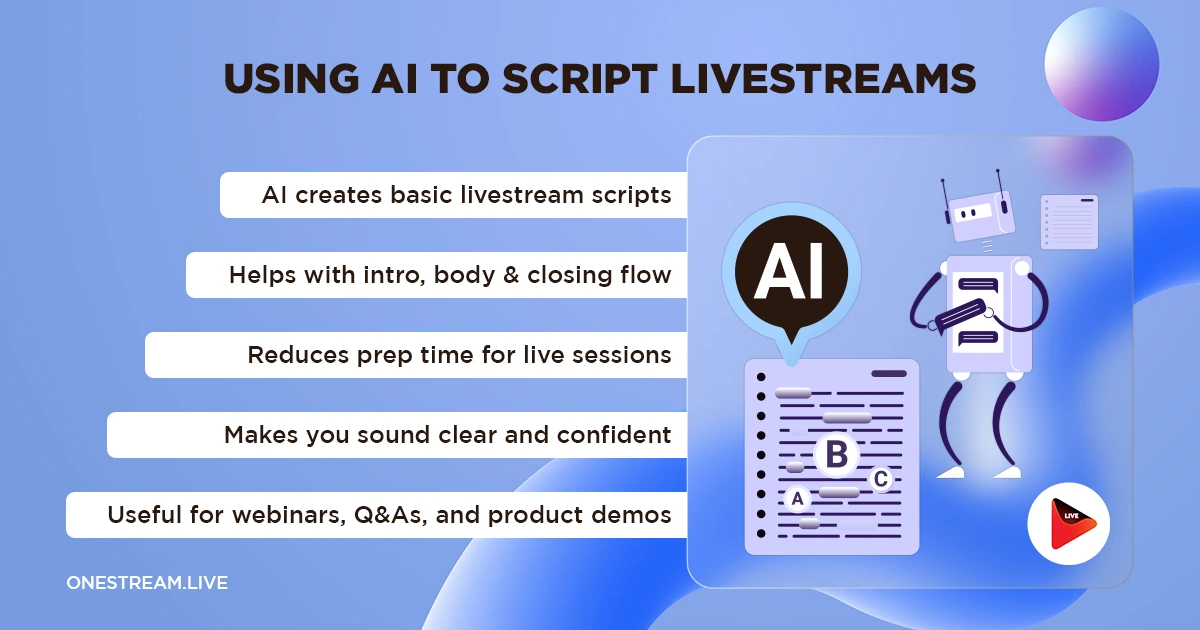
An AI script generator turns a rough idea into a structured outline with an intro, key points, and a closing call to action. You don't read it word for word. You use it as a map, so you sound prepared without sounding rehearsed.
Here's a simple process that works for any stream.
1
Give the AI real context. Share your topic, audience, stream length, and the one thing viewers should walk away with. "Write a 30-minute stream outline for beginner home cooks about knife skills" beats "write a stream script."
2
Ask for structure first. Request an outline with rough timestamps: a hook, three main segments, a Q&A break, and a closing call to action. Fix the order before you ask for full sentences.
3
Draft only the key lines. Have the AI write your opening hook, segment transitions, and closing. Leave the middle as bullet points so you can talk naturally.
4
Make it sound like you. Read the draft out loud and rewrite anything you'd never say. If a few lines still feel robotic, a tool like Humanize AI text can rephrase them in a more natural tone before your final read.
5
Put it where you can see it. Paste the script into the teleprompter built into OneStream Live Studio, set your scroll speed, and keep your eyes on the camera.
Pro Tips
Try this prompt: "You're helping me script a [length]-minute live stream on [platform] about [topic] for [audience]. Write an outline with rough timestamps: a 15-second hook, three main segments, a Q&A break with two poll questions, and a closing call to action to [goal]. Write full sentences only for the hook, the transitions, and the closing. Keep everything else as bullet points. Use a casual, friendly tone, and avoid buzzwords."
The Studio teleprompter runs in your browser with no download, holds scripts up to 20,000 characters, and stays visible only to you, so guests and viewers never see your notes.
Try the Teleprompter in OneStream Live Studio to read your script like a pro, then go live on the destinations you pick from 45+ integrations.
Turn Voice Notes Into Talking Points With an AI Script Writer
Not a fan of scripts? Record a two-minute voice memo about what you want to cover, transcribe it, and ask your AI script writer to turn it into five tight talking points. You get focus without losing your off-the-cuff energy.
Use a Webinar Script Template That Holds Attention
Webinars follow a predictable flow, which makes them a great fit for AI. Ask for a webinar script template with a welcome, an agenda, three teaching points, a demo, Q&A, and next steps. Then add your own stories and examples, because that's the part no AI can write for you. If you're still choosing where to host, compare your options in our webinar platforms guide.
Once the stream ends, your replay becomes the richest source of new content you have.
How AI Content Repurposing Turns One Stream Into a Week of Posts
AI content repurposing means feeding your stream's transcript into an AI tool and asking it to reshape the material for other formats. One hour of live video can supply a blog draft, a newsletter, a handful of social captions, and scripts for short clips, all from words you already said.
The trick is working from the transcript, not your memory. Paste it in and ask specific questions, like "Pull the five most useful tips from this stream" or "Find three lines that would work as short clip hooks."
Use an AI Social Media Post Generator for Captions
Most AI writing tools work as a capable AI social media post generator once you hand them the transcript. Ask for platform-specific versions: a short, punchy line for X, a value-packed post for LinkedIn, and an Instagram caption that ends with a question. Then ask an AI hashtag generator, or the same assistant, for a short list of relevant tags, and keep only the ones your audience actually uses.
Use an AI YouTube Title Generator for Titles and Descriptions
Titles decide whether people click. Treat your assistant like an AI YouTube title generator: ask for ten options under 60 characters, then remix the strongest one. The same prompt works as a stream title generator for your next Twitch or Kick show. For the replay, use it as an AI YouTube description generator by asking for a two-line summary, chapter timestamps from the transcript, and your key links.
Repurpose the Replay Into Blogs, Emails, and Clips
Here's what a single 30-minute stream can turn into:
- A blog post built from your main teaching points
- An email newsletter with your top three takeaways
- Three to five short clip scripts, each with a hook and caption
- A quote graphic featuring your most shareable line
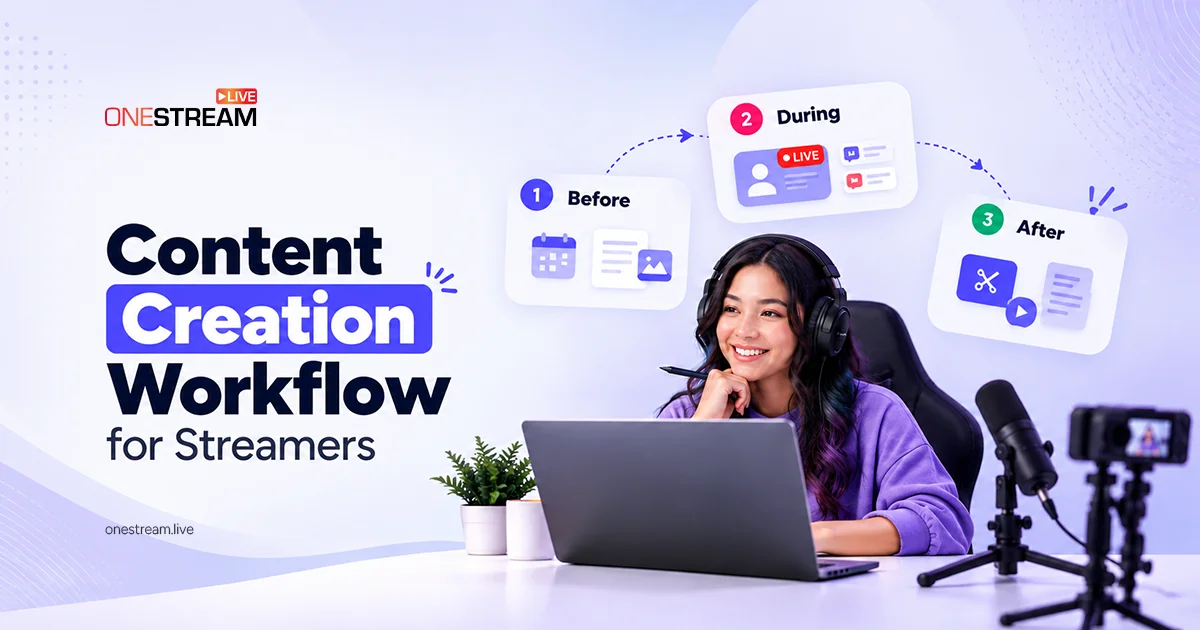
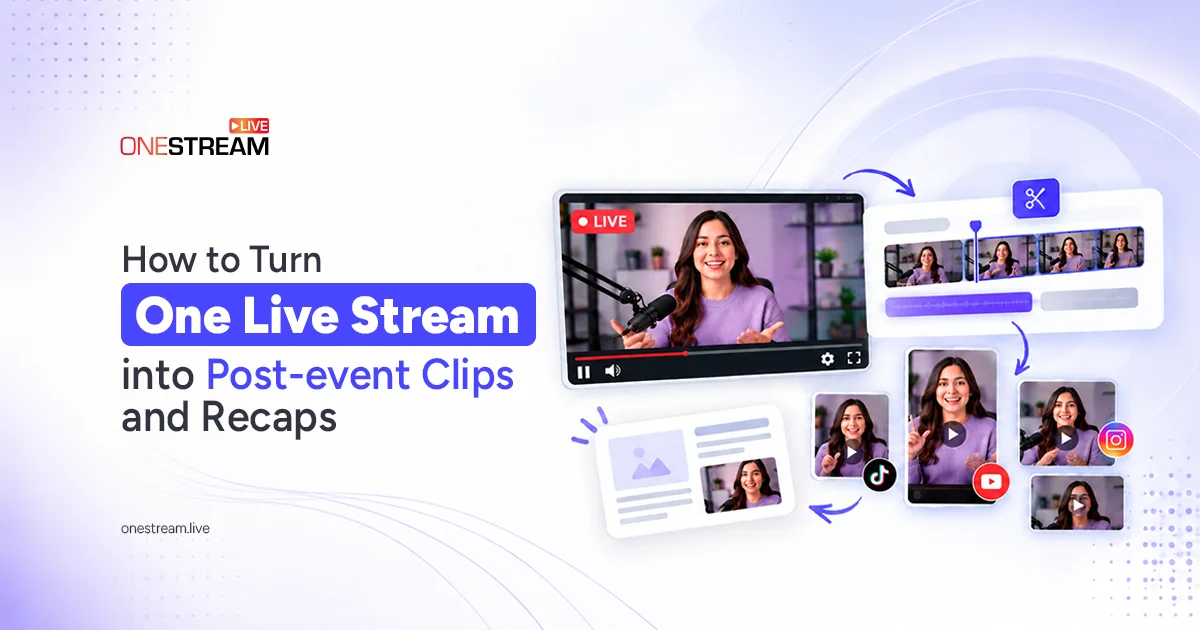
For the clipping side, follow our guide on turning one live stream into a week of clips and recaps. If you want the full plan for before, during, and after you go live, our content creation workflow for streamers maps every step.
So which tools should you actually use for each job? Here's a quick map.
Best AI Tools for Content Creators, Matched to Each Streaming Task
The best AI tools for content creators are the ones that match the task in front of you. A general AI writing assistant covers most scripting and caption work, while specialist tools handle brainstorming, long-form drafts, polishing, and live delivery.
| Task | Tool type | Examples | Watch out for |
|---|---|---|---|
| Stream scripts and outlines | General AI writing assistant | ChatGPT, Claude, Gemini | Generic phrasing, so add your own stories |
| Ideas and title sparks | Word or idea generator | A random word generator | Ideas still need your filter |
| Long recap articles | Long-form writing assistant | aithor.com | Check every fact before you publish |
| Social captions and hashtags | AI assistant or scheduler with built-in AI | ChatGPT, Claude, Gemini, social schedulers | Match each platform's tone |
| Smoothing stiff lines | AI humanizer | Humanize AI text | Still give it a final human read |
| Checking how text reads | AI checker | Undetectable AI | Detectors can be wrong |
| Delivering the script live | Teleprompter | OneStream Live Studio | Practice your scroll speed first |
You don't need every tool on this list. Start with one general assistant, learn to prompt it well, and add a specialist tool only when a task keeps slowing you down.
The same playbook scales up when a whole business runs on video.
How Businesses Using Video Can Benefit From AI Writing Tools
Businesses use AI writing tools to keep up with video at scale: scripting product demos, summarizing webinars, and turning every recording into blogs, emails, and social posts without growing the team.
Video is standard practice now. Wyzowl's 2026 State of Video Marketing report found that 91% of businesses use video as a marketing tool. The bottleneck usually isn't filming. It's the writing that surrounds every video.
Keep one voice across every writer. Instead of training an AI from scratch, most teams save brand voice instructions: tone, words to avoid, product names, and a few sample posts. Assistants like ChatGPT, Claude, and Gemini let you save instructions like these, so every draft starts on brand. For deeper needs, working with experts to develop custom AI solutions can tailor the tools to your specific workflow and brand voice.
Fact-check before you publish. In October 2026, Google updated its guidance on using generative AI content to call it critical to manually review and fact-check all AI-generated content before publishing. The review covers titles, meta descriptions, structured data, and image alt text too. AI speeds up the draft. Your team still owns the accuracy.
Pro Tips
Once your script is ready, multistream your business’s live video with OneStream Live to the destinations you choose from 45+ integrations, then schedule your best replays to stream again for viewers in other time zones. When your AI writing tools and your live stream tools work together, one recording keeps paying off for weeks.
Final Thoughts
AI writing tools won't replace your personality on camera, and they shouldn't. What they do is clear the writing pile that keeps you from going live more often.
Use an AI script generator to walk in prepared. Use your transcript to turn one stream into a week of posts. And give every draft a final human read before it goes anywhere.
Start small this week: script your next stream with AI, load it into your teleprompter, and repurpose the replay into three posts. Then go live everywhere your audience already watches.
Frequently Asked Questions
Which AI tool is best for content writing?
The best AI tool for content writing depends on the job. General assistants like ChatGPT, Claude, and Gemini handle scripts, captions, and outlines well, while a specialist AI writing tool may focus on long-form drafts, SEO, or editing. For most streamers, one general assistant and a clear, detailed prompt cover nearly all everyday writing tasks.
What is an AI script generator?
An AI script generator is a tool that turns a topic or rough notes into a structured script with an intro, main points, and a closing. Streamers use one to outline live shows, webinars, and short videos, then edit the draft so it sounds natural before reading it from a teleprompter.
Are free AI writing tools good enough, or should you pay?
Free AI writing tools handle short scripts, titles, and captions well. Paid plans usually add higher usage limits, longer inputs, file uploads, and saved instructions, which help when you work from long stream transcripts. Start free, and upgrade only when limits on length or usage begin slowing down your weekly content workflow.
Are there tools to detect AI writing?
AI detectors exist, and they estimate how likely a piece of text is to be machine-written, but none are fully reliable. OpenAI retired its own AI text classifier in July 2023 because of its low accuracy. Treat any detector score as a rough signal, and rely on your own edit to make writing sound like you.
What is the best AI social media post generator?
The best AI social media post generator is usually the assistant you already use, fed with the right source material. Paste your stream transcript into ChatGPT, Claude, or Gemini and ask for platform-specific captions. Several social media schedulers also include built-in AI caption writers, which saves you a copy-and-paste step.
OneStream Live is a cloud-based live streaming solution to create, schedule, and multistream professional-looking live streams across 45+ social media platforms and the web simultaneously. For content-related queries and feedback, write to us at [email protected]. If you have a story to share about your live streaming experience with OneStream Live, we would be glad to feature it. You're also welcome to Write for Us!