
Independent broadcasters and creator-led businesses in the creator economy face a real bottleneck getting paid across borders, stuck waiting on a slow, often unreliable legacy banking system to clear a transfer. Here’s how updated infrastructure and a new regulatory groundwork are fixing those bottlenecks for entrepreneurs building a living from livestreaming.
Cross-border payments impose a lot of friction on creators building audiences across several countries at once. New regulations are allowing decentralized payment tools to connect with traditional banks, which means entrepreneurs can cover their production costs and pay hosting bills in minutes instead of days.
For creator businesses that operate on a global scale, having cash tied up is not an option.
Where Creator Revenue Gets Stuck
The scale of the opportunity is not in question. Mordor Intelligence puts the live streaming market at roughly $97 billion in 2026, growing at a 26.7% compound annual rate, inside a creator economy that Grand View Research sizes at over $250 billion.
What is in question is how much of that reaches the creator.
Most creators run a dollar-denominated business on top of a local-currency life. Sponsors quote in dollars. Cloud hosting bills in dollars. But the payout lands in local currency, days later, after passing through a chain of correspondent banks that each take a cut on the way through.
The delay is the part that hurts most. A sponsorship agreed at one exchange rate settles weeks later at another, and the number negotiated is not the number received.
Meanwhile, the costs do not wait. Servers bill monthly. Editor’s invoice on delivery.
That gap between when revenue is earned and when it is usable is the working capital squeeze that stalls most creator businesses long before audience size ever does.
Local Exchange Markets Offer Liquid Capital Options For Global Creators
The squeeze is sharpest for creators in markets where the local currency moves against the dollar they earn in, which is also where the creator population is growing fastest.
Creators in these markets increasingly benchmark their earnings against live stablecoin rates rather than official bank rates. That figure tells them what a dollar of sponsorship revenue is worth on the ground today, not what it might be worth after a clearing cycle.
Take one corridor as an example. As of July 7, 2026, the live market conversion value for USDT to PKR, tracked in real time on Binance, sits around 277.97.
The depth behind that rate is what makes it usable. Dollar-pegged stable coins carry the deepest liquidity of any digital asset in emerging markets, and as Forbes reports, payroll and marketplace payouts from developed to emerging markets are among the fastest-growing uses of that liquidity.
Liquidity at that scale lets a creator business skip centralized clearing houses when a payment needs to move fast. Settlement finality on these networks is measured in seconds, and it does not stop for weekends, holidays or bank cut-off times.
Settling hosting and production costs against liquid stablecoin balances protects a creator’s cash reserves against slow domestic banking delays, so a media company does not need large idle balances just to cover next month’s server bill.
Global Regulation Opens Banking Doors For Digital Entrepreneurs
For years, the objection to all of this was compliance. Banks would not service digital asset payment providers, so creator tools built on them lived in a grey zone.
That changed in 2026.
The EU’s Markets in Crypto-Assets Regulation is now fully enforced. From July 1, 2026, any firm serving EU clients without a license is in breach of EU law, and a single license passports across all 27 member states, per ESMA guidance.
In the US, the GENIUS Act was signed in July 2025, creating the first federal framework for payment stablecoins. Brazil’s central bank rules took force on February 2, 2026.
Pakistan’s parliament passed the Virtual Assets Act, 2026, making PVARA a permanent federal regulator, and the State Bank followed by authorizing commercial banks to open accounts for licensed providers.
That last detail generalizes, and it is the one that matters. The regulatory story is not really about crypto.
It is about banks becoming willing to service licensed digital payment platforms as ordinary counterparties. Once that happens, a creator payout tool can hold a bank account and get paid by a sponsor’s finance team without a fight.
Power Grids Now Set The Price Of Streaming Infrastructure
Streaming runs on data centers, and data centers now compete directly with artificial intelligence for grid capacity.
The IEA reports that data center electricity demand grew 17% in 2025 and is set to double by 2030. It also notes that the swelling pipeline of data center projects is straining planning systems and holding up grid connections.
For a streaming entrepreneur, that cuts against the usual optimism. Hosting costs are more likely to rise than fall over the next few years, and regions with surplus generation and fast grid connections will become genuinely cheaper places to host.
The practical response is to stop treating compute as a fixed background cost. Cloud-based encoding and distribution let a creator business scale to actual demand rather than provisioning for peak and paying for idle capacity all month.
Multi-Platform Distribution Now Defines Creator Success
Creators who leaned on one platform learned the hard way how fragile that is. Algorithms shift without warning, regional limits quietly block parts of an audience, and viewers move between platforms depending on the time of day.
A creator can publish strong, consistent work and still watch their reach decline because a platform adjusted its priorities.
A single algorithm tweak or shadowban can wipe out a large share of a channel’s viewership, which makes single-platform reliance a high-risk business model rather than a preference.
Multistreaming has accordingly shifted from growth hack to risk management. It spreads platform risk, opens several monetization surfaces from one performance, and shows entrepreneurs through comparative analytics where their audience actually lives.
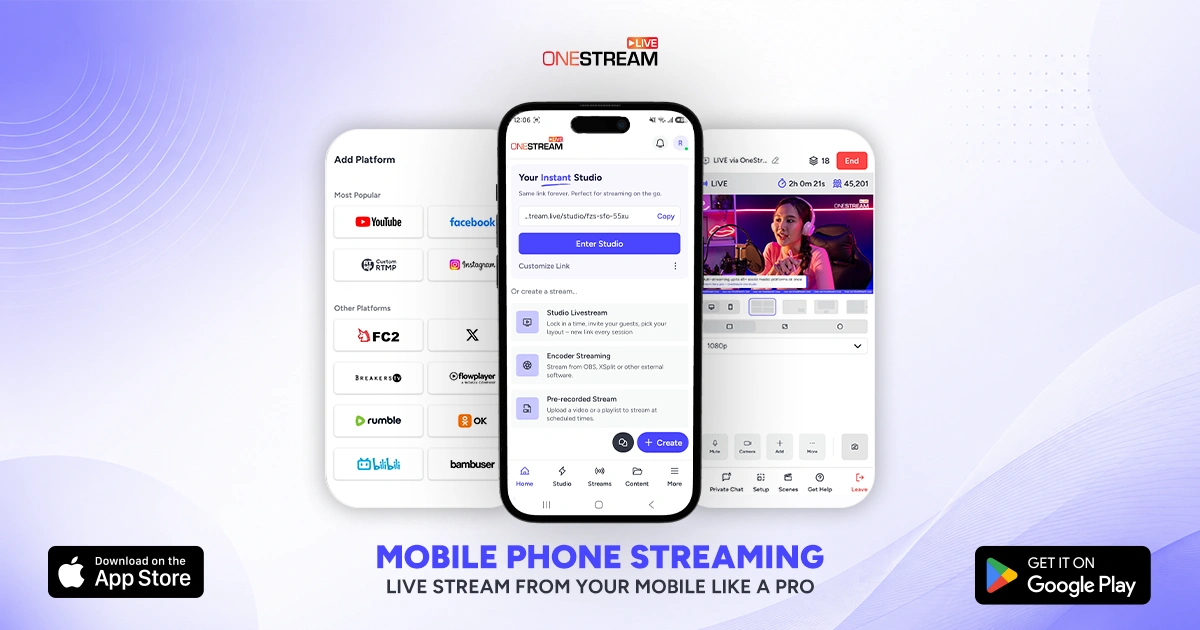
That’s why over 2 million creators and businesses use OneStream Live to multistream everywhere their audience already is, from a single browser session, without a separate setup for every destination.
The rule that has emerged is simple. Treat the livestream as the advertisement, not the destination, and move committed viewers onto an owned channel that no algorithm controls.
Web Platforms Integrate Ledger Systems For Uptime And Payouts
Uptime matters as much as audience size. If a connection drops mid-broadcast, that session’s audience is gone, and for a creator whose sponsorship rates are priced against concurrent viewership, a dropped stream is a direct revenue event.
Reliability comes from redundant ingest endpoints, distributed delivery and automatic failover. The failure surface multiplies with every additional destination you broadcast to.
What ledger systems add sits on the money side. They produce a verifiable, timestamped record of what was earned and when it settled, which for creators chasing a sponsor’s finance department is worth almost as much as the speed itself.
Creator Payout Systems Move Toward Always-On Settlement
Payment rails are following the same pattern. Sponsors, platforms and ad networks increasingly settle creator payouts through continuous ledger tools rather than batching transfers through slow processors, giving independent broadcasters and small creator teams the cash flow certainty once reserved for large media companies.
Entrepreneurs building livestreaming businesses are protecting their margins by moving away from legacy payment networks toward continuous, verifiable settlement.
Faster clearing reduces the risk of cash gaps during slow months. Distributed, always-on infrastructure gives the creator economy a genuine blueprint for scaling without the overhead that once made global streaming a game only large studios could afford.
The money side is still catching up. The distribution side already has, so there’s no reason to let one platform decide how far your work travels. Get started with OneStream Live and broadcast everywhere your audience already is.

Frequently Asked Questions
Platforms pay monthly, not on delivery, and only once you clear a minimum balance. They are waiting on their own advertisers, too. Brand deals add their own terms on top. The money is earned long before you can use it.
Most of the cost sits in the exchange rate, not the visible fee. The rate you get is not the one you saw when you agreed to the deal. Bank hops add more. Neither is itemized, so fewer lands than you expected.
Yes, and increasingly through licensed businesses rather than grey market ones. How far the rules have come depends on where you are. Tax applies either way.
Because it decides which payment tools banks will work with. That decides who your sponsor’s finance team is allowed to pay. To the sponsor, it is just an invoice.
Editors, subscriptions, gear and rent bill on a fixed cycle. Income arrives late and unevenly. The mismatch is the problem, not the size of the bill. It forces creators to sit on cash they would rather spend on production.
OneStream Live is a cloud-based live streaming solution to create, schedule, and multistream professional-looking live streams across 45+ social media platforms and the web simultaneously. For content-related queries and feedback, write to us at [email protected]. You’re also welcome to Write for Us!