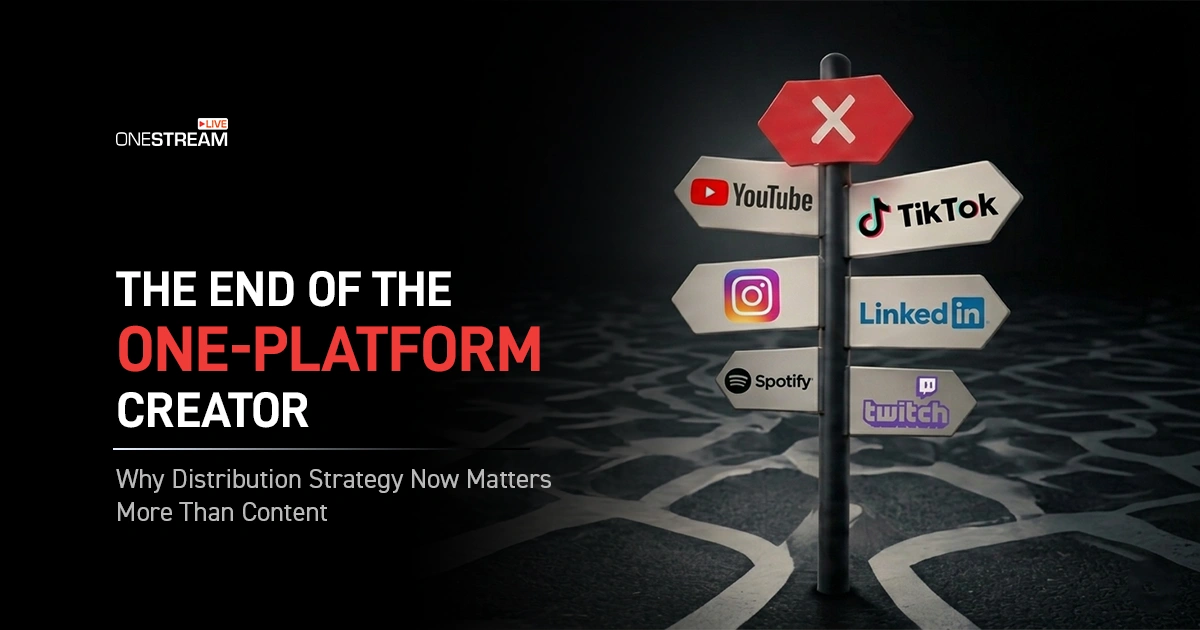
Just a few years ago, many creators could rely on a single platform to grow and earn. Modern content distribution strategies have changed that reality. Algorithms shift without warning, reach drops without a clear reason, and accounts can lose traction overnight.
Content alone does not guarantee visibility anymore. Content distribution now shapes outcomes just as much as the content itself. The idea of a “home platform” still exists, yet it carries more risk than before.
Rethinking Access and Reach in a Restricted Environment
Access plays a larger role in distribution than many expect. Content may exist online, yet that does not mean it is available everywhere. Regional limits still affect large parts of the internet.
Some viewers turn to VPN tools to bypass these limits and reach content that would otherwise stay blocked. This behavior shows how demand can exist even when access does not. Creators rarely see the full extent of this hidden audience. Those who want to understand this gap can explore how access works from the user side.
One way to do that is to try a VPN for free and see how content availability changes across regions. Meaning, reach is not only about content quality or platform choice. It also depends on access.
Creators who take this into account can shape a distribution strategy that reflects real audience behavior rather than platform assumptions.
The Illusion of a Global Audience
Many platforms present data suggesting extensive, international coverage. The truth is seen to be otherwise on a closer look. Content is frequently confined to specific territories by licensing regulations, site policies, or local limitations. An artist might think that they communicate to a world audience, but much of the world does not see the work.
These limits have been circumvented by the viewers, and such actions result in a discrepancy between what is reported and what actually takes place on platforms.
Such distance is deceptive to creators. The analytics can indicate a clean map of where the audience is, although it is not necessarily a true access pattern. There are viewers who are not where they are real. There are others that are not visible because of limitations.
Producers that rely on a single platform are likely to develop an approach based on incomplete information. A broader content distribution strategy will mitigate that risk and provide a better picture of reach to audiences.
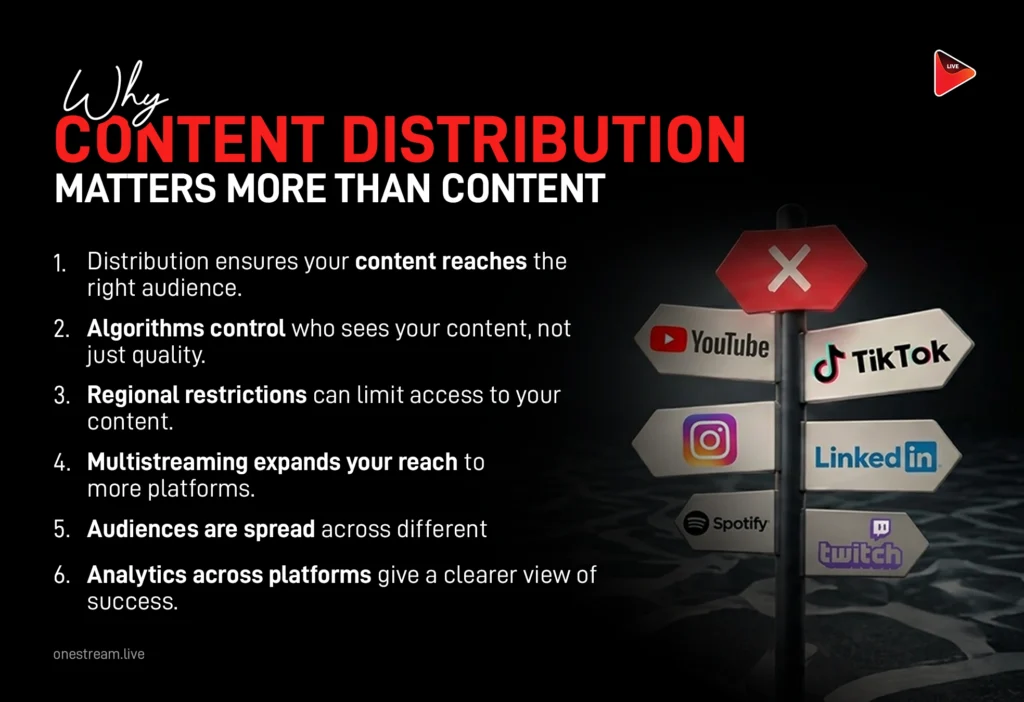
Platforms Control Reach More Than Content Does
Content quality still plays a role, but it no longer guarantees visibility in the way it once did, because platforms such as YouTube, TikTok, Instagram, and Twitch now act as powerful filters that decide how far any piece of content can travel. What appears in a feed, how long it stays there, and who actually sees it all depend on systems that operate behind the scenes.
A creator can publish well-structured and thoughtful content on a regular basis and still face declining reach, not because the work has changed, but because the platform has adjusted its priorities toward a different format or behavior.
TikTok might be more inclined to offer shorter content at high speed, whereas YouTube might recommend longer viewing time, and Instagram can alternate between Reels and other formats without any obvious indication. This introduces a scenario in which creators have no complete control over their distribution. They are subject to rules they have no influence over, and for which they cannot easily predict their visibility.
The use of one platform within this setting puts a business in a position of being highly susceptible to declines in reach that can be hard to regain. That’s why multistreaming is the best solution. OneStream Live solves this problem by letting you stream to over 45 social platforms and websites simultaneously, so your content reaches every platform with no extra effort.
Audience Behavior Has Fragmented
The behavior of audiences has changed to such an extent that single-platform strategies are no longer that effective, as viewers now switch between platforms like TikTok, YouTube, Instagram, and Twitch during the time of the day, depending on context, time, and the type of content they desire to watch.
This movement does not follow a predictable pattern, which means that no single platform can capture the full attention of an audience at any given moment. A single upload no longer reaches the full audience, even if that audience has already chosen to follow the creator, because attention is spread across multiple environments.
As expectations shift, audiences begin to assume that content will be available across platforms, and when it is not, they rarely go out of their way to search for it. Creators who respond to this pattern can extend their reach without changing the core of what they produce.
Data Can No Longer Be Taken at Face Value
Analytics can still offer a valuable perspective, though they no longer provide a full or entirely accurate view of performance, as the information in applications such as YouTube Studio, TikTok Analytics, or Instagram Insights reflects only a part of the reality.
Measures like reach, impressions, and audience location might seem obvious to the naked eye, but are subject to platform constraints and user actions that do not necessarily show. The limits on the region and the availability of content, and even the distribution of content in different platforms, have an influence on what appears in reports. That may result in conclusions that appear true but fail when cross-platform comparisons are made.
A more confident approach is to compare data across numerous platforms, where variations in performance begin to reveal patterns that cannot be demonstrated by a single platform. The wider perspective enables producers to see where the content actually resonates and where it may be challenging to be seen.
Final Thoughts
As content creators, it is no longer enough to rely only on a single platform to grow and engage your audiences. Content distribution strategy has become just as important as the content itself. We notice algorithms constantly shifting, regional access limitations, and audience behavior fragmenting across platforms, so content creators must move to multistreaming to make sure that their content reaches its full potential.
A well-rounded distribution strategy that spans multiple platforms can provide a clearer picture of true audience engagement and mitigate the risks associated with relying on just one platform.
OneStream Live helps you extend your content’s reach with minimal extra effort. Start streaming to all platforms today and maximize your visibility!

Frequently Asked Questions
Algorithms change fast, and audiences are spread across platforms. A good distribution strategy makes sure that your content gets seen by more people.
When a creator relies on one platform, they are at the mercy of changes in algorithms and policies. One day your reach might be great, and the next, it could drop unexpectedly. Plus, some regions may not even have access to your content because of licensing issues. This makes it risky to put all your eggs in one basket.
Some regions block your content due to licensing or platform policies, which can limit your potential audience. Access is not the same everywhere.
Multistreaming lets you broadcast to multiple platforms at once, so you can expand your reach without extra effort. Using OneStream Live, you can multistream to more than 45 social media platforms and web at the same time.
Platforms decide who sees your content, when, and how long it stays visible. This is all controlled by their algorithms, which are always changing.
OneStream Live is a cloud-based live streaming solution to create, schedule, and multistream professional-looking live streams across 45+ social media platforms and the web simultaneously. For content-related queries and feedback, write to us at [email protected]. You’re also welcome to Write for Us!