Live streaming has come a long way in the past few years. It used to be something influencers did to connect with fans between sales posts, but it’s now a serious sales channel in its own right, and one of the fastest-growing ecommerce channels for brands willing to show up consistently.
The past few years have seen the rise of live shopping, creator-led live commerce, and real-time sales driven by live-stream engagement. It’s so lucrative that any brand that feasibly could livestream probably should. This is especially true for personal brands and appointment-based businesses that rely heavily on trust and customer relationships.
The problem is that many brands treat live streams as one-off events rather than thinking of livestreaming itself as a serious, dedicated ecommerce channel. If this is you, and you’re struggling to work out how to use live streaming to your advantage, this article is for you. Here, we’ll teach you how to turn live streaming into a repeatable, scalable, and reliable revenue channel.
Why Live Streaming Works for E-commerce
Live streaming may not seem like an intuitive choice for e-commerce, but it can provide the essential human element many e-commerce channels lack. Real-time interactions with a streamer are more immediate and personal than interactions on a blog post or a pre-filmed video reel, and this immediacy builds a lot of trust. As any good marketer knows, gaining the customer’s trust puts you well over the halfway mark to conversion.
A good live stream has all the ingredients you need to simultaneously get sales and build long-lasting customer relationships. It combines entertainment, product discovery, and the kind of trust-building integrity that you can’t get on a pre-filmed, edited reel. Instant purchasing also lets you capitalize on the excitement generated during the stream for real-time purchases from those who like what they’re seeing.
But these aren’t the only advantages of live streaming for e-commerce. Live streaming typically offers much higher engagement than static content and provides an immediate feedback loop that streamers and brands can use to develop a closer, stronger brand connection with followers in real time. All of this is invaluable both for driving conversions during the stream and promoting long-lasting brand/customer relationships in the future.
From One-Off Streams to Repeatable Strategy
One issue that many brands experience is turning one-off streams into a reliably repeatable event with consistent results. This is, in many ways, part of the nature of live events: much depends on highly variable factors like the audience’s mood, the streamer’s feelings, and so on. However, with the right strategy, it is perfectly possible to turn live streaming into a consistent and reliable ecommerce channel.
The first step is to introduce weekly programming. For example, you might schedule in weekly live drops or an ongoing series of themed sessions. This kind of regular and consistent programming isn’t just for the benefit of your audience – it’s also for social media algorithms, which love consistency from the brands they work with. If you can be relied upon to turn up and stream for a certain amount of time at a certain time each week, then the algorithms will treat your streams more favorably over time.
If you’re concerned that live streams are a bit too ‘general’ or unstructured, then think about themes or scripts you can introduce. For example, you might offer product launches every quarter, product tutorials on a set day each week, a program of behind-the-scenes tours, and so on.
The trick with these is to maintain the structure without losing the immediacy and real-time relatability that makes live streaming so appealing to audiences. Let’s take a closer look at how to achieve this:
Structuring Streams for Conversion
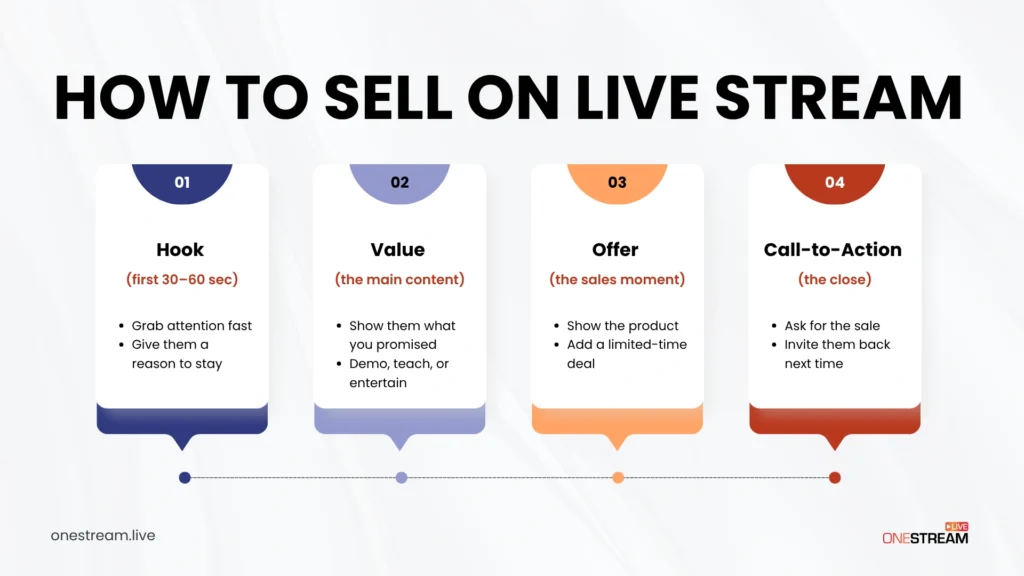
For best results, your live streams should have a clear, structured flow. A typical flow looks something like this – but you should adjust to best fit the product, platform, and streamer you’re working with:
1. Hook – this ‘grabs’ and engages the viewers in the first 30-60 seconds. For example, you might tease the value the viewers can expect if they stay watching the stream (‘I’m going to show you how to…’, ‘If you want X, keep watching!’ etc)
2. Value. The body of the stream needs to fulfill the promise of the hook. Give the viewers something worth their while. This could be education, entertainment, information, a connection with a streamer they like, or special offers… if you’re not sure what your audience wants most from your streams, ask them! Get them to put suggestions in the comments or the chat, send out surveys, and so on. For service-based brands such as fitness coaches, beauty professionals, and consultants, live demonstrations and Q&A sessions can be particularly effective.
3. Offer. This is the sale/conversion point. Highlight specific products, put together limited-time bundles, give real-time discounts, and so on. Make sure that purchase links are obvious and easy to access from a range of devices. Scarcity (limited-time offers) marketing is often very effective for live stream conversions.
4. Call-to-action. It’s usually a good idea to round off with a CTA. This can be encouragement to buy the products featured in the stream, to follow the live stream channel and/or brand, or simply to tune in for the next stream.
To avoid your structure from feeling formulaic and to maintain the immediacy and relatability of live streaming, try to keep the energy high and engage with the audience as much as possible. This may take you onto certain tangents, so build some flexibility for audience engagement into your live stream structure.
Repurposing Content for Scale
While much of the appeal and success of live streams is due to their immediate, real-time nature, the benefits of live streaming don’t have to end when you switch off the camera. Don’t let your streams disappear after going live. The footage can easily be repurposed into short social media clips, product page videos, email content, and so on. One stream can be turned into multiple assets, giving live streaming fantastic ROI and keeping the benefits going long after the ‘live’ part ends.
Integrating Live Streaming With Your Ecommerce Funnel
So, where does live streaming fit into your ecommerce funnel? Well, it depends a lot on how you stream, who your audience is, and what you want to achieve. However, in general, live streaming can work well for people in multiple stages of the funnel.
For example, you might connect streams to product pages and landing pages for consumers in the Awareness stage of the funnel. You can add live streams and live stream clips to email flows for things like retargeting and building engagement with current or former customers.
Pre-stream promotion can be great for lead capture, and post-stream follow-ups can yield valuable customer data that can be used to refine messaging throughout the funnel.
Ultimately, with the right strategy, live streaming can become part of a full funnel rather than a standalone tactic.
Scaling With Automation and Multistreaming
Automation and streaming tools like OneStream Live can turn a sporadic and disjointed streaming strategy into a consistent, sophisticated, and effective ecommerce channel. For example, you can use OneStream Live to:
- Schedule streams
- Multistream across platforms
- Automate stream publishing
This will help you to reach wider audiences and to maintain that all-important consistency that audiences and algorithms both love. At the same time, it will save much of the time and effort involved in manually setting up and distributing live streams, allowing brands to devote much more effort to the stream itself.
Monetizing Through Personal Brand and Service-Based Selling
Live streaming works better for some businesses and business models than for others. In general, live streaming is a great tool for personal brands, service-based businesses, and demonstration-led industries. The format lends itself particularly well to tutorials, consultations, usage demos, ‘meet the team’-style content, and so on.
Salons and beauty professionals, for example, are increasingly using live streams to showcase treatments, demonstrate products, and build the kind of personal connection that drives bookings. For these businesses, live streaming works hand in hand with business tools for salons that manage bookings, payments, and customer relationships before, during, and after the stream.
Tracking Performance and Optimizing
As with most things, you need to track and monitor your live stream performance to optimize it. Key metrics include:
- Viewership – the number of people watching your streams, and the demographics they fall into.
- Engagement – comments, clicks, shares, etc.
- Conversion rate – the number of people who take the action the stream is promoting (e.g., making purchases, following the brand profile, etc)
- Revenue per stream – the amount of money each stream brings in. It’s worth tracking both the revenue a stream brings in while it’s live and the revenue stream vids or repurposed stream assets bring in after the live session.
Once you’ve got enough performance data to draw useful insights, make improvements and iterate through testing your formats, adjusting your timing, refining your offers, and anything else that the data suggests.
Conclusion
Live streaming provides a sense of immediacy and personal connection that’s hard to achieve with other digital channels. As such, live streaming can be an incredibly effective ecommerce channel that drives more business, adds value for customers, increases revenue, and strengthens brand/customer relationships.
The right tools can make all the difference here. Use OneStream Live to schedule, produce, monitor, repurpose, and track your e-commerce live streams without the stress.

Frequently Asked Questions
Live streaming in ecommerce is the use of real-time video broadcasts to showcase products, engage with viewers, and drive sales. It combines entertainment, product discovery, and instant purchasing into a single channel.
Yes. Live streaming works especially well for small businesses, personal brands, and service-based businesses because it builds trust quickly and requires minimal production budget compared to traditional video content.
A weekly schedule is the sweet spot for most brands. Consistent programming helps social media algorithms favor your content and trains your audience to show up at the same time each week.
The best platforms depend on your audience, but TikTok, Instagram, YouTube, and Facebook are the most popular for live commerce. Multistreaming tools like OneStream Live let you broadcast to several platforms at once.
Track four core metrics: viewership, engagement (comments, shares, clicks), conversion rate, and revenue per stream. Also, measure the revenue from repurposed clips after the stream ends.
OneStream Live is a cloud-based live streaming solution to create, schedule, and multistream professional-looking live streams across 45+ social media platforms and the web simultaneously. For content-related queries and feedback, write to us at [email protected]. You’re also welcome to Write for Us!