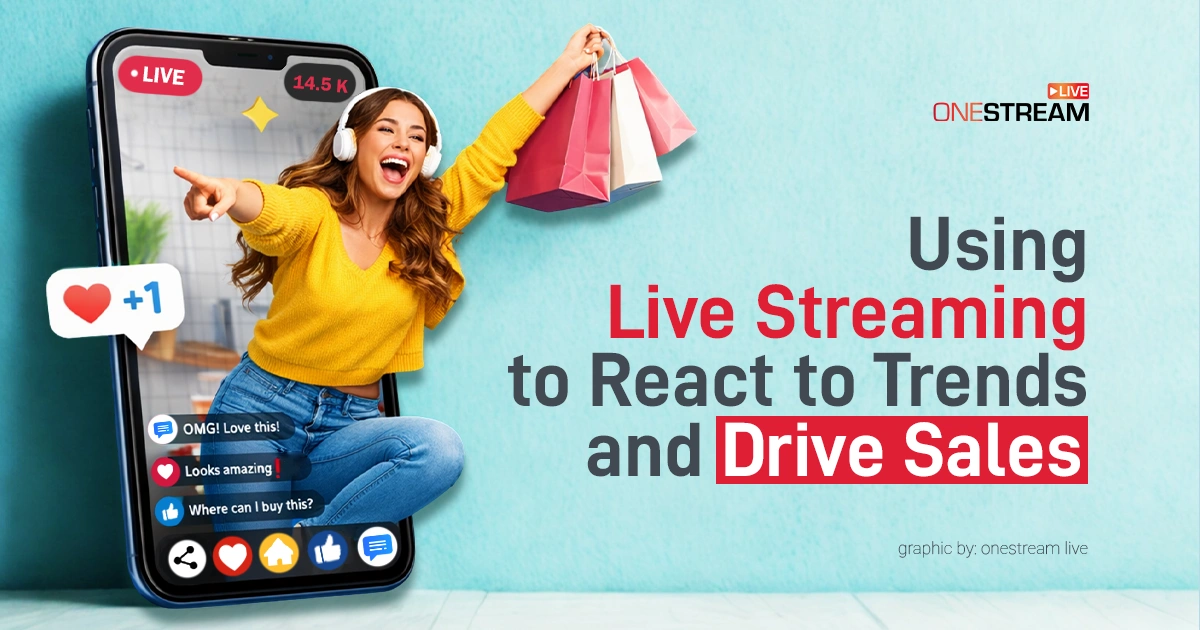
We live in an era where trends don’t wait. By the time your team finishes a script and edits a video, the hype might be gone. So, if you want to use a trend, you have to act fast. Most content formats fail to deliver here. But live streaming marketing works differently because it happens in real time.
It is one of the best choices to respond promptly and connect trends to your offer. But you can only benefit from this tactic when you have a clear system. How do you build one? And how do you get measurable live streaming sales? That’s what we’ll discuss in this guide.
Live streaming marketing helps brands react quickly to trends and connect with audiences while interest is still high.
A clear system for spotting and evaluating trends makes it easier to plan effective live sessions.
Strong offers and limited-time deals during live streams can turn viewers into buyers in real time.
Preparation matters. Test your links, landing pages, and checkout flow before going live to avoid losing sales.
Post-stream follow-ups such as replays, emails, and retargeting help convert viewers who did not buy during the live session.
Why Is Live Video Streaming Effective for Trends and Sales?
There are two main elements here: speed and psychology. That’s if you put it very briefly.
Over 28% of users watch live streams weekly. People love the urgency of it, and they keep coming when it has something to do with current hot topics. That’s why a well-run live video session lets your brand:
- Jump into the conversation right away,
- Offer value while the interest is still high,
- Allow viewers transition into buyers in real time (literally).
But even without stats, common sense explains the effectiveness of live streaming, too.
Trends fade fast. And if you want to benefit from those trends, you simply can’t afford slow content cycles. That’s why going live is one of the fastest ways to communicate with your audience in real time.
7 Steps to Trend-Based Live Streaming Marketing That Drives Sales
Nothing drives purchase decisions more than customer emotions. Yet, with an overload of information, making people curious and genuinely emotional about your product is hard.
But this is where trend-based live video marketing can help.
Step 1: Build a Trend Reaction System
Is it possible to react to something new and hype(ish) by accident? Not really. You won’t have time to, let’s say, “engineer” a reaction. If you want live streaming marketing to work well, you need to build a trend-reaction system inside your company.
Start small, and don’t overcomplicate things at the beginning.
Create a dedicated Slack channel (or a separate chat in any other tool you’re using) for trends. Everyone in SMM, paid advertising, competitor research, partnerships, and content should be dropping interesting signals there daily or weekly.
If this becomes strategic for your brand, take it further:
- Assign someone to monitor industry news and platform-specific trends.
- Review social feeds, Google Trends, TikTok trends, industry news, etc.
- Hold short daily “trend scan” meetings (15 minutes max).
- Evaluate what could realistically work for your product or service.
Now comes another important part: filtering.
Not every trend is good for your brand. It goes without saying that you have to be selective. Jumping into irrelevant topics just for visibility will confuse people or, worse, will make them trust you less.
See if a trend aligns with your positioning:
- Can you naturally connect it to our offering?
- Does it attract the right audience?
You don’t have to go viral. That’s not your goal when you’re a business. The real objective is to attract relevant audiences and drive live streaming sales.
Step 2: Define Clear Roles and Formats
If you want to execute fast, everyone must know exactly what they’re responsible for. There shouldn’t be a single step where people don’t know what they need to do.
So, make sure you define all the roles in advance. For example, someone has to become:
- A trend validator who decides if it’s worth reacting or not,
- A campaign strategist who connects a specific trend to your unique offer,
- A host who will turn into a familiar face of your live sessions.
Besides, you have to find someone responsible for visual support (slides, banners, product shots, etc.) and sales materials/funnels (links, landing pages, checkout flow, etc.).
Next, define your formats.
Not every trend requires the same approach. You might switch between:
- POV reaction streams,
- Trend breakdown and expert commentary,
- Audience Q&A sessions,
- Live comparison (“Trend X vs. our solution”),
- Interactive polls and challenges, etc.
When formats are predefined, you don’t waste time deciding how to structure each stream. You just sort of “plug” the trend into an existing system, and it works for you.
Step 3: Shape Your Real-Time Marketing Campaign
Many brands misunderstand real-time marketing because it isn’t just about reacting to current events. Since you’re a company, not a content creator who is after views and likes, you need a proper starting point.
In other words, every live streaming initiative must answer a simple question: Why are we doing this? If you want your live sessions to perform consistently, they should be part of a clear live commerce strategy. Do you want to:
- Sell a specific product?
- Promote a limited bundle?
- Capture leads for your new release?
- Drive traffic to a particular landing page?
This is where you will create a bridge between the trend and your offer.
For example, let’s say a trend is a viral productivity method that is circulating. It’s a perfect opportunity to sell project management software by using this angle: “We tested this trending productivity hack live. Here’s what actually works.”
But first, you have to build the full system around it:
- Pre-event emails (“We’re going live reacting to this viral trend” and things like that),
- Social posts teasing the session (maybe you could tag influencers who are praising it, or explain how it started),
- Paid advertising to amplify reach (if it makes sense),
- Video SEO strategies to optimize your streams,
- On-stream promotion (how are you going to sell your product/service?),
- Post-stream follow-up (an email sequence with replays, limited discounts, etc.).
Step 4: Explore Diverse Sales Techniques
If your live video streaming drives attention but not sales, the first thing to blame is usually the format. But most likely, it’s the way you present your offering.
First of all, you need one strong core offer. Don’t overwhelm viewers with 12 product options. Choose one primary hero product that connects to the trend and lead with it.
Then, use upsells and cross-sells. During the stream, introduce complementary items and premium services. It is also important to mention your add-on services. This increases average order value, and you don’t need any additional traffic for that.
Besides, because your live stream creates urgency, your sales mechanics should match that pace. You could do that with limited-time deals, such as:
- Discount valid until the stream ends,
- Bonuses for live viewers,
- Early-bird pricing, etc.
Another helpful tactic is to highlight these offers visually during the stream. Using OneStream Live, you can add scrolling tickers to display discount codes, limited-time offers, or important messages so viewers don’t miss them.
Also, don’t forget to test your live stream and everything related to your offer to make sure there are no technical issues. Otherwise, all the other work will make no sense. For example, in terms of the sales part, keep an eye on:
- Shopping links (Are they visible and clickable?),
- Discount codes (Are they simple?),
- Landing pages (Are they loading fast?),
- Payment process (Is it smooth?).
Something as “small” as a clunky checkout can kill your live streaming sales very quickly. So, before going live, test everything like a customer would.
Step 5: Use Conversion Techniques to Drive Sales
Structure your stream strategically because live streaming for sales requires a clear conversion flow. A high-converting live video session usually involves a strong hook. You can start with:
- What viewers will learn,
- What problem will you solve?
- And what exclusive offer awaits?
You can also tease a bonus revealed at the end to increase retention.
After this, you have to introduce the trend. Break down what’s happening. Why is everyone talking about it? What’s misunderstood? Position your brand as a relevant solution, and connect that trend to your offering.
It would be great to show your product in action. You can also use urgency when talking about it, but don’t sound scammy. If you don’t know where to start, try effective and time-tested approaches:
- “This special price is available only until the stream ends,”
- “First X buyers get free shipping,”
- “Bonus add-on included today only,” etc.
Another effective tactic is price anchoring. Show the original price, and highlight the savings people get. To make the sales process easier, make sure your host has several docs prepared, such as clear benefit statements, FAQ answers, objection-handling guides, social proof examples, etc.
Step 6: Support Your Live Stream With a Homepage Video
Your website is a powerful conversion tool. So, why not use it to promote your live stream? There are several strategies you can try, but one of the freshest approaches is to add homepage videos promoting your stream.
The easiest approach is using OneStream Live, which lets you embed your stream on your homepage while streaming to all your social media accounts at the same time. This way, you can reach audiences both on search engines and across social platforms without running multiple streams.
Depending on how you use it, it can help you both to increase attendance and improve your post-stream sales. Overall, homepage videos can serve you as:
- A teaser for an upcoming live session,
- A short recap, driving replays,
- A direct CTA (e.g., “Watch Now”).
Just make sure that your CTA is clearly visible and easy to understand. And check that your video doesn’t hurt UX or slow your website speed.
Step 7: Leverage the Post-Stream Momentum
The end of the stream shouldn’t be seen as the finish line. You can still continue converting people with the following strategies:
1. Recap. Right after your live video streaming session, send a short recap email with key takeaways and a reminder that the offer is still available (until a clear deadline). Many viewers hesitate during live sessions, so you can convince them after it.
2. Retargeting. Next, retarget anyone who watched, clicked, or added your products to cart. Your advertising here should focus on objections and benefits. And yes, it makes total sense to add urgency.
3. Landing page. Finally, keep a dedicated landing page live for a few days with the replay, FAQs, featured products, and maybe a countdown (if relevant). Trends move fast, but interestingly enough, buying decisions sometimes take a little longer.
Pro Tip: If you want a simple place to share your replay, you can create a dedicated stream page with OneStream Live without needing a website, hosting, or a domain. If you already have a website, you can also embed your live stream or replay directly on your landing page.
Conclusion
Live streaming can be a great revenue channel. But you have to approach it the right way and launch it with a strategy in mind.
Once you plan it properly and have clearly defined processes, when any new trend emerges, your team knows how to react fast. And this is one of the most important elements to successful live streaming marketing.
Running streams across several platforms should also stay simple. OneStream Live lets you schedule your broadcasts, multistream to your social media accounts, and embed your stream on your website from one place.
If you want to put this approach into practice, you can start using OneStream Live to run and manage your live streams across multiple platforms.

FAQs About Live Streaming Marketing
Live streaming marketing is the use of real time video broadcasts to promote products, share information, and interact with audiences directly. Brands can demonstrate products, answer questions, and encourage viewers to buy during the live session.
Live streaming creates urgency and real time interaction. Viewers can see products in action, ask questions instantly, and make purchases during the stream, which often leads to higher engagement and conversion rates compared to traditional online content.
Businesses can monitor social media trends and quickly create live sessions around popular topics. By connecting a trending conversation with their product or service, brands can attract attention and convert viewers into customers.
Many brands use platforms like YouTube Live, Facebook Live, Instagram Live, and TikTok Live to reach their audiences. With multistreaming tools, businesses can broadcast to several platforms at the same time to increase reach.
Start by choosing a topic connected to your audience’s interests, prepare a clear offer, and promote the stream before going live. Using tools like OneStream Live, you can schedule streams, multistream to multiple platforms, and embed your stream on your website.
OneStream Live is a cloud-based live streaming solution to create, schedule, and multistream professional-looking live streams across 45+ social media platforms and the web simultaneously. For content-related queries and feedback, write to us at [email protected]. You’re also welcome to Write for Us!