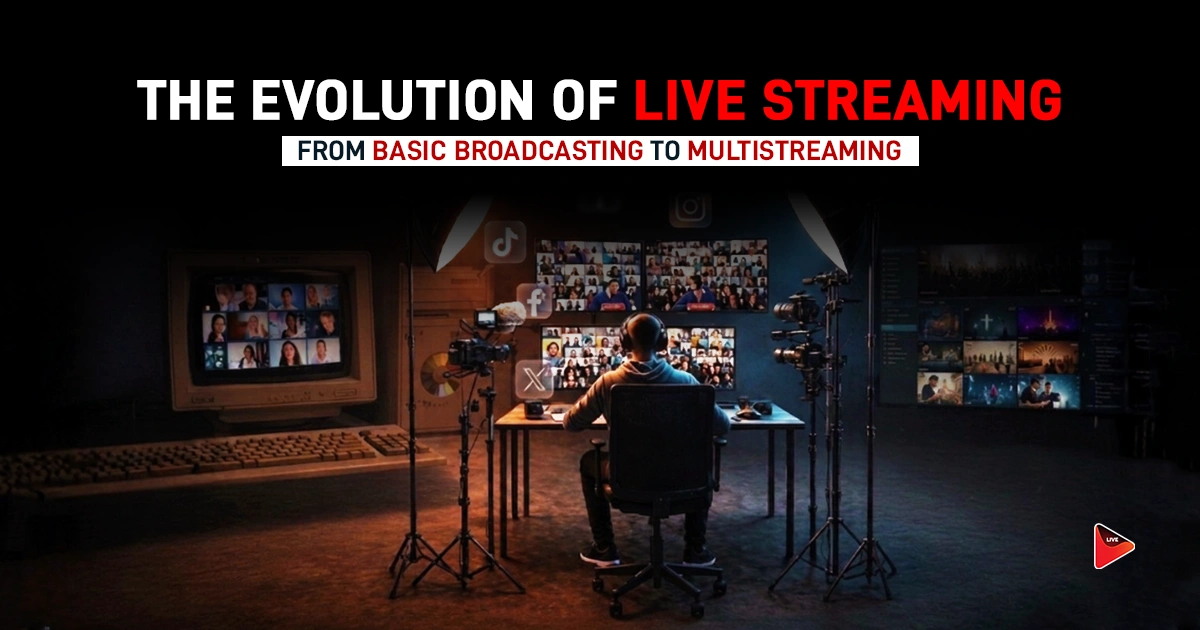

The initial instance of a webcam being connected to the internet, the infamous 1993 University of Cambridge coffee pot cam, no one had imagined that in 30 years’ time, whole businesses would be built and crumbled on live video. But here in 2026, Twitch stars have Super Bowl sized audiences, brands are selling drops in minutes on TikTok Live, and churches are reaching people around the world on multistreaming dashboards that would leave early web pioneers dizzy. This rapid growth is driven by how fast streaming tech has evolved. It is more than a fun nostalgia trip to know how we got from grainy 240p frames to crystal clear 4K simulcasts, it is the key to planning your next content push, marketing campaign, or product launch.
Below, we trace the tech milestones that mattered, explain why multistreaming has become the new normal, and show you how to future proof your live strategy without getting lost in complexity.
Streaming tech has evolved from basic webcam broadcasts to advanced multistreaming workflows.
Early live streaming was limited by low quality, high latency, and weak infrastructure.
Improvements in protocols, mobile networks, and cloud systems changed how live video works.
Audience expectations increased with features like low latency, interactivity, and multi platform access.
Multistreaming helps reach more viewers and reduces reliance on a single platform.
Modern live streaming requires a combination of tools, automation, and scalable workflows.
From Camcorders to Cloud: A Brief Timeline of Streaming Tech
The road from single-node broadcasting to synchronous multistreaming looks short on paper, but every jump comes with its own headaches and opportunities. Read more about the dedicated development team services behind the latest solutions. Below is the condensed story.
1. Dial-Up Days: 1995-2005
Early platforms such as RealPlayer and Windows Media Encoder were essentially glorified FTP servers pushing tiny video files disguised as “live.” Frame rates hovered around 8-12 fps, and buffering wheels were permanent on-screen residents. Brands avoided live because a single freeze could tank credibility.
2. The Flash Era: 2005-2013
Adobe Flash and RTMP changed everything. Suddenly, creators could embed streams on any page, ushering in Justin.tv (the forerunner of Twitch) and early Facebook Live experiments. Latency dropped under five seconds for the first time. At this stage, companies began to hire dedicated development teams to build custom players, ad insertion tools, and basic analytics.
3. Mobile & HLS: 2013-2019
Apple’s HTTP Live Streaming (HLS) standard and 4G networks put a broadcast studio in every pocket. Periscope’s “go live in two taps” UX trained audiences to expect instant coverage, and YouTube’s adaptive bitrate surprise launched at VidCon 2016. This era introduced API-driven overlays, making it easier for software engineering partners to integrate real-time polls, donations, and e-commerce carts.
4. Cloud & Multistream: 2019-Present
When the 2020 lockdowns hit, C-suites discovered Zoom; creators discovered restreaming hubs like OneStream Live and OBS plug-ins that could dispatch one feed to a dozen destinations at once. The cost of spinning up a cloud encoder on AWS or GCP plummeted, letting scrappy teams compete with major networks. By 2024, Twitch’s simulcast rules relaxed, opening floodgates for creators and forcing marketers to rethink platform exclusivity.

Why Audience Expectations Went Through the Roof
Ask any viewer under thirty to wait ten seconds for a buffer, and you’ll watch them swipe away in three. Ultra-low-latency protocols (LL-DASH, WebRTC) unshackled the chat window from the video, so commentary feels native, not taped on. But it’s not just speed. Modern viewers expect:
- Multi-angle choice (think Formula 1’s cockpit cams).
- Instant replays triggered by chat commands.
- Embedded storefronts where you can buy the hoodie the host is wearing.
Delivering all that means your marketing team can’t rely solely on off-the-shelf SaaS. Many companies hire dedicated development teams or augment in-house talent with remote tech teams to bolt custom modules onto commercial platforms. A cosmetics brand, for instance, might need shade-matching AI baked into the livestream itself.
At the same time, compliance bars rose. GDPR, COPPA, and Brazil’s LGPD all touch live video, pushing businesses to seek software engineering partners who understand both code and regulation. Skipping that homework can result in six-figure fines and public trust vaporized overnight.
The Rise and Rationale of Multistreaming
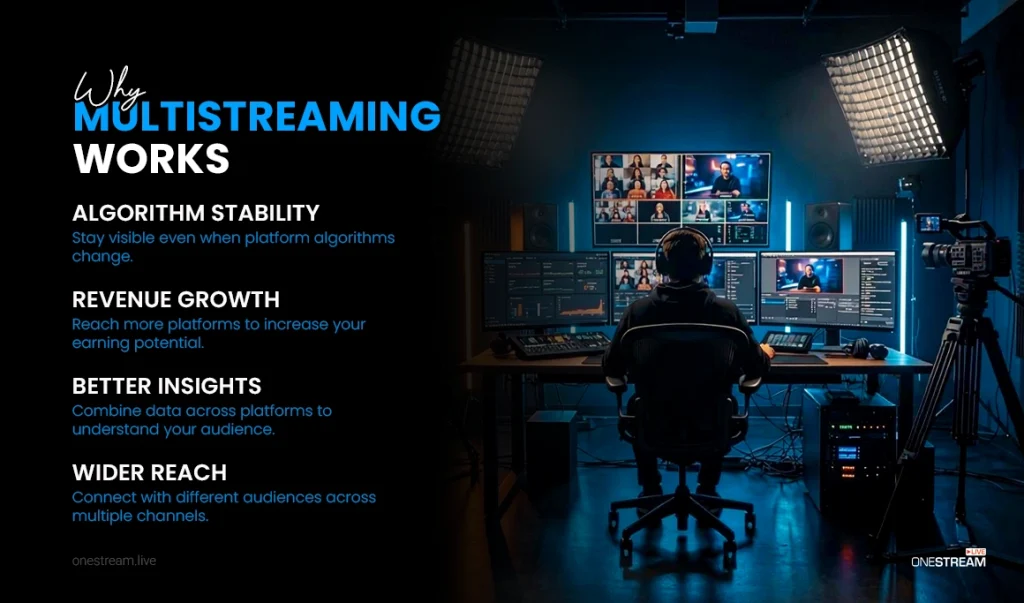
If 2020-2022 was the “go live anywhere” craze, 2023-2026 is the multistreaming consolidation phase. Instead of juggling separate chats on Facebook, LinkedIn, Twitch, and YouTube, creators now pipe everything into a single One Stream solution, then syndicate highlights automatically. Why it matters:
1. Algorithm Insurance
Platforms tweak reach formulas daily. Simulcasting diversifies risk; if one site throttles your niche, the others keep you afloat.
2. Incremental Revenue
The report confirms that average professional creators now operate across 3.2 distinct revenue streams to reduce platform dependency, with brand sponsorships remaining the largest overall revenue model at 31.5% of the market share. Sponsors crave eyeballs, and multistreaming magnifies them without extra shoot days.
3. Data Triangulation
Aggregating analytics across platforms lets marketers spot demographic gaps – perhaps your TikTok viewers skew Gen Z female, while LinkedIn leans Millennial male. Effective targeting often starts with a quick script by a remote tech team pulling APIs into a single warehouse.
Still, multistreaming is not a one-step solution. Each platform has its own bitrate limits, content rules, and audience behavior. Successful streamers adapt their streams for each destination by adjusting format, layout, and messaging to match the platform.
Building a Future-Proof Streaming Tech Stack
So, you’re convinced multistreaming is the future. Now what? Below are the critical layers you need to design (or redesign) between now and your next big launch.
1. Capture & Encoding
4K60 capture cards and NDI feeds are table stakes, but future-ready teams plan for HDR10 and 8K workflows even if they’re only outputting 1080p today. That means modular switchers and codecs you can update via firmware, not forklift replacements.
Read More: Hardware vs Software Encoding
2. Transport & CDN
The debate in 2026 is less about “cloud vs. on-prem” and more about which mix offers the lowest egress bills. Leveraging peer-assisted delivery and sub-second WebRTC for VIP tiers creates a massive efficiency multiplier. This architecture can offload a significant portion of video streaming bandwidth from central servers to the peer network.
3. Orchestration & Automation
Gone are the days when someone had to click “Go Live” on four tabs. Today, JSON manifests trigger OBS scenes, update lower thirds with product SKUs pulled from Shopify, and push the replay VOD to a platform within minutes.
4. Engagement Layer
Polls, giveaways, and shoppable QR codes feel basic now. The cutting edge is predictive interactivity powered by AI. This includes real-time sentiment analysis that adjusts the host’s prompts and automated language localization that switches captions on the fly.
Cost Considerations: Build, Buy, or Blend?
Budget is the elephant in the studio. A practical approach is to prioritize spending based on your streaming needs.
Invest more in features that directly impact your content and audience experience, such as production quality and interactivity. Use reliable tools for core streaming functions like transcoding and content delivery. Keep your setup flexible so you can scale your streaming workflow without unnecessary costs.
Final Takeaway
Live streaming’s journey from a single clunky webcam to frictionless, everywhere-at-once multistreaming is really a story of how fast streaming tech has evolved and how expectations have grown from both viewers and businesses. Meeting those expectations in 2026 requires more than just going live. It requires a flexible setup, the right tools, and a workflow that can scale.
If you want to simplify your workflow and reach more platforms without extra effort, OneStream Live helps you multistream, manage your content, and deliver your streams from one place.

Frequently Asked Questions
Streaming tech refers to the tools and systems used to deliver video or audio over the internet in real time. It includes capture, encoding, delivery protocols, and playback systems that allow users to watch content without downloading it.
Streaming tech has moved from low-quality, high-latency systems to fast, high-definition, and interactive experiences. Improvements in internet speed, mobile devices, and cloud infrastructure have made live streaming more accessible and scalable.
Multistreaming allows creators and brands to broadcast to multiple platforms at once. This increases reach, reduces dependency on a single platform, and helps connect with different audience segments across channels.
Modern streaming tech relies on protocols like HLS, WebRTC, RTMP, and SRT. These technologies control how video is delivered, how fast it reaches viewers, and how stable the stream remains under different conditions.
Cloud technology allows creators to stream without heavy local hardware. It supports scaling, multistreaming, and global delivery, making it easier to manage live content across platforms.
OneStream Live is a cloud-based live streaming solution to create, schedule, and multistream professional-looking live streams across 45+ social media platforms and the web simultaneously. For content-related queries and feedback, write to us at [email protected]. You’re also welcome to Write for Us!