
Most creators who feel their live video “isn’t working” don’t have an equipment or platform problem. They have a format problem. They picked the wrong types of live streaming for what they were actually trying to achieve, broadcasting when they needed a conversation, or running a loose hangout when they needed a structured presentation.
“Live video” is not one thing. It’s a family of formats, each built around a different goal, audience size, and level of interaction. Once you see them as distinct tools rather than a single undifferentiated activity, choosing the right one and getting the result you want becomes a lot easier. Here’s the full map.
Why the Format Matters More Than the Gear
It’s tempting to believe that better results come from a better camera, a faster encoder, or the right platform. Those things matter at the margins, but they’re not what determines whether a live video succeeds. The format does.
The format determines three things before you ever hit go live. How many people you can reach, how intimate the experience feels, and what kinds of interaction are even possible. A polished broadcast to 10,000 viewers and a one-to-one video call are both live streaming formats, and they serve entirely different purposes. Match the format to the goal and the gear becomes a detail. Mismatch them, and no amount of production value will save it.
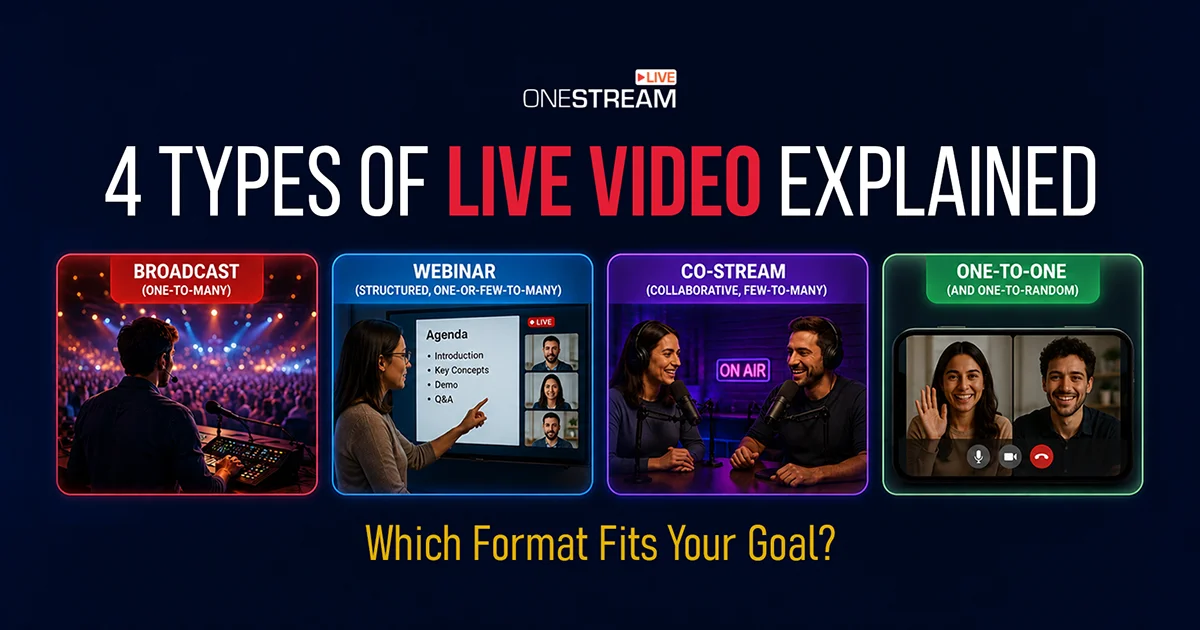
4 Types of Live Streaming Formats Explained
Not all live streaming formats are built the same. Each one serves a different goal, attracts a different audience size, and offers a different level of interaction.
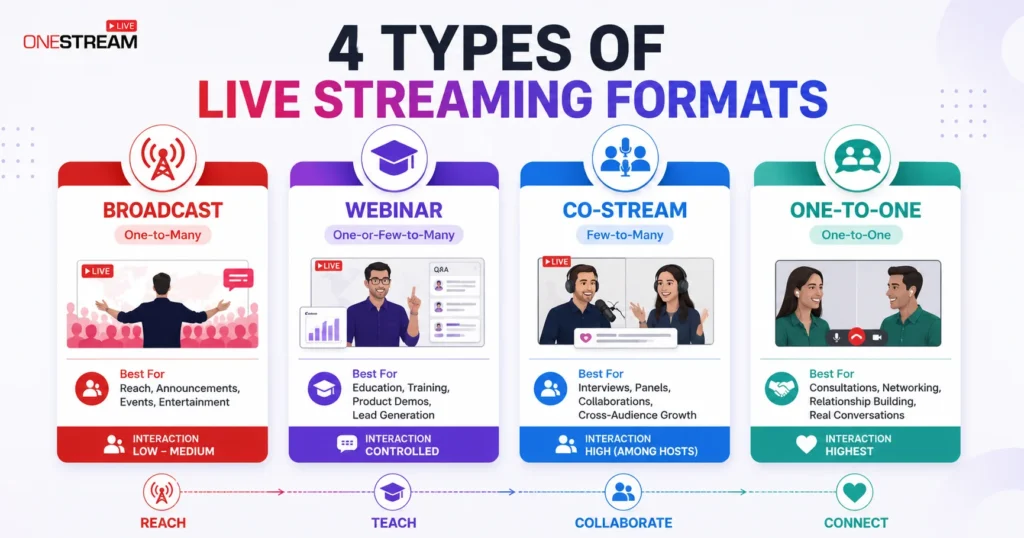
Broadcast (One-to-Many)
Broadcast is what most people picture when they hear “live streaming.” One creator goes live to a large audience, often across several platforms at once.
Best for: reach, announcements, product launches, entertainment, live events, and building a following. If your goal is to put your message in front of as many people as possible, this is the format.
Interaction level: low to medium. Viewers can comment and react, but the relationship is mostly one-directional. You speak, they watch, and a fraction participate in chat.
Main trade-off: broadcast maximizes reach and minimizes intimacy. You can touch thousands of people, but each individual connection is shallow. That’s not a flaw. It’s the nature of speaking to a crowd.
This is also where a multistreaming tool like OneStream Live earns its keep. Broadcasting to 45+ platforms simultaneously is the most direct way to extend a single live session’s reach without any extra effort.
Webinar (Structured, One-or-Few-to-Many)
A webinar is a broadcast with a backbone. It’s a live video organized around teaching, presenting, or demonstrating, usually with a clear agenda and a structured way for the audience to participate.
Best for: education, training, onboarding, product demos, and lead generation. Webinars are the workhorse of B2B and creator-education content.
Interaction level: controlled. The audience participates through Q&A, polls, and chat, but within a framework you set. The structure is the point. It keeps a large group focused on a single thread.
Main trade-off: webinars carry high authority and strong lead value, but they demand preparation. A rambling webinar is worse than no webinar, because the audience showed up expecting to learn something specific. The format rewards planning and punishes improvisation. Using OneStream Live, you can schedule and automate your webinar streams up to 60 days in advance, so the production side never gets in the way of the content.
Co-Stream (Collaborative, Few-to-Many)
A co-stream brings multiple hosts or guests into the same live video, broadcasting together to a shared audience. Think interviews, panels, podcasts recorded live, and creator collaborations.
Best for: interviews, panel discussions, collaborations, and cross-audience growth. When two creators co-stream, each brings their own audience, and both grow.
Interaction level: high among the hosts, medium with the audience. The energy comes from the dynamic between people on screen, which keeps viewers engaged even when they’re not directly participating.
Main trade-off: co-streaming generates great energy and expands reach, but it requires coordination. Scheduling across people, settling on talking points, and managing the technical setup of multiple feeds all add up. The more people on screen, the more there is to manage. OneStream Live supports up to 16 studio guests and 4 multi-cameras, so the technical side of co-streaming is handled without the usual setup headaches.
One-to-One (and One-to-Random)
At the far end of the spectrum from broadcast sits one-to-one live video: two people, talking directly, in real time. In a formal environment, this is a live interview or a video consultation. In the consumer world, it’s the fast-growing category of one-to-one and random video chat, where you’re connected directly to another person for an authentic conversation.
Best for: direct connection, real conversation, relationship-building, consultations, and spontaneity. When the goal is depth rather than reach, nothing else comes close.
Interaction level: the highest possible. It’s fully two-way and entirely real-time. Every word and reaction is shared between exactly two people. There’s no audience to perform for and no chat to moderate, just a conversation.
Main trade-off: zero scale, maximum intimacy. You can only talk to one person at a time, but that one connection is as deep as live video gets. This is the logic behind consumer platforms built around the format — apps like Benechat connect two people instantly for a real-time conversation, trading the reach of a broadcast for the immediacy of an actual exchange. It’s the opposite end of the dial from streaming to a crowd, and it serves a need the crowd never could.
Live Streaming Formats at a Glance
| Format | Audience Size | Interaction Level | Best For | Trade-Off |
|---|---|---|---|---|
| Broadcast | Large | Low to Medium | Reach, launches, events | Little intimacy |
| Webinar | Medium to Large | Controlled | Teaching, demos, leads | Requires preparation |
| Co-Stream | Medium | High (among hosts) | Interviews, collabs, panels | Needs coordination |
| One-to-One | One | Highest | Real connection, consults | No scale |
How to Choose: Match the Format to the Goal
The decision is simpler than it looks once you start from the goal rather than the tool.
For reach, go with broadcast. Go wide, multistream, and put your message in front of the largest possible audience. For teaching or lead generation, the webinar is the right call. Bring structure, prepare your agenda, and give the audience a controlled way to engage. For collaboration and energy, co-streaming is the format. Bring in guests, combine audiences, and let the interaction carry the session. For real connection, one-to-one is the only format that delivers. Trade scale for depth and have a genuine conversation.
The mistake most creators make is treating all four as interchangeable, then wondering why a broadcast didn’t feel personal or a casual hangout didn’t generate leads. Each format is good at exactly one thing and bad at its opposite.
Final Thoughts
The most effective creators don’t pick a single format and stick to it. They use the right one for each goal and often combine them within a broader strategy.
Broadcast to grow the audience. Use webinars to convert and teach. Co-stream to collaborate and expand reach. Go one-to-one to deepen the relationships that matter most. Each format serves a distinct purpose, and the creators who treat them that way are the ones who get consistent results.
Live video isn’t one activity you’re either good or bad at. It’s a set of distinct tools, each fitted to a different job. These four types of live streaming are not interchangeable, and the moment you start matching the format to the intention, the results follow. OneStream Live gives you everything you need to broadcast, teach, and collaborate, all from one platform.

FAQs About Types of Live Streaming
The three main types of live streaming are broadcast, webinar, and co-stream. Each format serves a different goal, from reaching large audiences with a broadcast to collaborating live with guests through a co-stream. One-to-one is also a recognised format, where two people connect directly in real time for deeper conversation.
A broadcast goes out to a large open audience with minimal interaction. It works best for announcements, events, and building reach. A webinar is structured around teaching or presenting to a specific group, with controlled interaction through Q&A and polls. It is better suited for lead generation and education.
Co-streaming is a live video format where two or more hosts or guests broadcast together to a shared audience. It’s commonly used for interviews, panels, and creator collaborations, and it’s one of the fastest ways to grow by combining audiences.
It depends on the goal. Broadcast works best for product launches and brand awareness. Webinars are the strongest format for lead generation, onboarding, and training. Co-streaming works well for partnerships and thought leadership.
Multistreaming applies specifically to broadcast-style live streaming, where a single stream is pushed to multiple platforms simultaneously. OneStream Live lets you broadcast to 45+ platforms at once and maximize reach from a single live session.
OneStream Live is a cloud-based live streaming solution to create, schedule, and multistream professional-looking live streams across 45+ social media platforms and the web simultaneously. For content-related queries and feedback, write to us at [email protected]. You’re also welcome to Write for Us!