
External encoder streaming lets you produce a broadcast in software you already know, then send it out everywhere at once. OBS, vMix, Wirecast, Zoom and the rest all work the same way. You push one feed to OneStream Live, and OneStream Live pushes it to 45+ destinations.
This guide covers what encoder streaming is, how it works, which protocols are supported, how stream keys are organized, and which encoders connect.
- External encoder streaming sends a feed from OBS, vMix, Wirecast or any other encoder into OneStream Live, then out to 45+ destinations at once.
- You need two things to connect: a server URL and a stream key.
- Four protocols are supported: RTMP, RTMPS, SRT and WHIP.
- The Signals panel shows whether your encoder is actually reaching OneStream Live before you go live.
- A backup stream key runs alongside your primary and takes over if the primary drops.
What is External Encoder Streaming?
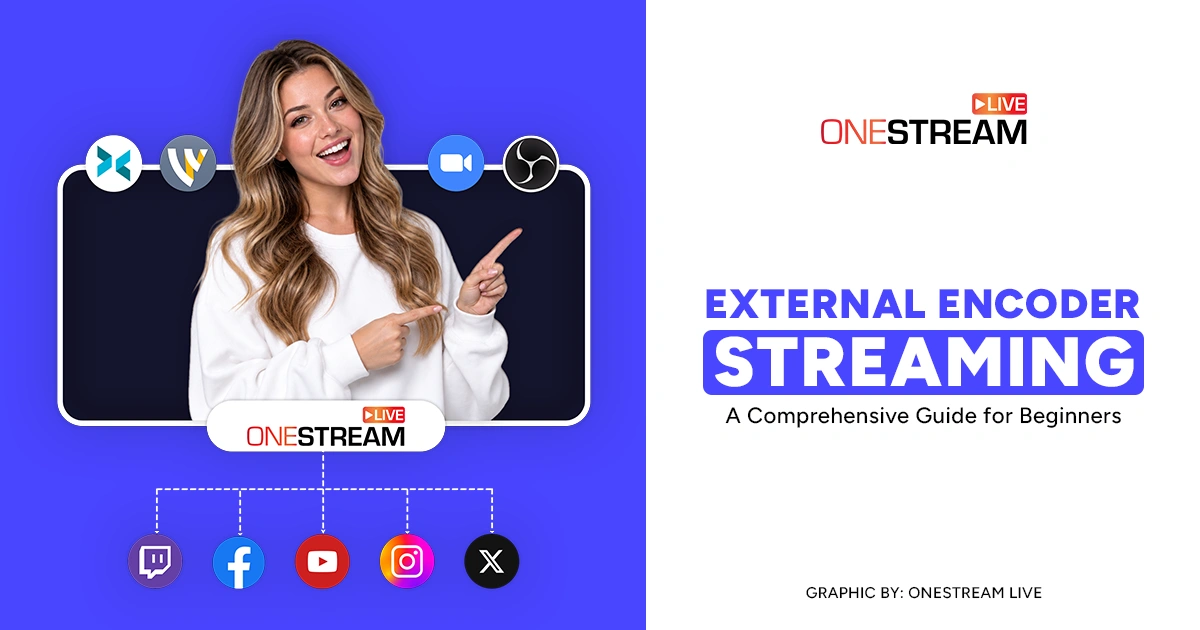
External encoder streaming means using an encoder for streaming, such as OBS or vMix, to compress your camera and mic feed and send it to OneStream Live over a protocol like RTMP. OneStream Live then sends that one feed to all your destinations at once, so you produce in the tool you know and still reach everywhere.
RTMP means Real-Time Messaging Protocol. It is a way to show live video on the internet, and it is commonly used for live streams, live TV and calls.
Large, high-quality videos are very big files. Sending them over the internet would take a long time without RTMP. With RTMP, the video is split into small parts that are faster to send. Those parts then come together to show the whole video on the viewer’s screen.
RTMP was first made by Macromedia for their Flash Player. Adobe later bought Macromedia, and it became Adobe Flash Player. These days RTMP is used to send encoded video to social media, live streaming websites and media servers.
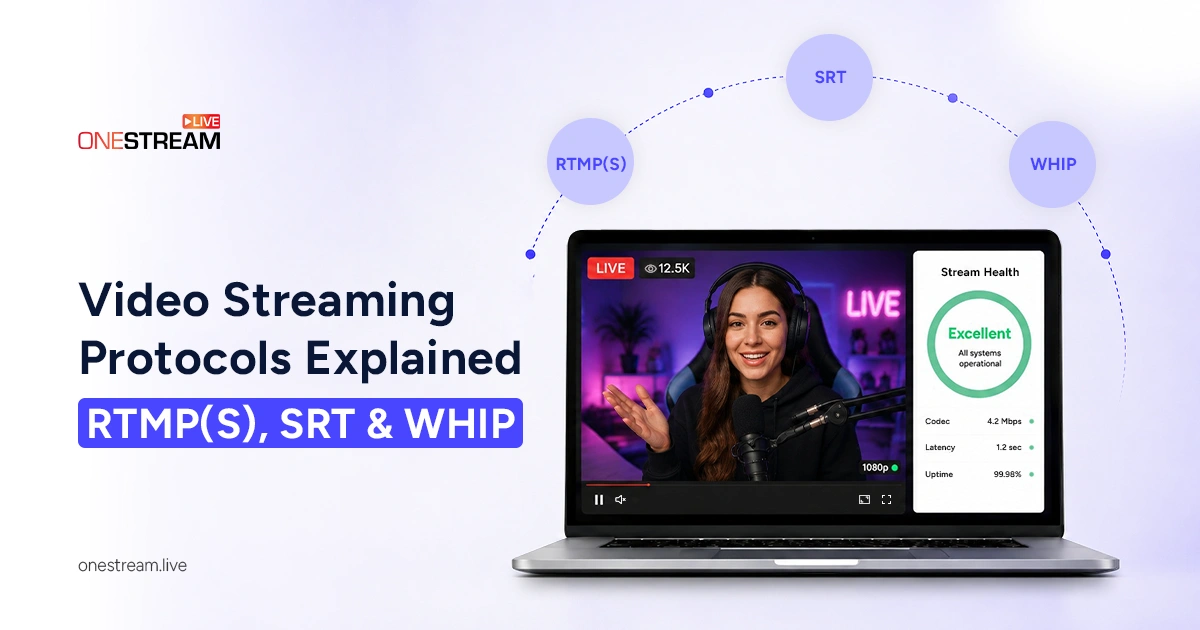
RTMP is no longer the only route in. OneStream Live also accepts RTMPS, SRT and WHIP, so you can pick the protocol that suits your setup.
Read More: Guide to RTMP Settings | OneStream Live
How Does External Encoder Streaming Work?
An encoder stream works by breaking large data files, such as video, into small pieces. These pieces, called packets, are sent individually from your encoder. They are then reassembled for the person watching. This is what keeps the delay short, which is known as low latency.
How much your encoder compresses is set by the bitrate. The best bitrate for streaming to OneStream Live is 3000 kbps at 720p and 30 FPS, and you can find the rest in our recommended encoder settings.
Here is the path a stream takes.
1
Your camera and microphone record your video and sound.
2
Your encoder takes that video and sound and turns it into packets so they can travel quickly to a server.
3
The server receives the packets and prepares them for delivery.
4
Viewers watch on their phones, computers or TVs.
You need two things to connect any encoder to OneStream Live.
Server URL. This is the address your encoder sends to. For example, Vimeo’s server URL looks like rtmp://rtmp-global.cloud.vimeo.com/live. The server URL usually stays the same.
Stream key. This is your passcode, a long string of characters such as 95hfc34a-dd5b-4d61-bece-70gkew3m4aq. It identifies your stream, and this is the part that changes.
Streaming Protocols Supported
Four protocols work with OneStream Live, and the choice comes down to what your setup needs.
- RTMP is classic and widely supported. If you are unsure which to use, start here.
- RTMPS is RTMP with encryption, for when the feed needs to stay secure in transit.
- SRT handles unreliable networks. It recovers lost packets, so it holds up on connections that would break an RTMP stream.
- WHIP is the low-latency option. It is built on WebRTC and can deliver in under a second.
The protocol is set per stream key, so different keys can use different protocols. For the full RTMP vs SRT vs WHIP comparison, see our guide to streaming protocols.
How Stream Keys Work in OneStream Live
OneStream Live gives you a Default Key to start with. You can also create additional keys and name them yourself, with the number depending on your plan.
Naming them after the setup they belong to saves guessing later. Something like Studio Rig or Event Camera is easier to pick out of a list than a string of characters.
Stream Keys sits under Management in the left sidebar, and each key shows its protocol as a badge beside the name.
How to Start External Encoder Streaming on OneStream Live
You need two things to connect any encoder to OneStream Live.
Server URL. This is the address your encoder sends to. It usually stays the same.
Stream key. This is your passcode, a long string of characters that identifies your stream. Keep it private, since anyone with it can stream to your account.
Follow these steps to go live.
1
Sign in to OneStream Live, then click Encoder Stream on your dashboard.
2
Click Set Destinations and choose where your stream should go.
3
Copy the Server URL and Primary Key. The Default Key is selected to start with, and you can switch keys from the Stream Keys tab on the right.
4
In your encoder, choose a custom server and paste both values. In OBS, that’s Settings > Stream > Service: Custom. Then click Start Streaming in the encoder.
5
Check the Signals panel. Primary Stream changes from Offline once your feed arrives.
6
Click Go Live Now or Schedule Broadcast to go live later.
Check Your Signal Before You Go Live
Two things here are worth more than any protocol choice.
Encoder Incoming Signals tells you whether your encoder is actually reaching OneStream Live. The panel reads Offline until your feed arrives, so you can confirm the connection before you click Start Broadcast rather than finding out in front of an audience.
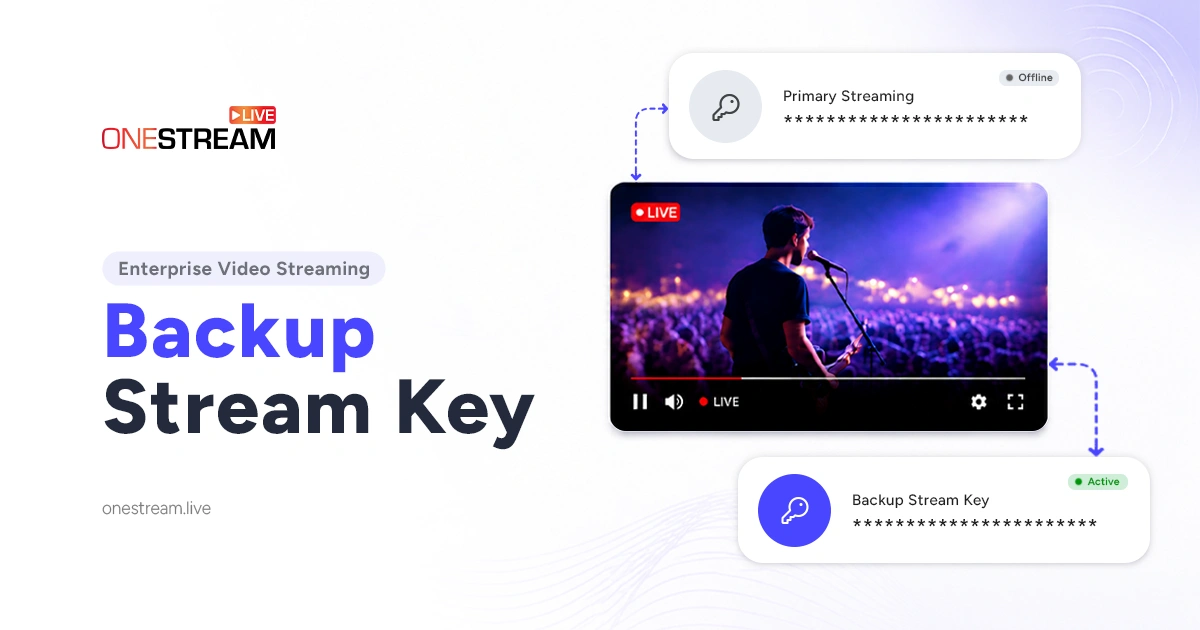
Backup Stream Key adds redundancy. Click Add Backup Stream and you get a second server URL and key running beside your primary. Your encoder pushes the same broadcast down both paths, only the primary reaches your audience, and the backup takes over if the primary fails.
The stream preview lets you switch between the primary and backup feeds, so you can check both are healthy before anything goes out.
Which Encoders Work With OneStream Live?
OneStream Live works with almost any streaming software you can think of. Here are the main ones.
OBS
OBS stands for Open Broadcaster Software. OBS RTMP streaming is a free and open-source software application that allows users to record and/or live stream video content from a variety of sources, including a webcam, a computer screen, or a game. OBS is a popular choice for gamers, streamers, and content creators of all kinds.
vMix
vMix is a live production tool for Windows that handles multiple cameras, graphics and switching in one place. It suits multi-camera setups and events that need proper production control.
Wirecast
Wirecast is a live video production software that allows you to create and stream professional-looking live videos from your computer. With Wirecast, you can add multiple cameras, switch between them, add graphics, text, and music, and even record your live stream for later viewing.
Wirecast is a great option for anyone who wants to create high-quality live videos without having to learn complex video editing software. It’s easy to use and has a wide range of features that can help you create professional-looking live videos.
XSplit
XSplit is a live streaming and recording software that allows you to broadcast your gameplay, presentations, or other live content to a variety of platforms, including Twitch and YouTube. It also allows you to add overlays, graphics, and other effects to your live stream.
XSplit is a popular choice for gamers and other content creators who want to broadcast their live content to a wide audience. It is easy to use and offers a wide range of features, making it a great option for anyone who wants to start streaming or recording live content.
Ecamm Live
Ecamm Live is a live streaming software for Mac that makes it easy to create professional-looking live streams. Its features include support for multiple cameras, HDMI capture devices, and Mac screen sharing. You can also use a live camera switcher to control your broadcast in real time.
Streamlabs
Streamlabs offers one of the simplest methods to broadcast live on social media. It was designed with the goal of making live content creation accessible to everyone. It includes features like broadcasting to multiple platforms and tools for engaging with the audience.
Zoom
Zoom is a video conferencing platform that allows you to connect with other people online. You can use Zoom to have video calls, meetings, and webinars. Zoom is a popular tool for businesses, schools, and individuals. It is easy to use and has a lot of features.
Webex
WebEx is a cloud-based collaboration platform that helps people connect and share information from anywhere. It offers a variety of features, including video conferencing, file sharing, and whiteboarding. WebEx is used by businesses of all sizes to improve communication and productivity.
OneStream Live works with any live streaming tool that lets you enter a server URL and a stream key. There are effectively no restrictions on which encoder you use.
Final Word
External encoder streaming gives you the production control that browser tools cannot. You build the broadcast exactly as you want it, then hand one feed to OneStream Live and let it reach everywhere at once.
The setup is two fields and a protocol. After that, the Signals panel tells you the connection is working and a backup key covers you if it stops.
Ready to connect yours? Create a stream key, paste it into your encoder, and go live.
Frequently Asked Questions
What is external encoder streaming?
Encoder streaming means sending a live feed from third-party software into OneStream Live, which then restreams it to Facebook, YouTube, LinkedIn and 45+ other destinations at once.
Which protocol should I use?
RTMP for general use, RTMPS when the feed needs encrypting, SRT on an unreliable connection, and WHIP when you need latency under a second.
Can I use more than one stream key?
Yes. You get a Default Key and can create additional named keys. How many depends on your plan.
Can I schedule an encoder stream?
Yes. Use Schedule Broadcast rather than Start Broadcast to set it for a later time.
What is the best encoder for live streaming?
There is no single answer. OBS is the usual starting point because it is free and capable. vMix and Wirecast suit multi-camera production, Ecamm Live suits Mac users, and Zoom or Webex make sense when your content is already a meeting.
OneStream Live is a cloud-based live streaming solution to create, schedule, and multistream professional-looking live streams across 45+ social media platforms and the web simultaneously. For content-related queries and feedback, write to us at [email protected]. If you have a story to share about your live streaming experience with OneStream Live, we would be glad to feature it. You’re also welcome to Write for Us!