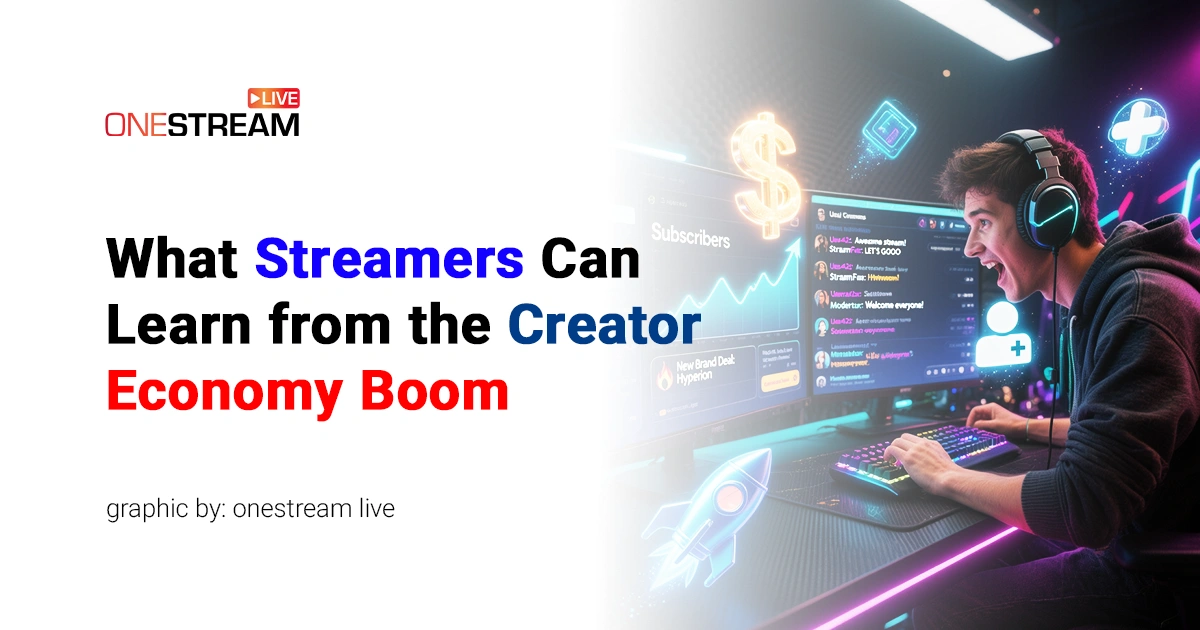
The term “creator economy” has been chewed up, spit out, and rebranded so many times that it has lost almost all its flavor. If you read the glossy headlines, you’d think we were all living in a utopian digital renaissance where anyone with a ring light and a WiFi connection is minting million-dollar checks.
The reality is colder, harder, and significantly more interesting.
The “boom” isn’t about more people becoming creators; it’s about the professionalization of the ones who remain. The data is screaming a specific story, one that most generic business blogs are missing because they are too busy rewriting press releases.
If you look closely at the creator economy market size projections for 2025, you stop seeing a “boom” and start seeing a “filtration system.” The media companies and the streamers who treat this like a P&L statement are the only ones who will survive in 2025.
- Use prerecorded streaming to broadcast 24/7 without personal burnout.
- Master the digital creator vs. video creator distinction to command higher rates.
- Multistreaming to 45+ platforms is the only safety net against algorithm changes.
- Reliability, not just virality, secures high-value Content Creator Brand Deals.
- Hosted live pages give you total ownership of your audience and income.
- The right Creator Economy Tools automate the grind so you can focus on growth.
What is the Creator Economy? (The Streamer’s Definition)
If you type “what is the creator economy” into a search bar, you will get a sanitized definition about “monetizing passion.” That’s not it at all. For a streamer in 2025, the creator economy definition is this:
The shift from renting an audience to owning a distribution network.
When you stream on Twitch, you are a tenant. You pay rent in the form of revenue splits and algorithmic compliance. If the landlord (the platform) decides to change the locks (ban you or bury your content), you are homeless. The successful modern creator uses these platforms as lead generation, not the final destination.
Digital Creator vs Video Creator
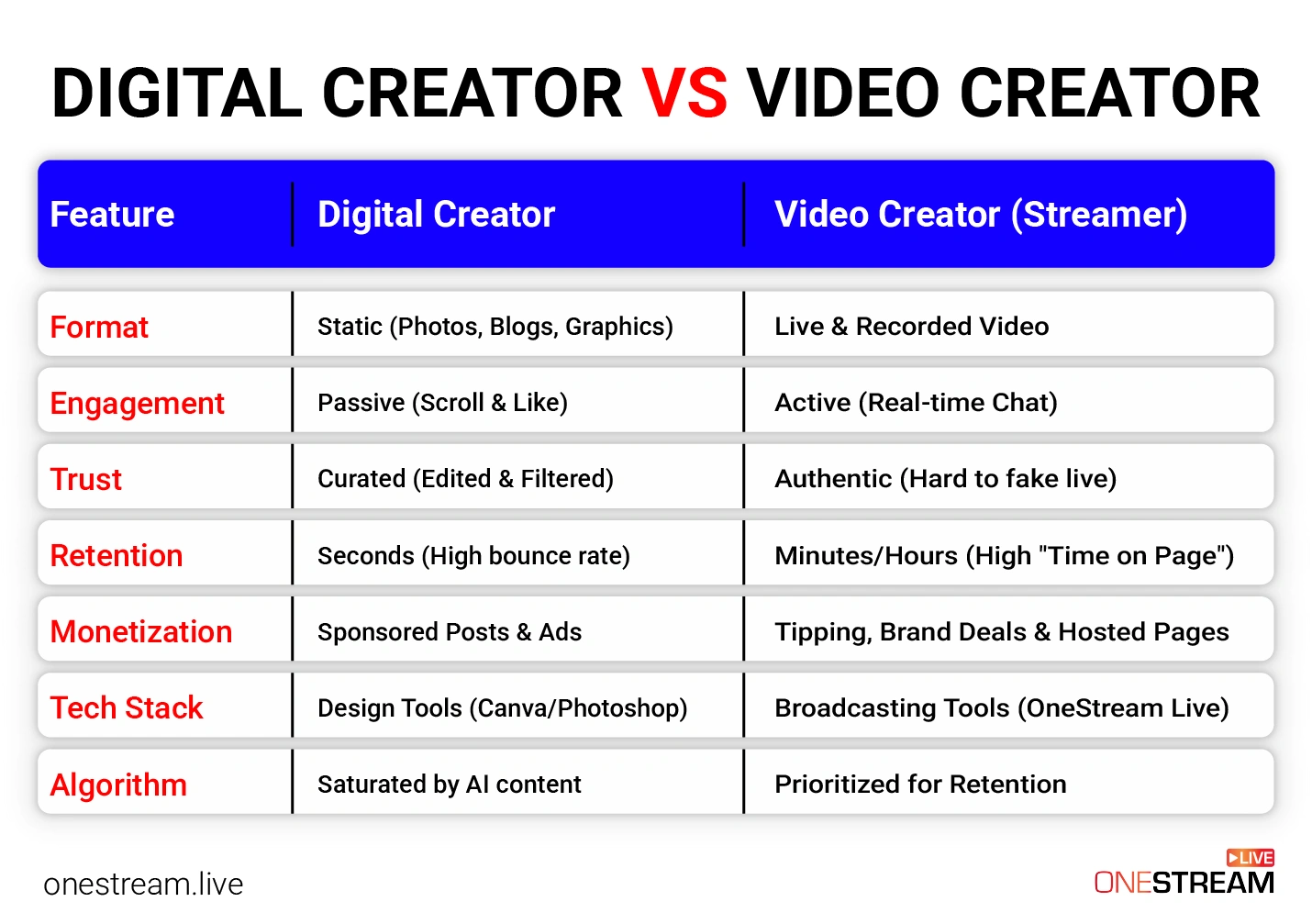
This is where the nomenclature matters. You’ll see the terms tossed around, but there is a distinct difference between a digital creator and a video creator.
- A Digital Creator might make static assets, templates, or tweets.
- A Video Creator commands attention in real-time.
Streamers are the heavyweights of the video creator class. You aren’t just making content; you are hosting an event. The “Boom” favors the video creator because the video creates higher trust. It is harder to fake a personality live for three hours than it is to curate a refined persona in a captioned photo.
The Rise of "Creator Economy Live"
While the broader economy slows down, the live sector is accelerating. Why? Because it’s the only thing AI can’t easily replicate yet.
You can generate a blog post or a static image with a prompt. You cannot generate the chaotic, human energy of a live stream with the chat interaction, the real-time mistakes, and the shared moment.
However, “going live” is exhausting. This is the streamer’s paradox: to grow, you need to be online constantly; to stay sane, you need to sleep.
1. Solving the Time Crisis
This is where the strategy shifts from “hustle” to “systems.” You cannot physically be live 24/7, but your channel can.
This is why tools like OneStream Live have become essential infrastructure. They offer a feature called Pre-recorded Streaming, which effectively clones you. You can take your best content, like a perfect speedrun, a deep-dive tutorial, or a podcast episode, and broadcast it as if it were live.
Moreover, by using playlist streaming, you can queue up content to capture audiences in time zones where you are usually asleep. You wake up to a chat room that has been active all night.
2. The Vertical Pivot
Another massive shift in the Creator Economy Live sector is the screen orientation. We used to live in a 16:9 world. Now, thanks to TikTok and Reels, we live in a 9:16 world.
If you are ignoring vertical streaming, you are ignoring the mobile audience, which is arguably the majority. But buying a second camera and managing a vertical layout is a headache.
The smart workaround is using software that handles the geometry for you. OneStream Live Studio allows you to switch to Portrait Streaming with a single click. This lets you tap into the “scroll” culture of Instagram and TikTok without redesigning your entire physical studio.
Read More on How to Live Stream in Portrait Mode with OneStream Live
The Business of Creator Economy
Let’s talk about the money. The “Boom” brought a lot of cash into the ecosystem, but it also brought complexity.
If you are still relying 100% on ad revenue or subscriptions from one platform, you are arguably not a business owner, you are then a gig worker. The serious players in the Creator Economy are diversified. They have merch. They have coaching programs. They have brand deals.
1. Content Creator Brand Deals
More content creators are moving toward brand deals, as they realize platforms pay peanuts. The real money is in B2B relationships.
But brands are picky. They don’t just want “exposure” anymore. They want professional reliability. They want to know you won’t flake on the stream, that the quality will be HD, and that you can handle the technical load. Using a professional tool stack signals to brands that you are a safe investment.
Furthermore, as you start making real money, the complexity of managing it grows. You aren’t just collecting tips in a jar anymore. You are dealing with cross-border payments, varying tax laws, and an asset portfolio that needs protection.
You need to be smart about your assets, whether that means diversifying revenue streams, managing sponsorship contracts, or even keeping an eye on available cryptocurrencies to hedge against market fluctuations. The modern streamer is half-entertainer, half-CFO.
2. Owning the Destination
The ultimate flex in the creator economy is getting people off the rental platforms and onto property you own. This is where Hosted Live Pages come into play.
Most streamers don’t have the time or skill to code a custom website. But if you don’t have a website, you don’t have a home base. A hosted live page is a personalized web page that OneStream Live hosts for you.
Why does this matter for monetization?
The Call-to-Action (CTA). On YouTube, the “Subscribe” button is red because YouTube wants people to subscribe to YouTube. On your own Hosted Live Page, you control the buttons.
You can add a Clickable Call-to-Action Button right under the player that leads to your merch store, your consultation booking page, or your newsletter signup. You strip away the distractions and focus the viewer on your business goals, not the platform’s retention goals.
What Creator Economy Tools Are Required?
In the gold rush, the shovel-sellers win. But you don’t need to sell shovels; you just need to stop digging with your hands.
Your choice of creator economy tools is the single biggest predictor of your longevity. If your workflow is “turn on webcam, talk, turn off webcam,” you will burn out. You need automation.
1. The Multistreaming Imperative
We mentioned the “Platform Problem” earlier. The solution is Multistreaming. Historically, streaming to Twitch and YouTube at the same time required a massive PC to handle the encoding load of two streams. It would melt a standard laptop.
Cloud-based solutions changed the physics of this. You send one stream to the cloud, and the cloud splits it and sends it to 45+ social media platforms. You double or triple your reach without touching your CPU usage.
But the fear with multistreaming is always community fragmentation. “If I stream to both, who do I talk to?” This is solved by Unified Chat. It aggregates the messages from Twitch, YouTube, Facebook, and others into a single window. You don’t need five monitors. You see everything in one place, and your community feels heard regardless of where they are watching.
2. The RTMP Factor
As you graduate from “amateur” to “pro,” you will eventually outgrow basic webcams. You’ll want DSLRs, capture cards, and maybe a sophisticated OBS setup with fourteen scenes.
This is where External RTMP Streaming becomes critical. You need a bridge between your high-end hardware and the streaming destinations.
A robust RTMP integration allows you to use tools like Zoom, OBS, or Wirecast and pipe that feed directly into your multistreaming engine. It separates the production (your PC) from the distribution (the cloud).
Conclusion: The Economy Doesn't Wait
The Creator Economy isn’t a charity. It doesn’t care if you “really want it.” It rewards leverage.
The boom has provided the infrastructure. The audience is in the billions, scrolling, waiting for something real. The advertisers are desperate for authentic voices to pitch their products. The tools are waiting to automate the boring stuff so you can focus on the creative stuff.
The only variable left is you.
Are you going to keep acting like a user, feeding the algorithm for free? Or are you going to start acting like an owner?
The streamers who win in the next five years won’t necessarily be the most talented or the most attractive. They will be the ones who built the best systems. They will be the ones who used Pre-recorded Streaming to be in two places at once. They will be the ones who used Hosted Live Pages to build an email list. They will be the ones who treated their stream not as a show, but as an asset.
The tools are ready. The economy is waiting. Stop digging with your hands!
Frequently Asked Questions
It is the digital ecosystem where independent content creators, influencers, and streamers monetize their audiences directly, rather than relying solely on traditional media gatekeepers. For streamers, it means shifting from a hobbyist mindset to running a small media business.
The creator economy is valued at around $200 billion in 2025 and is projected to reach nearly $500 billion by 2027. This rapid growth is driven mainly by live video and direct-to-fan monetization models, which enable creators to engage fans and generate revenue more effectively.
While both create content, a Digital Creator often focuses on static assets like photos, blogs, or graphics. A Video Creator (or streamer) commands attention in real-time, leveraging live interaction and video feeds to build deeper, more active community engagement.
Current data suggests there are over 207 million content creators worldwide. However, the number of professional creators—those earning a full-time living—is much smaller, highlighting the need for professional tools and business strategies to stand out.
Anyone who produces entertaining or educational material for digital platforms is a creator. However, in the professional sense, it refers to individuals who have built a sustainable business around their personal brand, utilizing video, writing, or audio to generate revenue.
OneStream Live is a cloud-based live streaming solution to create, schedule, and multistream professional-looking live streams across 45+ social media platforms and the web simultaneously. For content-related queries and feedback, write to us at [email protected]. You’re also welcome to Write for Us!