
Woke up to a yellow dollar sign next to your latest upload? You are not alone, and you are not stuck. YouTube demonetization can cut the ad income on a single video or switch it off across your whole channel, often with no warning.
And 2026 moved the goalposts more than once. YouTube rewrote what counts as "inauthentic" content, loosened several ad rules, and announced new Partner Program terms that kick in on February 1, 2027.
This guide breaks down the 12 mistakes that trigger demonetization right now, what changed this year, and the exact steps to protect your channel and your income. No rumors, no viral word lists. Just the rules as YouTube writes them.
Key Takeaways:
- YouTube demonetization means a video or channel earns limited or no ad revenue because it breaks YouTube's monetization policies or advertiser friendly guidelines.
- Since July 2026, YouTube's inauthentic content guidance names three channel level risks: generic or repetitive videos, shock driven formats, and AI personas giving expert advice on sensitive topics.
- Using AI does not cost you monetization on its own; templated, mass produced AI videos with no original insight do.
- From February 1, 2027, new YouTube Partner Program applicants need 1,000 subscribers plus 8,000 watch hours or 20M Shorts views, and current partners must accept the updated terms by January 31, 2027.
- You can challenge a limited or no ads decision from the Impact summary card in YouTube Studio, which requests a human review.
What Does Demonetized Mean on YouTube?
Being demonetized on YouTube means a video, or your whole channel, can no longer earn full ad revenue. A single video gets limited ads or no ads when it breaks the advertiser friendly guidelines. A whole channel loses monetization when it breaks the channel monetization policies, which cuts both ads and fan funding features.
You see video level decisions in the Notices column on the Content page in YouTube Studio, next to each upload.
Why does this happen? Advertisers pay the bills, and they don't want their brands next to risky content. Automated systems check every upload, and since March 2025 some videos also get a human review that can take up to 24 hours. Machines still make mistakes, so knowing the triggers matters.
| Status | What it means | What you can still earn | Your first move |
|---|---|---|---|
| Limited ad earnings | Only some advertisers run ads on the video | Lower ad revenue plus fan funding | Check the Impact summary card, then edit or appeal |
| No ad earnings | The video can't run any ads | Other revenue streams may still work | Fix the issue or appeal for a human review |
| Channel demonetized | The channel loses YouTube Partner Program access | No ads or YPP features on any video | Fix channel wide problems, then reapply when Studio allows |
YouTube Monetization Rules in 2026: What Changed?
YouTube changed its monetization rules almost every month in 2026. Most updates loosened ad rules for content with clear context, while the new inauthentic content guidance and the 2027 Partner Program terms raised the bar for whole channels.
| Date | What changed | What it means for you |
|---|---|---|
| July 2025 | Stronger profanity in the first 7 seconds can now earn ad revenue | An early swear no longer kills ads automatically |
| January 2026 | Non graphic, dramatized content on controversial issues can earn ads | Scripted stories on tough topics can monetize, except a focus on child abuse or eating disorders |
| February 2026 | Content showing 30 round magazines can earn ads | Firearms reviewers get a little more room |
| March 2026 | Young subjects, human or animal, shown in distress with gore or shock earn no ads | Keep shock imagery of kids and baby animals out of videos and thumbnails |
| July 2026 | Inauthentic content guidance names three types of channels that can't monetize | Templated, shock bait and fake AI expert channels risk losing YPP |
| August 2026 | YouTube clarified how depictions of death in educational, documentary and news content monetize | Add clear context to news and documentary uploads |
| September 2026 | Graphic gaming content in seconds 8 to 15 can earn ads, and gaming or scripted content with recreational drugs can earn ads | Start gaming videos clean for the first 7 seconds |
| September 2026 | Sponsorship rules became the Branded Content Policies, with automatic labels for undeclared deals | Tick the paid promotion box on every brand deal |
| October 2026 | Public interest content, like congressional proceedings, can earn ads | Political news coverage gets more room |
| February 1, 2027 | New YPP entry thresholds, a rolling Shorts bar, and new activity rules | Accept the new terms in Studio by January 31, 2027 |
YouTube logs every advertiser rule change on its ad guideline updates page, so bookmark it and check it once a month.
YouTube Partner Program Requirements in 2026 and 2027
Today, you need 1,000 subscribers plus 4,000 public watch hours in the last 12 months, or 10M Shorts views in the last 90 days, to earn ad revenue through the YouTube Partner Program (YPP). Starting February 1, 2027, new applicants need 8,000 watch hours in the last 365 days or 20M Shorts views in 90 days, still with 1,000 subscribers. Channels already in YPP keep their status.
Fan funding and YouTube Shopping stay at 500 subscribers plus 3,000 watch hours or 3M Shorts views. From February 2027, earning from the Shorts Creator Pool each month also needs 10M qualified Shorts views over the last 90 days. Miss it, and only your Shorts pool earnings pause, according to YouTube's Partner Program update. For the full setup, follow our guide on how to monetize your YouTube channel.
12 Mistakes That Trigger YouTube Demonetization
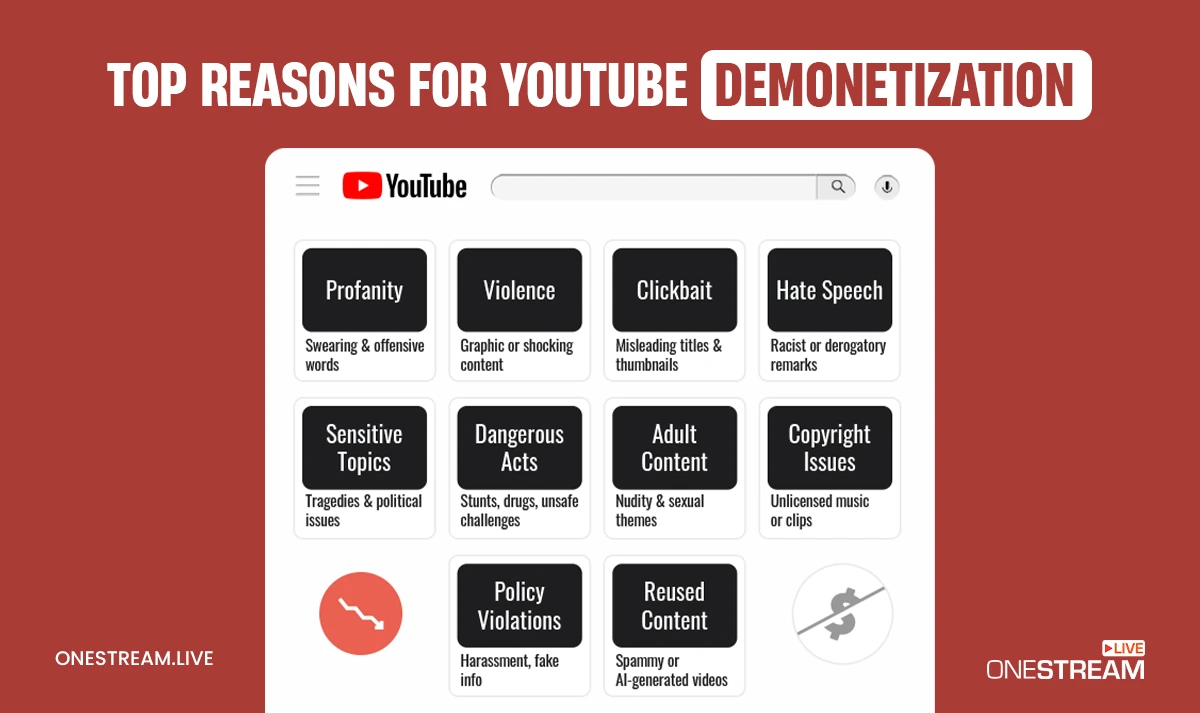
Most YouTube demonetization comes from a short list of repeat mistakes. Some hit one video. Others, like inauthentic or reused content, hit your entire channel, because reviewers judge your main theme, most viewed videos, newest uploads and your titles, thumbnails and descriptions.
1. Uploading Templated, Mass Produced Videos
This is the biggest risk of 2026. YouTube's generic or repetitive content rule blocks channels where videos feel interchangeable, such as image slideshows, scrolling text with no narration, or the same storyline template with the same outcome every time.
YouTube names AI content made with generic templates directly. A repeated intro and outro is fine; the bulk of each video must be different and add real value. Because the rule covers your whole channel, a batch of low effort uploads can cost you everything. Read the full YouTube inauthentic content policy before you scale any format.
2. Reusing Clips Without Adding Your Own Voice
YouTube's reused content policy did not change in 2026, and it still catches plenty of creators. Compilations of other people's clips, TikTok reuploads, songs with only the pitch or speed changed, and videos built on silent reactions can't monetize.
Reactions, reviews and commentary are fine when viewers can see a meaningful difference: your voice, your storyline, or substantive editing. Getting permission from the original creator won't protect you, because this policy is separate from copyright.
3. Chasing Shock Value With Manipulative Formats
The new unsatisfying or off putting content category targets videos built to shock rather than satisfy. Think repeated scenes of animals in exaggerated danger, random AI clips stitched together to surprise viewers, or realistic fake news about a celebrity death or a natural disaster.
Trends are still welcome. Add your own spin and a real story arc, and you stay on the right side of the line.
4. Letting an AI Persona Give Expert Advice
Channels that use AI personas to deliver advice on health, legal issues, money or politics can't monetize under the 2026 guidance. An AI "doctor" giving diagnoses or an AI podcast host sharing investment tips is out.
If your niche is finance, law or wellness, show up as yourself, cite real sources and share your actual credentials.
5. Skipping the Altered or Synthetic Content Label
YouTube requires you to disclose realistic content that is meaningfully altered or synthetically generated, like a real person appearing to say something they never said. You turn on the altered content setting in YouTube Studio during upload.
Disclosure won't limit your reach or your ability to earn. Skipping it is the real risk, since creators who repeatedly fail to disclose can face content removal or suspension from YPP. Script help, captions and minor edits don't need a label.
6. Swearing in Titles, Thumbnails, or Nonstop
YouTube relaxed its profanity rules in July 2025. Stronger profanity in the first seven seconds can now earn ad revenue, and moderate swear words inside a video have qualified for full ads since 2023.
Two things still hurt you: profanity in your title or thumbnail, and extreme profanity, hateful language or slurs, which earn no ads at all. YouTube shares examples in its guidelines but no complete banned words list, so skip the viral "demonetization words" lists and clean up your metadata instead.
7. Showing Graphic Violence Too Early
Gore and graphic violence are classic ad killers, and timing matters more than ever. Since September 2026, graphic gaming content that appears in seconds 8 to 15 can earn ad revenue, but graphic gaming footage in the first seven seconds still can't.
Real world gore and accident footage stay risky. News and documentary uploads get more room with clear context, as YouTube clarified in August 2026.
8. Posting Sexual or Suggestive Content
Sexually explicit content earns nothing and may be removed. Suggestive thumbnails, nudity and sexual audio can limit ads too, even on an otherwise clean video.
YouTube did ease a few areas. Since November 2023, breastfeeding content and non sexual dance like twerking can earn ads. On the other side, videos that teach people how to create synthetic sexually explicit images have earned no ads since December 2024.
9. Crossing Community Guidelines Lines
Hate speech, harassment, dangerous challenges, and false claims that undermine elections don't just lose ads. They can get your video removed and add a strike to your channel.
Context still counts in your favor. In October 2026, YouTube clarified that public interest content like congressional proceedings can earn ad revenue. In September 2026, it allowed ads on gaming and scripted content that features recreational drugs, plus educational content about drug trafficking groups that doesn't glorify them.
10. Playing Copyrighted Music in Videos and Live Streams
Copyrighted music is the most common everyday trigger. Content ID scans uploads and live streams, and a match can send your revenue to the rights holder, mute your audio, or block the video.
Turning off ads won't save you, because claims apply whether you monetize or not. Use the YouTube Audio Library, licensed tracks or your own music, and check the background audio in every live stream too.
11. Using Clickbait Titles and Thumbnails
YouTube reviewers check your video metadata, including titles, thumbnails and descriptions, when they assess your channel. Misleading titles, thumbnails that don't match the video, and keyword stuffed descriptions can limit ads on an otherwise clean upload.
Match every thumbnail to the video, and keep graphic or sexual imagery out of it, even as a joke.
12. Missing the January 2027 Terms Deadline
This mistake has nothing to do with content. YouTube's Partner Program terms change on February 1, 2027, and you must accept the updated modules in YouTube Studio by January 31, 2027. Miss it, and you stop earning from those features until you accept. You stay in YPP, but your income pauses.
From the same date, YouTube treats your channel as active only if you reach 1,000 watch hours in 365 days, 1M Shorts views in 90 days, or upload 2 long videos or 5 Shorts every 90 days. Find the terms notice on your Studio dashboard or in the Earn tab and accept every module.
How to Avoid YouTube Demonetization in 2026
Avoiding YouTube demonetization comes down to three habits: plan clean content, prove it is yours, and check your notices after every upload. Run through these steps for each video and live stream.
1
Review the rules every quarter. Bookmark the advertiser friendly guidelines and channel monetization policies, since YouTube updated its ad guidelines seven times in 2026 alone.
2
Script sensitive segments. Use a teleprompter for live streams so you say exactly what you planned when you cover a tough topic.
3
Record and review your streams. OneStream Live's Live Studio records your session as you stream, so you can trim slips, music and graphic moments before you publish the replay.
4
Test risky content first. With scheduled recorded streams, you edit and check a video before it airs as a live broadcast.
5
Disclose at upload. Tick the altered content setting for realistic AI and the paid promotion box for every sponsorship or free product.
6
Rate your content honestly. Answer the self certification questions in YouTube Studio truthfully, including mild profanity or violence.
7
Check the Notices column. Look at every video within 24 hours of upload, since some monetization checks include a human review.
What to Do If You Already Got Demonetized
Don't panic or delete the video. Most video level decisions can be fixed or appealed straight from YouTube Studio.
1
Find the notice. Open YouTube Studio, go to Content, and look at the Notices column.
2
Read the Impact summary card. It explains why the video lost ads and what you can do about it.
3
Fix what you can. Edit the title, swap the thumbnail, or trim the problem section.
4
Appeal for a human review. Select the Appeal button if you believe the video meets the guidelines.
5
Clean up channel wide issues. If your whole channel lost YPP, remove or rework templated and reused uploads, then reapply when YouTube Studio shows you are eligible.
How to Protect Your Income Beyond YouTube Ads
The safest way to beat demonetization is to make sure one yellow icon never wipes out your whole income. Spread your earnings across fan funding, brands, live selling and more than one platform.
Ways to earn that don't depend on YouTube ads
- Fan funding: Channel memberships, Super Chat and Super Stickers open at 500 subscribers, and that threshold doesn't change in 2027.
- Branded content: Sponsorships pay well, but always tick the paid promotion box, because YouTube can now label undisclosed brand deals automatically.
- Live selling: With Live Sales, you show shoppable product cards and QR codes on screen while you stream.
- Multistreaming: Go live on 45+ platforms at once, so your audience and income never depend on one channel.
- Your own branded page: Custom Websites let you host live streams on a branded page with password protection and your own domain.
Keep Your Channel Monetized in 2026 and Beyond
Avoiding YouTube demonetization in 2026 is less about fear and more about habits. Make every video materially different and clearly yours. Keep titles, thumbnails and the first seven seconds clean. Disclose realistic AI and every brand deal.
Then mark January 31, 2027 on your calendar and accept the new Partner Program terms. Finally, build income that doesn't hinge on one platform's ad decision. Stream everywhere your audience watches, sell live, and own a branded home for your streams.
Ready to grow beyond a single channel? Set up your first multistream in minutes.
Frequently Asked Questions
What words get you demonetized on YouTube?
Extreme profanity, hateful language and slurs earn no ads, and profanity in titles or thumbnails can limit ads. Moderate swear words inside the video are usually fine, and since July 2025 stronger profanity in the first seven seconds can earn ad revenue. YouTube shares examples in its guidelines, not a complete banned words list.
What happens when you get demonetized on YouTube?
YouTube demonetization on a single video means limited or no ad earnings for that upload. If your whole channel is demonetized, you lose ad revenue and YPP features like memberships and Super Chat. You can still upload, appeal decisions, fix channel issues and reapply once YouTube Studio shows you are eligible.
Does YouTube demonetize AI generated videos?
Not by default. YouTube allows AI tools that support your creative vision, like editing scripts or visualizing original characters. What loses monetization is AI content built on generic templates, mass produced uploads, shock clips stitched together, and AI personas giving health, legal or financial advice. Realistic synthetic content also needs a disclosure label.
Can you use copyrighted music on YouTube without monetization?
Not safely. Content ID detects copyrighted music whether or not you monetize, and the rights holder can claim your revenue, mute the audio, or block the video. Turning off ads doesn't protect you. Use the YouTube Audio Library, licensed tracks or your own music, and check background audio during live streams too.
Is YouTube changing its monetization policy in 2027?
Yes. Starting February 1, 2027, new creators need 1,000 subscribers plus 8,000 watch hours in 365 days or 20M Shorts views in 90 days to join YPP for ads. Existing partners keep their status, but they must accept the updated terms in YouTube Studio by January 31, 2027 to keep earning.
OneStream Live is a cloud-based live streaming solution to create, schedule, and multistream professional-looking live streams across 45+ social media platforms and the web simultaneously. For content-related queries and feedback, write to us at [email protected]. You’re also welcome to Write for Us!