
Few things terrify online creators more than the specter of YouTube demonetization. One day you’re earning revenue from your videos; the next, a dreaded yellow dollar icon appears and your income evaporates.
For creators relying on YouTube monetization as income, these rules can feel like a moving target. But understanding what causes demonetized videos—and how to avoid them—is the first step to protecting your revenue and building a sustainable channel.
In this comprehensive guide, we’ll explore what causes demonetization on YouTube, how to stay on the right side of YouTube’s rules, and practical tips to protect your channel’s monetization. As a content creator (especially if you stream with OneStream Live to YouTube), these insights will help you understand YouTube’s policies with confidence.
Why does YouTube demonetize videos? Avoid reused content, profanity, and AI-generated clips that trigger demonetization.
How to not get demonetized on YouTube? Follow 2025 YouTube demonetization rules and stay advertiser-friendly.
What happens when you get demonetized on YouTube? Losing ad revenue and features isn’t permanent—fix issues fast and reapply.
Can you use copyrighted music on YouTube without monetization? No, Content ID will block or claim your video.
What are YouTube monetization requirements 2025? Hit 1,000 subscribers and 4,000 watch hours to stay eligible.
What is YouTube Demonetization and Why Does It Happen?
YouTube demonetization occurs when YouTube restricts or removes your ability to earn ad revenue on a video or even an entire channel. In simple terms, a demonetized video won’t show paid ads, meaning the creator earns nothing from it.
But why does YouTube demonetize videos at all?
The short answer is advertisers.
YouTube’s most valued audience is the advertisers footing the bills, and they don’t want their brands displayed alongside inappropriate or controversial content. Thus, if your video contains material that advertisers consider undesirable, YouTube may limit or shut off ads to keep those advertisers happy.
Why does YouTube demonetize videos that don’t obviously break rules?
While blatant violations (like graphic violence or hate speech) are clear causes, sometimes creators find demonetized videos without a clear reason. Remember that YouTube uses automated algorithms (and limited human reviewers) to scan content.
These systems can occasionally flag content erroneously or err on the side of caution. In short, YouTube’s bots aren’t perfect, so demonetization can happen by mistake, which is why understanding and proactively avoiding triggers is so important.
How Does YouTube Monetization Work (and What Are the 2025 Requirements)?
Before diving into demonetization triggers, it helps to know how YouTube monetization works in the first place.
YouTube runs a program called the YouTube Partner Program (YPP). Creators in the YPP earn a share of the ad revenue that plays on their videos, as well as access to other monetization features like channel memberships, Super Chats, and more. But not everyone can monetize right away – you must meet certain eligibility criteria and agree to follow YouTube’s monetization policies.
YouTube Monetization Requirements (2025)
As of 2025, to join the YPP, a channel must have at least 1,000 subscribers and sufficient watch time or Shorts views. Specifically, you need 4,000 valid public watch hours in the past 12 months or 10 million valid Shorts views in the past 90 days, on top of the 1,000 subscribers.
These thresholds haven’t changed in the recent policy updates – they remain the core hurdle new creators must clear. (In addition, YouTube requires you to be in good standing: e.g. no active Community Guidelines strikes, 2-Step verification enabled, and an AdSense account linked.) Only after fulfilling these can you turn on monetization by applying to YPP via YouTube Studio and getting approved.
Once you’re in the program, how does YouTube monetization work financially?
In simple terms, advertisers pay YouTube to run ads; YouTube then pays you (the creator) a cut of that revenue (roughly 55% for ads on your videos).
The more views and ad clicks your content gets, the more you earn – which is why a YouTube monetization calculator can be handy to estimate earnings based on views and engagement.
However, these earnings depend on your videos staying advertiser-friendly. If a video is flagged for limited or no ads (demonetized), those calculator estimates go out the window because that video can’t fully earn from ads.
Essentially, no ads = no revenue, no matter the views. This is why maintaining monetization is crucial once you have it.
YouTube Shorts Monetization
A quick note for Shorts creators – YouTube introduced a Shorts ad revenue-sharing model in 2023. Shorts views now count toward monetization eligibility (10M views threshold as noted).
Ad revenue from Shorts is pooled and split among creators based on view proportions after YouTube’s cut. While YouTube Shorts monetization is a game-changer for short-form creators, it comes with the same catch: if your Shorts contain disallowed content (say, a few seconds of copyrighted music or graphic footage), they could be demonetized or even removed just like any video.
Shorts must also follow all community and ad-friendly guidelines. The YouTube monetization policy applies platform-wide, regardless of video length.
Top Reasons for YouTube Demonetization
So, how do you get demonetized on YouTube? There are many landmines that can trigger demonetization, some obvious and some surprisingly subtle.
YouTube’s advertiser-friendly content guidelines spell out a wide range of content categories that are ineligible for full ads. Here are the most common causes of demonetization on YouTube:
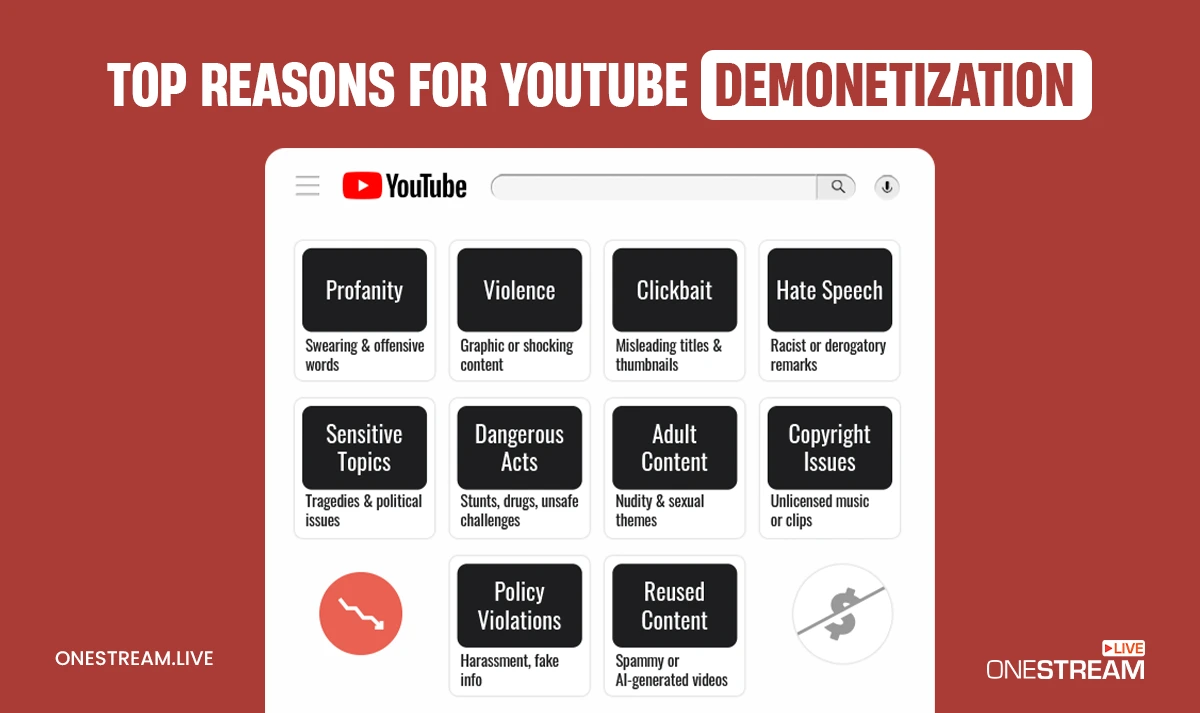
1. Inappropriate Language (Profanity)
Swearing excessively or using certain curse words, especially in titles, thumbnails, or the first moments of a video, can lead to limited ads. YouTube updated its policy in 2023 to be slightly more lenient – moderate profanity (like “shit” or “bitch”) may get limited ads instead of none.
However, extreme profanity or racial/homophobic slurs are strictly ad-unfriendly and often result in full demonetization. As a rule, keep your content and metadata (titles/descriptions) as clean as possible.
There is even a folkloric “YouTube demonetization words list” circulated by creators, listing words (from obvious ones to oddly innocuous ones) that allegedly trigger demonetization. While YouTube doesn’t publish an official list, these community-created lists underline that even certain ordinary words in the wrong context can trip the demonetization filter.
When in doubt, err on the side of caution with your wording!
2. Violence and Shocking Content
Graphic violence, gore, or disturbing imagery will make advertisers pull back. Violent content that is dramatized or in a news context might get a pass with limited ads, but gratuitous violence or shocking scenes (think accident footage, fight videos, gruesome injuries) are often demonetized.
Even video game footage can get limited ads if it’s extremely graphic. If your content includes violence for educational or documentary reasons, add plenty of context and warnings. But if violence is the main draw, expect no ads.
3. Adult or Sexual Content
Any form of pornography or sexually explicit content is completely demonetized (and likely removed). But even less explicit sexual content can face ad restrictions.
Nudity, sexually suggestive scenes, or discussions of sex can get you limited or no ads. For example, a educational video on breastfeeding was historically demonetized if any explicit detail was visible, though policies evolved (by 2024, YouTube allowed breastfeeding content with minimal sexual context to monetize).
The line can be blurry, but as a rule: if it’s something you wouldn’t show on daytime TV, it’s probably not ad-friendly.
4. Hateful or Derogatory Content
This one is straightforward: hate speech or slurs targeting a protected group will not only get you demonetized but likely a Community Guidelines strike. Even if not outright hate speech, any derogatory or extremist content (racism, misogyny, etc.) will make your video advertiser-toxic.
Brands do not want to appear alongside such content, and YouTube’s systems will quickly slap a no-ad warning.
5. Controversial or Sensitive Issues
Discussing sensitive events (like political conflicts, tragedies, or controversial social issues) can be tricky. YouTube often flags content about terrorism, violent crimes, war, tragic events, or even certain political topics as not suitable for all ads.
For instance, videos exploiting a recent tragedy or spreading misinformation about elections can get demonetized or removed. That said, YouTube has eased up in some areas: content discussing topics like adult sexual abuse or abortion in a non-graphic, contextual manner became eligible for ads in late 2023.
The key is how you discuss these issues. Objectively, educationally, and without graphic details is more likely to survive monetization, whereas sensational or one-sided takes may not.
6. Harmful or Dangerous Acts
Videos showing dangerous stunts, drug abuse, or instructions for illicit activities will run afoul of both YouTube’s community rules and ad policies. For example, content that glorifies drug use or provides instructions to manufacture harmful weapons or drugs is strictly demonetized.
Even prank or challenge videos that could encourage unsafe behavior might get you limited ads. Similarly, anything that could be seen as promoting harmful conspiracies or medically unreliable advice (say, anti-vaccine misinformation) can lead to demonetization under “harmful acts and unreliable content.”
7. Reused or “Repetitious” Content
This is a huge hot-button issue in 2025. YouTube has long had a policy against reused content: channels that just copy-paste material from others or produce mass-produced, low-effort videos.
But starting July 2025, YouTube is cracking down harder on what it calls “unoriginal” content. Reaction channels, AI-generated videos, text-to-speech listicles, or compilations of others’ clips are most at risk of demonetization under these new rules.
YouTube’s monetization policy update in 2025 explicitly targets mass-produced or repetitious content that doesn’t add value. In practice, this means if you’re, say, auto-generating videos using AI voiceover and stock footage, or just re-uploading clips from TikTok, you could lose monetization altogether on your channel.
Even reaction video creators need to be careful: you must add substantial original commentary or transformative edits to someone else’s video to be considered “original.” Simply nodding along or adding minimal commentary won’t cut it.
This 2025 policy update is YouTube’s response to the explosion of AI-generated and low-effort content flooding the platform. The bottom line: be authentic and add your own unique value. If an algorithm could have made your video or it’s just recycling existing content, it’s a demonetization risk.
8. Misleading Metadata or Clickbait
A lesser-known cause of demonetization is misleading titles, thumbnails, or descriptions. Clickbait that overpromises or deceives viewers can now lead to demonetization or even removal.
For example, false claims in your title like “Free PS5 Giveaway (Not Clickbait)” when there is no giveaway, or using a violent/sexual thumbnail unrelated to your content, could trigger penalties. YouTube started testing a policy (in some regions like India) to curb overly manipulative clickbait in 2024 and beyond.
Always ensure your metadata honestly represents your content. It’s not just good for user trust, it also keeps you on YouTube’s good side.
9. Copyrighted Music or Footage
One of the most common demonetization triggers for everyday creators is the use of copyrighted music or video clips that you don’t have rights to. If you use a popular song as background music without permission, YouTube’s Content ID system will flag it.
In many cases, you won’t get a channel strike, but your video will be claimed by the music’s copyright owner. Meaning you can’t monetize it at all (the owner might monetize it or mute it). In some scenarios, the video could be blocked worldwide.
Many creators wonder if they can use copyrighted music on YouTube without monetization. The reality is, even if you aren’t monetizing, the copyright owner can still take action.
Read Blog on How to Add Copyright-Free Music to Your Streams?
Not monetizing your video yourself doesn’t grant immunity; the content will still be detected. The safest approach is: don’t use any music, images, or video clips you don’t own or have a license to use.
There are plenty of royalty-free music libraries (including YouTube’s own Audio Library) that you can use without fear. If you absolutely must include copyrighted material (say you’re doing a critique or a news report under Fair Use), be prepared for claims and consider not monetizing that particular video.
And never assume “background” use of a song will be ignored – Content ID is extremely sophisticated.
10. Community Guidelines Violations
Beyond ad-specific rules, any violation of YouTube’s Community Guidelines (hate speech, harassment, self-harm promotion, etc.) will at a minimum demonetize a video and often result in removal or strikes. For example, content that involves harassing or cyberbullying an individual can get demonetized or worse.
Same goes for videos that promote frauds or dangerous misinformation (e.g. encouraging an unsafe “challenge”). Community Guidelines are basically the hard limits of YouTube, crossing them means you shouldn’t expect your video to stay up at all, let alone make money.
Always ensure your content abides by these fundamental platform rules, as they are the baseline before monetization even comes into play.
As you can see, the list of demonetization triggers is long. There’s no single “YouTube demonetization policy” document that lists every forbidden word or action, but by studying YouTube’s advertiser-friendly content guidelines and staying updated on policy changes, you can get a pretty clear idea of what to avoid.
In summary: keep it clean, original, and respectful. If your content wouldn’t be welcome in a family-friendly, advertiser-approved environment, it likely won’t be fully monetizable on YouTube.
Latest YouTube Policy Updates (2024–2025): AI-Generated Content and More
Two big areas of focus for Google going into 2025 are AI-generated content and reused content, as we touched on, as well as greater transparency for viewers. Here’s what content creators need to know about the latest YouTube updates:
1. Crackdown on AI “Mass-Produced” Videos
By mid-2025, YouTube is explicitly targeting channels that churn out AI-generated or mass-produced videos with little human creativity. Reaction clips with AI voiceovers, auto-generated Top 10 videos, or any content that feels “assembly line” can be flagged as “inauthentic” under YouTube’s new demonetization rules.
Creators are required to ensure their content is original and adds clear value. If you use AI tools, that’s not an automatic ban, but you must use them thoughtfully.
For instance, using an AI avatar or voice for narration is allowed, but if the entire video is just AI reading text that’s copy-pasted from Wikipedia, you’re in trouble. YouTube’s monetization update (July 15, 2025) basically says: no more payments for copied or AI-dumped videos.
You might not get a formal strike, but you could lose your monetization privileges until you clean up the content. The onus is now on creators to be transformative: edit, add commentary, show your personality.
2. Mandatory AI Content Disclosure
Another important change: YouTube now requires disclosure if you use highly realistic AI in your content. According to YouTube’s announcements in early 2025, if a video depicts realistic altered or synthetic media (for example, an AI-generated face or voice that could be mistaken for real), the creator must disclose it.
YouTube may even label such videos for viewers. This policy is meant to tackle concerns around deepfakes and misleading AI content.
For monetization, this means if you do use AI-generated elements, transparency is key. Failing to disclose AI-manipulated media could result in penalties, including demonetization or removal.
3. Advertiser-Friendly Guidelines Updates
YouTube continuously fine-tunes what’s considered ad-friendly. In 2023 and 2024, some updates loosened restrictions: e.g., allowing ads on content discussing certain sensitive topics in a contextual way, or allowing mild profanity after the first 7 seconds of a video.
Other updates tightened rules, such as demonetizing content that promotes synthetic sexual imagery (e.g., AI-generated explicit images) or content that exploits sensitive events for profit. As a creator, it’s wise to periodically check YouTube’s advertiser-friendly content guidelines page for these updates.
Staying current with these policies lets you adapt your content strategy proactively.
In summary, 2025’s YouTube monetization rules demand more originality, transparency, and responsibility from creators than ever before. The focus is on rewarding E-E-A-T (Experience, Expertise, Authoritativeness, Trustworthiness).
How to Avoid Getting Demonetized on YouTube: Best Practices
Now for the million-dollar question (sometimes literally!): how to not get demonetized on YouTube in the first place. Here are some practical strategies and tips to help ensure that sweet green monetization icon stays on for all your uploads:
1. Stick to the Rules (Know Them Inside-Out).
This sounds basic, but many creators get in trouble simply because they aren’t fully aware of YouTube’s policies. Make it a point to regularly review YouTube’s Community Guidelines and Advertiser-Friendly Guidelines.
These documents outline in detail what content is allowed, what is limited, and what’s a definite no-go. When in doubt, consult the guidelines. Bookmark the pages and use them as a checklist when planning videos.
2. Plan Your Content and Avoid Last-Minute Mistakes.
Experienced creators will tell you that experience (the first “E” in E-E-A-T) counts. If your channel touches on borderline topics, plan how you’ll present them.
For instance, if you’re covering a sensitive event or controversial subject, script your commentary carefully to maintain an objective or educational tone (and maybe include a brief disclaimer). One useful trick is to use a teleprompter when recording: this ensures you say exactly what you intended and don’t ad-lib something that violates policy.
Tools like OneStream Live Studio even have a built-in teleprompter feature that lets you read your script on-screen while live streaming, helping you stick to compliant language. The more you can pre-produce or rehearse your content, the less likely you are to have slip-ups like accidentally swearing or showing something disallowed.
3. Use Royalty-Free and Original Assets.
A golden rule to avoid demonetization due to copyright is to use only content you own or have rights to. This means background music, sound effects, images, and video clips should either be original, licensed, or from free libraries.
If you need music, use YouTube’s free Audio Library or other copyright-free music sources: never just rip a track from Spotify. Similarly, if you want to show B-roll footage or memes, use stock footage or ensure it’s under fair use (with your commentary over it).
OneStream Live offers a handy library of stream-safe background music and overlays that you can use in your live streams, so you don’t inadvertently play copyrighted content. Avoiding copyright issues is one of the easiest ways to steer clear of demonetization, because Content ID will catch infractions instantly.
4. Be Careful with Thumbnails, Titles, and Tags.
Demonetization isn’t just about the video content, your video’s metadata can also trigger flags. An otherwise clean video can get limited ads if the title or thumbnail is problematic.
For example, avoid putting graphic imagery or provocative text in your thumbnail (even as a joke). If your video is about a video game with violence, you don’t need to showcase the bloodiest scene on the thumbnail; choose a tamer image.
Likewise, don’t stuff your title or description with potentially sensitive keywords just to game SEO. Some creators have found that even words like “kill” or “dead” in titles (say in a video game context) can cause a yellow icon.
Also, avoid clickbait that overpromises or misleads, as noted earlier. If your content is edgy but within policy, you might add context in the description to clarify intent (e.g., “All stunts performed in a safe, controlled environment” or “Discussion intended for educational purposes”). It shows YouTube’s reviewers that you’re responsible about your content.
5. Self-Certify and Monitor Your Monetization Status.
When you upload videos, YouTube now has a self-certification questionnaire where you, the creator, rate your content. Be honest and conservative with this self-rating.
If you acknowledge mild profanity, YouTube is more likely to trust your rating and might give you limited ads but not pull ads entirely. If you lie on the self-cert and the automated system finds otherwise, you could get instantly flagged.
After publishing, keep an eye on the monetization icon next to your video in YouTube Studio. If it turns yellow (limited), click to request a manual review if you believe your video is actually ad-friendly. Often a human reviewer will overturn an automated decision if your content truly meets guidelines.
So, don’t be afraid to appeal demonetization decisions, it’s worth a try and often successful. However, only appeal if you’re confident.
6. Diversify Your Revenue Streams (Don’t Rely Solely on Ads).
No matter how careful you are, there is always some risk of YouTube demonetization due to factors outside your control. The best safeguard for your income is to diversify how you monetize your content. Here are a few ideas:
Channel Memberships & Super Chat: Once you’re eligible, enable features like memberships, where fans pay a monthly fee for perks, or Super Chats/Stickers during live streams.
Sponsored Content and Affiliate Marketing: Many creators work with brands for sponsored segments or use affiliate links to earn commissions. This income is independent of YouTube’s ad system. Just be sure to follow FTC guidelines and disclose sponsorships.
Merchandise and Direct Support: Selling your own merchandise or directing viewers to Patreon, PayPal, or other support platforms can create a steady revenue stream. YouTube even allows merchandise shelves and donation buttons for eligible creators.
Own Your Platform: Consider uploading or live streaming on other platforms in addition to YouTube. OneStream Live allows you to multistream your content to over 45 platforms simultaneously, including YouTube, Facebook, Twitch, Twitter, and even custom web destinations.

By following these best practices, you significantly reduce the chance of seeing your content demonetized. It’s about being proactive, professional, and audience-conscious.
As a final piece of advice: never try to “beat the system” by sneaking forbidden content in hopes that nobody notices. It’s not worth it.
Some creators have attempted to censor profanity with funny sounds or skirt the edge of sexual content, but YouTube’s AI is pretty darn smart. If you think a joke or a scene might be crossing a line, it probably is.
FAQs About YouTube Demonetization
YouTube demonetizes videos that violate its advertiser-friendly guidelines. Common reasons include profanity, copyrighted music, reused content, violence, and AI-generated videos flagged as “unoriginal.”
To stay monetized, follow YouTube’s demonetization policy closely in 2025.
Meet 1,000 subscribers and 4,000 watch hours in 12 months (or 10M Shorts views in 90 days).
Follow YouTube monetization rules and community guidelines.
Set up an AdSense account and link it to YouTube.
Apply for the YouTube Partner Program (YPP) in your dashboard.
Enable monetization features on eligible videos.
Tip: Focus on original, advertiser-friendly content to avoid demonetization.
When your channel gets demonetized, you lose access to ad revenue, Super Chats, memberships, and other monetization features. You can still upload videos, but won’t earn money until you fix the issues and reapply for the YouTube Partner Program.
You need 4,000 valid public watch hours in the past 12 months and 1,000 subscribers to qualify for YouTube monetization in 2025. Shorts creators can also qualify with 10 million public Shorts views in 90 days under the updated YouTube monetization rules.
No. Even if you don’t monetize, YouTube’s Content ID system can still detect copyrighted music.
The copyright owner may block your video, mute the audio, or monetize it themselves. To stay safe, use royalty-free music or YouTube’s Audio Library.
Yes. YouTube uses AI to flag videos with profanity, slurs, or sensitive terms.
While there’s no official YouTube demonetization words list, community-created lists highlight risky words that can trigger limited or no ads. Keep titles, descriptions, and scripts clean to avoid demonetized videos.
Not always. First, check why your channel was demonetized—most issues can be fixed.
If it’s due to reused content, copyright strikes, or policy violations, focus on resolving them and reapply to the YouTube Partner Program. Starting a new channel should be a last resort if your current one is permanently banned or ineligible for monetization.
Wrap Up
Avoiding YouTube demonetization ultimately boils down to creating content that advertisers love (or at least don’t hate), staying informed on policy changes, and being smart about how you grow your revenue. YouTube is an incredible platform for reach, but remember that as a creator you’re playing in their sandbox with their rules.
By following the guidance in this article: keeping content clean and original, using tools like OneStream Live for your streaming strategy, and diversifying your income, you can build a sustainable, thriving presence on YouTube without living in constant fear of demonetization.
Here’s to your next video being monetized and your creativity rewarded!

OneStream Live is a cloud-based live streaming solution to create, schedule, and multistream professional-looking live streams across 45+ social media platforms and the web simultaneously. For content-related queries and feedback, write to us at [email protected]. You’re also welcome to Write for Us!