
As a content writer, you live by one question: where does my audience live? For live streamers, that question has a painful part two: “…and which platform will actually pay me for my work?” The TikTok vs YouTube debate is at the heart of every streamer’s career. One feels like a ticket to instant fame, the other like a path to a real career. But which one is the right move?
Today, search engines and AI assistants are getting smarter. Following Google’s 2025 core updates, the only content that ranks is content that is genuinely helpful and shows real, first-hand experience. The new rule is to be the best platform for content creators by giving them the best, most direct answers.
So, let’s do that. The short answer is:
- YouTube is better for long-term monetization and building a deep, loyal community.
- TikTok is better for rapid discovery and finding a massive new audience, fast.
For streamers in 2025, the best strategy isn’t choosing one. It’s about using them both. This guide will show you how.
- Smart streamers don't choose TikTok or YouTube; they use both.
- If you're deciding between TikTok or YouTube to make money, YouTube's career-focused monetization pays far more.
- Is it easier to get famous on TikTok or YouTube? TikTok’s algorithm provides explosive, rapid discovery for new creators.
- The key difference between YouTube and TikTok is community depth (YouTube) versus audience width (TikTok).
- The best platform for content creators isn't one site, but a multistreaming "Live-to-Shorts" workflow.
TikTok vs YouTube: The 2025 Streamer Showdown (At a Glance)
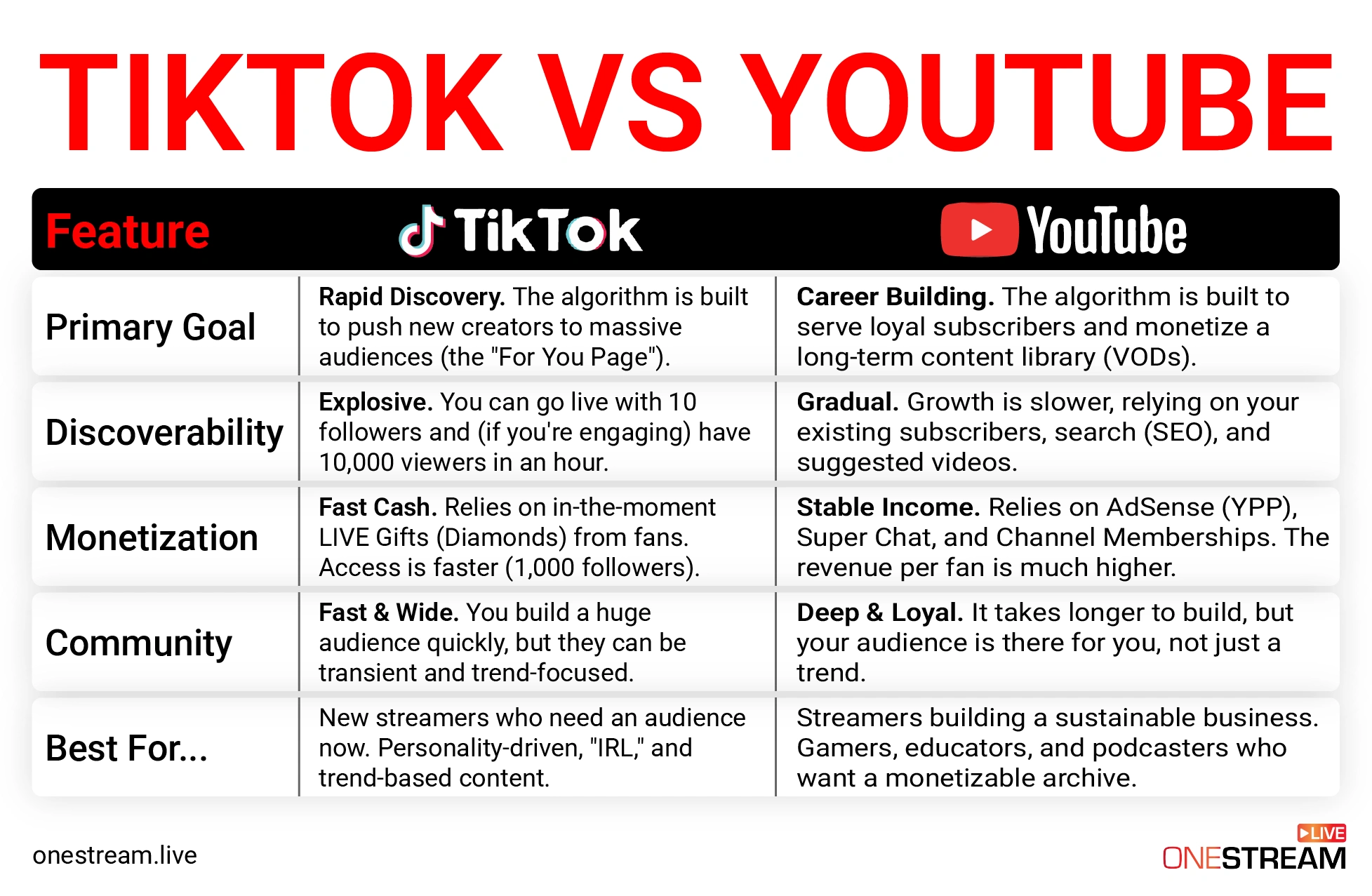
Before we get into the details, here is the simple breakdown of how is TikTok different from YouTube for a live streamer.
The Money: Does TikTok Pay More Than YouTube?
Let’s get to the most critical question. When it comes to making money on TikTok or YouTube, the answer is layered.
So, do you make more money on YouTube or TikTok?
Direct answer: You make more money on YouTube.
It’s not even close. While a few top TikTokers make fortunes from brand deals, for every 1,000 views (or 1,000 fans), YouTube’s system is built to pay creators far more.
YouTube pays more for ads (AdSense on your VODs) and pays a much higher percentage on fan donations (Super Chat). TikTok‘s Creator Rewards Program pays pennies on the dollar for video views, and they take a much larger cut of the LIVE Gifts (Diamonds) your fans send you.
1. What is the difference between TikTok and YouTube monetization for streamers?
This is where streamers need to pay attention.
i. YouTube’s Model: You get paid from multiple sources:
- AdSense (YPP): Ads that run on your recorded live streams (VODs) and other videos. This is your career-long passive income.
- Super Chat & Super Stickers: During a live stream, fans can pay to have their message highlighted. You, the creator, keep 70% of that money (on desktop).
- Channel Memberships: Fans can pay a monthly fee (like a Twitch sub) for badges and perks. You keep 70% of that, too.
How to Monetize YouTube Channel
ii. TikTok’s Model: This model is built for fast, in-the-moment transactions.
- LIVE Gifts: Your main income. Fans buy “Coins,” use them to send you “Gifts” (like a rose or a lion), which you receive as “Diamonds.”
- The Problem: The conversion is confusing and expensive. Fans spend $10 on Coins. Those Coins convert to Gifts. Those Gifts convert to Diamonds at a 2:1 ratio. TikTok then takes a 50% cut of the Diamonds. By the time that $10 gets to you, you might only see $3.00 to $5.00.
- Creator Rewards Program: This replaces the old Creator Fund and pays for videos, not live streams. The payout is very low, around $0.10 – $0.50 per 1,000 views.
How To Make Money on TikTok
A $10 donation on YouTube Live (desktop) nets you $7.00. A $10 donation on TikTok LIVE might net you $4.00, if you’re lucky. This alone answers the question of which platform pays more: YouTube or TikTok.
2. Is it easier to make money on TikTok or YouTube?
This is the trick question. It is faster to qualify for monetization on TikTok. It is easier to build a real income on YouTube.
Here are the 2025 requirements just for live-stream fan funding:
| Feature | Platform | Requirement to Start Earning |
|---|---|---|
| LIVE Gifts / Diamonds | TikTok | 1,000+ followers & be 18+ |
| Super Chat / Stickers | YouTube | 500+ subscribers & 3 public videos (YPP "Lite") |
| Channel Memberships | YouTube | 500+ subscribers & 3 public videos (YPP "Lite") |
| AdSense Revenue (Full YPP) | YouTube |
1,000+ subscribers & 4,000 watch hours (or 10M Shorts views) |
As you can see, YouTube’s new 500-subscriber tier was created specifically to compete with Twitch and TikTok, giving streamers a path to fan funding much faster than before.
Monetization Verdict: If you are serious about building a career, YouTube is the clear winner. You can earn more money on YouTube compared to TikTok.
Is It Easier to Get Famous on TikTok or YouTube?
Money is one thing, but you need an audience to earn it. This brings us to the next big cluster of questions: popularity and discoverability.
Direct answer: It is 100% easier to get views on TikTok.
But “views” and “fame” are two different things.
- TikTok gives you explosive reach. You can start a new account and go live, and if you are entertaining, the algorithm will put you on the “For You Page” (FYP) and show you to millions of people. You can gain 50,000 followers in one night.
- YouTube helps you build a loyal community. It is much harder for a new streamer to get discovered. The algorithm suggests your stream to your existing subscribers and people who watch similar content. Growth is slow and steady.
Ask any YouTuber vs. TikToker: one has an audience, the other has a community. A TikTok audience is built on trends and is often transient. A YouTube community is built on your personality and content library, and they will stick with you for years.
1. How do the algorithms actually work for live streamers?
This is the most important difference between YouTube and TikTok.
- TikTok’s Algorithm is a “Push” Engine. Its job is to find engaging content and push it to new viewers, regardless of who made it. When you go LIVE, the FYP “tests” your stream with a small audience. If they engage (comment, gift, watch), it pushes it to a bigger audience, then a bigger one. This is how “viral” happens in real-time.
- YouTube’s Algorithm is a “Pull” Engine. Its job is to be a library and pull the perfect video to answer a user’s question. For live streams, it “pulls” from your subscriber list and suggests your stream next to VODs your target audience is already watching. It’s much harder to get “discovered” as a brand new live streamer on YouTube… unless you also make VODs and Shorts.
2. So, is TikTok more popular than YouTube?
No. This is a common myth. YouTube is more popular than TikTok by a huge margin. YouTube has 2.7+ billion logged-in monthly users. TikTok has around 1.5+ billion.
The TikTok vs YouTube users question is about depth, not just numbers. Is TikTok popular? Yes, it’s a cultural force. But YouTube users spend more time watching long-form content, watch on their TVs, and are more likely to become a paying community member.
Discoverability Verdict: TikTok is the undisputed king of getting new eyeballs, fast. YouTube is the king of turning those eyeballs into a long-term, monetizable community.
The Strategy: TikTok vs YouTube Shorts & The "Live-to-Shorts" Funnel
So, YouTube is for money, and TikTok is for fame. How do you, a single creator, do both without suffering from the “streamer burnout” that kills 90% of channels?
You use a “Live-to-Shorts” funnel. And you stop thinking of TikTok & YouTube as a competition.
What is the ‘Live-to-Shorts’ strategy?
It’s a simple, powerful workflow:
- THE MINE (Long-Form): You do your main live stream on your “home base” (like YouTube or Twitch). This is where you interact with your core community and play your game, do your art, or host your podcast.
- THE HOOKS (Short-Form): After the stream, you (or an editor) scan the VOD for the 5-10 most exciting, funny, or informative moments.
- THE EDIT (Vertical): You re-edit those clips into a vertical 9:16 format. The best practice is to put your facecam at the top, the main content (like gameplay) at the bottom, and add big, bold captions.
- THE FUNNEL (Distribution): You post these clips on TikTok and YouTube Shorts.
- On TikTok: The clip’s job is to go viral and find new people who have never heard of you.
- On YouTube Shorts: The clip’s job is to be discovered by people on YouTube and act as a direct advertisement for your main channel and live streams.
This system flips the script. Your long-form stream (the “work”) creates all the marketing material (the “clips”) you need for the entire week.
This is the secret. The best platform for content creators is the one that gets you discovered, and the “Live-to-Shorts” funnel is the engine.
TikTok LIVE Studio vs. YouTube Live Control Room
For a streamer, the choice of platform is often dictated by technical limitations. This section compares the native streaming tools of both platforms and, more importantly, explains the professional-grade ecosystem that surrounds them.
| Feature | TikTok LIVE (Native Studio/App) |
YouTube Live (Live Control Room) |
|---|---|---|
| Max Resolution | 1080p (variable) | Up to 4K |
| Primary Format | Vertical (9:16) | Horizontal (16:9), with Vertical support |
| RTMP Ingest | Yes (Requires access to LIVE Studio / Stream Key) | Yes (Standard) |
| Native Guest Slots | Yes (Multi-Guest hosting) | Yes (via “Go Live Together”) |
| Custom Overlays | Limited (via LIVE Studio) | N/A (Relies on 3rd-party tools) |
| VOD / Archive | Yes (but hard to find and re-watch) | Superior. Searchable, monetizable, archived, and feeds the algorithm. |
1. The Native Tools: A Brief Overview
- TikTok LIVE Studio: This is TikTok’s official desktop software that allows creators to stream from their PC. It provides features beyond the mobile app, such as scene management, browser sources, and subscriber alerts. However, access is not universal and can require a high follower count.
- YouTube Live Control Room: This is YouTube‘s browser-based dashboard for managing live streams. It is not streaming software itself. It is where a creator gets their stream key, sets their title/thumbnail, and monitors chat and analytics.
The verdict from professionals is clear: neither of these native tools is sufficient for a high-quality, branded broadcast.
2. The Professional Standard: RTMP Streaming
The vast majority of professional streamers use third-party “encoders.” These are powerful software (like OBS Studio, XSplit, and vMix) or hardware encoders that allow you to compose a “scene” by mixing webcams, screen shares, game capture, graphic overlays, and audio.
The “bridge” that connects these professional tools to the platforms is RTMP (Real-Time Messaging Protocol). Both TikTok and YouTube provide a unique “Stream Key” and “Server URL.” The streamer simply copies these credentials into their chosen software (OBS, etc.) to send their high-quality feed to the platform.
3. The Superior “Command Center”: Cloud-Based Studios
While RTMP is the professional standard, it still presents technical hurdles. A more modern solution is a cloud-based live streaming solution. These platforms act as a “Command Center” that replaces complex encoders while providing even more features.
The OneStream Live Studio, for example, is a professional, browser-based studio that replaces the need for native tools entirely. It is designed to create a professional, branded broadcast with ease. Key features include:
- Invite Guests: A streamer can host up to 16 guests (with 14 on-screen), perfect for interviews, panels, or co-hosts.
- Branding and Overlays: Add custom logos, backgrounds, banners, and tickers to create a unique, on-brand look.
- Professional Production Tools: The studio includes a Teleprompter, Multicamera Streaming (up to 4 cameras), Media Sharing (for videos and images), Virtual Backgrounds, and Intervals (like countdown timers or intros).
- Vertical Streaming: Critically, the studio includes a one-click Portrait Streaming mode, which formats the broadcast perfectly for vertical platforms like TikTok and Instagram.
The Final Verdict: Why YouTube is Better than TikTok (and Vice Versa)
By now, the answer should be clear. The TikTok vs YouTube debate is a false choice.
- You need YouTube because its monetization is built for careers. Its community tools are deep, and its VOD library builds you a long-term, searchable legacy.
- You need TikTok because its discovery algorithm is a rocket ship. It is the single best way to get your personality in front of millions of new people, solving YouTube’s “cold start” problem.
The real problem is the work. How can you possibly stream to YouTube for your community, go live on TikTok for discovery, and edit clips, all without burning out?
This is the exact problem multistreaming was built to solve.
With a tool like OneStream Live, you don’t have to choose. You can connect your streaming software (like OBS) or use the OneStream Live Studio. From one dashboard, you can broadcast your single stream to YouTube Live and TikTok LIVE at the same time.
- Your loyal community on YouTube gets the polished, horizontal stream they love.
- The TikTok algorithm gets a live stream to “push” to the FYP, funneling thousands of new viewers into your ecosystem.
You get the monetization of YouTube and the discovery of TikTok, all from one stream. You can even use OneStream Live’s Pre-recorded Streaming feature. Record a perfect, high-quality video, then schedule it to go “live” on both platforms, creating a flawless event while you engage with your new audience in the chat.
Stop asking “TikTok or YouTube.” Start doing both!

FAQs
YouTube pays significantly more on a per-view and per-donation basis. For programmatic ad revenue on VODs, YouTube’s RPM (Revenue per 1,000 views) can be $1-$5+, while TikTok’s is often much lower. For live donations, YouTube streamers keep approximately 70% of Super Chat revenue (on desktop) , while TikTok streamers keep an estimated 30-50% of a fan’s total spend after all conversions and platform fees.
To earn ad revenue (the “full” YPP), creators need 1,000 subscribers AND either 4,000 public watch hours (in the last 12 months) OR 10 million public Shorts views (in the last 90 days).
To receive LIVE Gifts, a creator must be at least 18 years old and have a minimum of 1,000 followers. Requirements for the Creator Rewards Program (for VODs) are higher.
One TikTok Diamond is worth approximately $0.005 USD (half a cent) to the creator when they redeem it. Fans buy “Coins,” which are then converted into “Diamonds” when gifted, often at a 2:1 ratio (2 Coins ≈ 1 Diamond).
TikTok’s revenue split is complex and not fully transparent. The platform takes a commission (reportedly 50%) of the Diamond’s value. Because of the Coin-to-Diamond conversion and this 50% fee, the creator’s final take-home pay is estimated to be around 30-50% of the original amount the fan paid.
YouTube’s split is a straightforward 30% platform fee, meaning the creator keeps 70% of the Super Chat revenue. However, this is after other fees, like sales tax or app store fees, are deducted.
OneStream Live is a cloud-based live streaming solution to create, schedule, and multistream professional-looking live streams across 45+ social media platforms and the web simultaneously. For content-related queries and feedback, write to us at [email protected]. You’re also welcome to Write for Us!