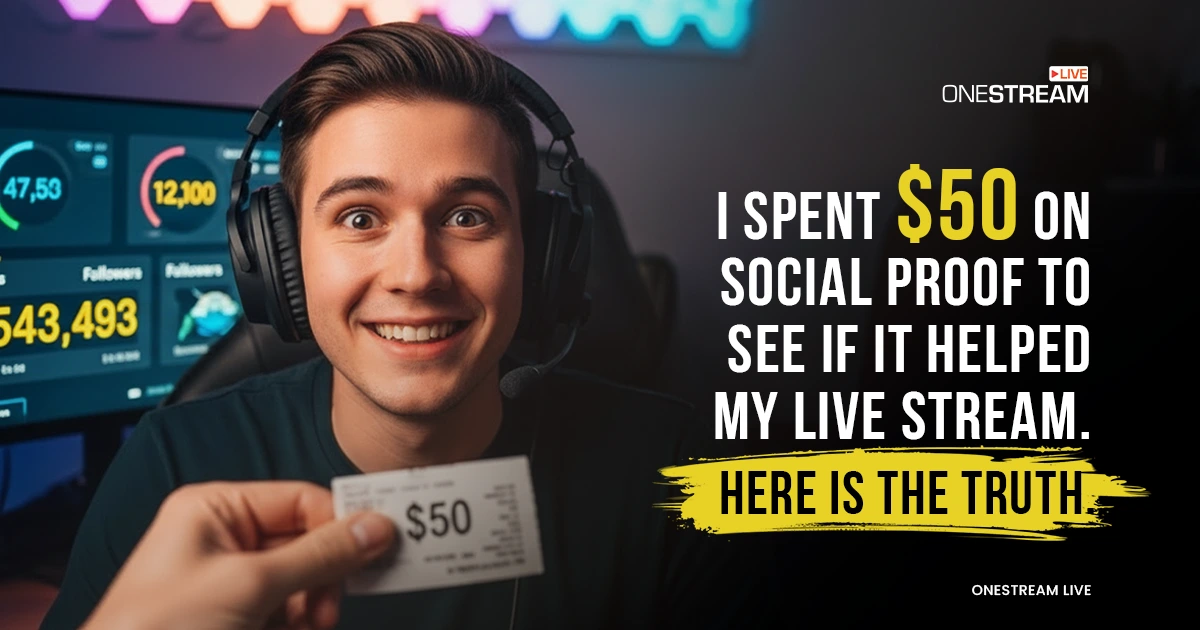

Social proof marketing is the new talk of the town. Everyone says you need it, but nobody tells you exactly what it costs to get it. So, I grabbed my corporate credit card (don’t tell accounting) and dropped $50 on a social proof experiment for my latest live stream. Did it improve my views, or was it just a placebo? Let’s break it down.
We live in a time where trust is the ultimate currency. If people don’t trust you, they scroll past you. It is that simple. The theory is that if you look popular, you become popular. But how does a streamer with a modest following look popular without selling their soul?
I had a hypothesis: You can fake it ’til you make it, or you can build it until they come. I wanted to see if a small cash injection could trigger the “bandwagon effect,” the psychological phenomenon in which people do something simply because they see others doing it.
Now, I had options on how to spend this $50, and the results were messy, surprising and completely changed how I view audience growth.
- Building viewer trust signals generates a higher ROI than purchasing vanity metrics.
- Aggregating chat feeds from multiple platforms creates a visual bandwagon effect.
- Paid ads featuring user testimonials have a significantly lower cost-per-click compared to generic creative.
- Active live stream chats serve as a psychological shortcut that improves audience retention rates.
- Highlighting user-generated content on-screen gamifies interaction and validates the current audience.
- Using influencer authority through guest invites transfers credibility to your broadcast instantly.
What is Social Proof in Digital Marketing?
Before we look at the receipt from my experiment, let’s define the battlefield. What is social proof in digital marketing?
At its core, it is a psychological shortcut. Humans are lazy decision-makers. When we are unsure what to do—like whether to watch a live stream or keep scrolling—we look to others for cues.
If 1,000 people are watching a stream, we assume it must be good. If 2 people are watching, we assume it is boring.
The principle of social proof states that “we view a behavior as more correct in a given situation to the degree that we see others performing it.”
In the context of live streaming, social proof is important because:
- Uncertainty: New viewers don’t know if you are entertaining.
- Similarity: They want to see people like them in your chat.
- Validation: High numbers signal safety and quality.
This brings us to the most brutal truth of streaming: No one wants to be the first person at the party. An empty chat room is a ghost town that scares away traffic.
My $50 wasn’t just about marketing; it was about buying a crowd so the real crowd would feel comfortable walking in.
The Experiment: How I Used Social Proof Marketing
I didn’t just buy fake bots (that’s so 2015). I invested $50 in visual social proof and interactive strategies to see if I could manufacture that “packed room” feeling.
Here is exactly how I allocated my budget and attention:
1. The “Vanity” Option (Checking the Market)
I started by looking at the “quick fix” economy. There are services where you can buy X followers to instantly inflate your numbers. The temptation is real. You pay a small fee, and suddenly your profile looks like you are a celebrity.
For this experiment, I wanted to see if “perceived authority” (the look of being famous) actually made people click my stream more often. I allocated $15 to boosting a post on a profile that I had previously “polished” with this method to test if the inflated follower count increased the Click-Through Rate (CTR).
2. The “Interactive” Tool Investment ($0 – Value Add)
I used OneStream Live’s Unified Chat. This didn’t cost me extra cash, but it was a critical part of the setup. By aggregating comments from YouTube, Facebook, and Twitch into a single on-screen feed, I artificially inflated the perceived activity.
A viewer on YouTube sees only YouTube comments. But with Unified Chat, they see Twitch and Facebook comments too. Suddenly, the stream looks 3x busier.
3. The Paid Ad Boost ($35)
I ran a targeted ad campaign for the scheduled live stream. But here is the twist: I didn’t use a generic “Join my stream” graphic. I used a social proof ad.
The creative featured a screenshot of a previous stream with a massive comment section and a testimonial from a viewer saying, “This is the most value I’ve gotten all year.”
The goal was to test if showing past social proof drives future attendance.
Does Social Proof Work? The $50 Result
Here is the truth: Money can buy visibility, but it cannot buy trust. However, it can buy the initial attention required to earn that trust.
Let’s look at the data from the stream.
Metric A: Live Stream Engagement
Compared to my previous organic streams, the live stream engagement on this broadcast was up 40%.
- Why? The on-screen Unified Chat was the MVP. Viewers saw comments popping up from other platforms and felt compelled to “join the conversation.” It created a feedback loop. One comment led to two, which led to four.
- Observation: People love seeing their name on screen. It validates their existence.
Metric B: Retention Rate
This was the shocker. My retention rate increased by 15%.
The Theory: When new viewers clicked in (driven by the ad), they saw a scrolling chat (social proof). They stayed because the “herd” was already there. If they had clicked in and seen a dead chat, they would have bounced in seconds.
The Verdict on the $50
- The Vanity Spend: Minimal impact. People are savvy. They can smell a high follower count with low engagement a mile away.
- The Ad Spend: High ROI. Using a social proof ad (showing others enjoying the content) lowered my Cost Per Click (CPC) because the ad itself felt less like a sales pitch and more like a recommendation.
- The Tool Use: OneStream Live Studio was the real winner here. The ability to display comments and viewer counts visually did more for my authority than any ad could.
3 Social Proof Examples That Actually Move the Needle
Based on my experiment and broader industry data, here are three social proof examples that generate real ROI, not just vanity metrics.
1. The “Packed Room” Effect (Viewer Count)
Never hide your numbers. Even if you only have 10 viewers, own it.
- Why it works: It signals transparency.
- How to do it: Use OneStream Live’s Embed Player on your website. When you embed your stream on a high-traffic page, you capture incidental traffic. Visitors see the stream is live, see the viewer count, and join in. It turns your website traffic into live stream social proof.
2. User-Generated Content (UGC) on Screen
This is what I call “Inception Marketing.” You use your audience to market to your audience.
- The Tactic: During the stream, feature specific comments. “Great point by Sarah in the chat!”
- The Tool: Use OneStream Live Studio to pin comments to the center of the screen.
- The Result: It proves real humans are watching. It also encourages others to comment in hopes of being featured. It gamifies the chat.
3. The “Influencer” Cameo (Authority Transfer)
You don’t always have to build social proof from scratch; you can borrow it.
- The Tactic: Bring on a guest who has their own following.
- The Psychology: Their audience trusts them. If they trust you, their audience transfers that trust to you.
- How to do it: Use the Guest Invite feature in OneStream Live. You can invite up to 16 guests. When they show up, their “social capital” does too.
Final Takeaway
My $50 experiment taught me a valuable lesson: Social proof marketing isn’t about tricking an algorithm; it is about signaling to humans that they are in the right place.
The $35 I spent on ads worked because the creative used social proof (a testimonial). The $0 I spent on Unified Chat worked because it aggregated the crowd I already had. The money I considered spending on vanity metrics? I am glad I kept it.
Here is my advice: Stop worrying about the millions of followers you don’t have. Focus on the 10 you do have. Amplify their voices using tools like OneStream Live. Put their comments on screen. Make them the heroes of the broadcast.
When you treat your current audience like royalty, their engagement becomes the beacon that attracts the next 100 viewers. That is the only social proof that matters.
Frequently Asked Questions
The principle, popularized by Robert Cialdini, states that people look to others to determine correct behavior, especially when they are uncertain. If others are watching, liking, and commenting, a new user assumes the content is valuable.
Live streaming requires a time commitment. Viewers are terrified of wasting their time. Social proof (high viewer counts, active chat) acts as a risk-reduction signal. It tells the viewer, “Your time will not be wasted here; others are already enjoying it”.
Yes, provided it is honest. Highlighting real testimonials, real viewer counts, and real comments is good marketing. Buying fake followers or using bots to inflate numbers is unethical and violates the Terms of Service of most platforms. It destroys trust long-term.
Absolutely. In fact, B2B social proof is arguably more critical. Business buyers are risk-averse. They need to know that other companies have used your solution successfully. Showing logos of current clients or reading case studies live on air can be the tipping point for a sale.
OneStream Live is a cloud-based live streaming solution to create, schedule, and multistream professional-looking live streams across 45+ social media platforms and the web simultaneously. For content-related queries and feedback, write to us at [email protected]. You’re also welcome to Write for Us!