

YouTube’s dominance is a ‘comfortable trap.’ It’s free, and its audience is massive, but you pay for it with your brand control, your audience data, and often, your sanity. But finding YouTube Live alternatives is where most people go wrong. They look for one platform to do it all, and that platform doesn’t exist.
As a strategist who analyzes the streaming market, I see it every day. You’re tired of restrictive policies that seem to change on a whim. You’re trying to build a business, but you’re battling an algorithm that buries you under a mountain of high-competition content. And you’re sick of unpredictable monetization hurdles and ad-revenue models that feel, frankly, disrespectful to your work.
This is the ultimate guide to finding the right tool for your specific job. The “best” YouTube alternative is a myth. The “best” alternative for you is the one that matches your goal.
To find it, you have to answer one question: “Who am I?”
I’ve broken down the entire 2025 streaming landscape into three distinct categories. Find your category, find your platform.
- The Social Giants: For creators and brands who need maximum, free reach.
- The Pro-Casters: For full-time streamers (especially gamers) who need creator-first monetization.
- The Business & Enterprise Platforms: For companies that need total control, security, and white-label branding.
- There’s no single YouTube Live replacement. Pick by goal: reach, monetization, or control.
- Facebook and Instagram Live are for nurturing an audience you already have, not finding a new one.
- TikTok Live is the strongest discovery engine if you’re starting from zero.
- Twitch wins on community and chat culture. Kick wins on the 95/5 subscription split.
- Vimeo, Dacast and Muvi are the route when you need ad-free, white-label control over your own player.
- Multistream to 45+ platforms with OneStream Live rather than betting everything on one.
Section 1: The Social Giants (For Maximum Reach & Community)
This category is for creators and brands who prioritize a built-in audience over granular control. You are trading advanced monetization features and white-labeling for access to the world’s most powerful (and free) discovery engines. Your goal is reach.
1. Facebook Live
- Who is it for? Brands, creators, and community leaders with an existing, established audience on Facebook (e.g., a private group or a page with thousands of followers).
- The 2025 Landscape: With over 3.07 billion monthly active users, Facebook is, by sheer numbers, the largest potential audience on earth. In 2025, Facebook is actively simplifying its monetization. It’s rolling its In-stream ads, Ads on Reels, and Performance Bonus programs into a single “Facebook Content Monetization beta,” which allows you to earn from video, Reels, photos, and text posts all in one place.
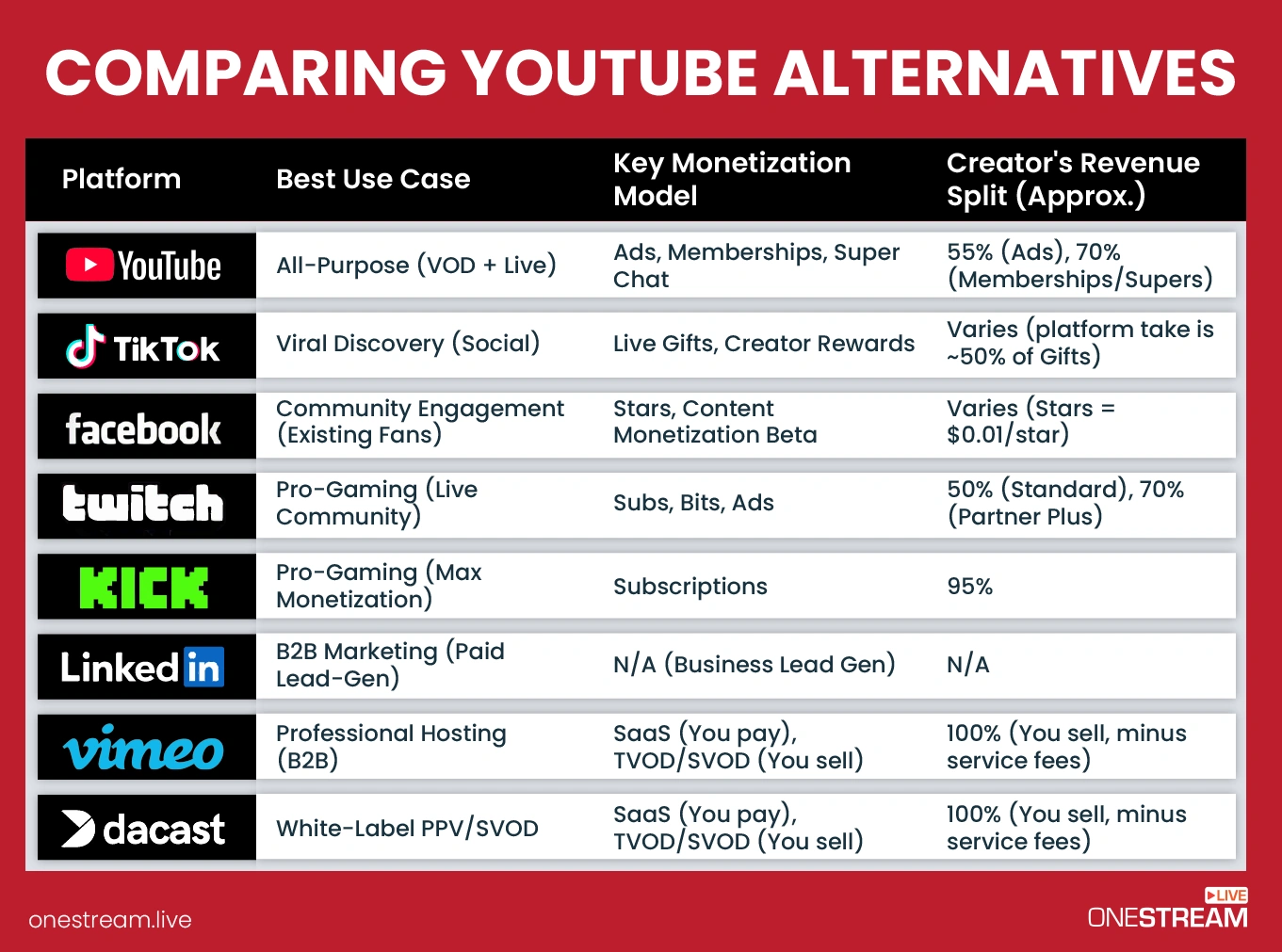
- Monetization: The primary tools are Facebook Stars, a direct-donation feature where viewers buy and send you stars (you get $0.01 per star), and the aforementioned Content Monetization program.
- The Expert Verdict: Facebook Live is surprisingly powerful for engaging a community you already own. It’s fantastic for private groups, Q&As, and connecting with fans. However, it comes with heavy trade-offs. Facebook’s video compression is notoriously heavy, so your stream won’t look as clean as it does on YouTube. More importantly, its public discoverability and SEO are virtually nonexistent.
Bottom Line: Use Facebook Live to nurture your fans; don’t use it to find new ones.
Linea Borg, a lifestyle writer at Academic Brits, adds, “Let’s not forget that Facebook has 3.07 billion active users currently, and you can monetize your live video.”
2. Instagram Live
- Who is it for? Lifestyle brands, coaches, and creators who thrive on personal, vertical, mobile-first engagement.
- The 2025 Landscape: The game-changer for Instagram is “Instagram Live Producer.” For years, IG Live was a low-fi, phone-only tool. Live Producer, now available for professional accounts, is a desktop feature that lets you connect third-party streaming software like OBS or Streamlabs. This means you can finally use external microphones, add multiple cameras, and incorporate professional graphics.
- Monetization: The primary method is “Badges,” a direct-donation feature where viewers can purchase support tokens during your stream.
The Expert Verdict: “Live Producer” changes everything. Instagram Live is no longer just a casual tool; it’s a serious contender for creators who want a polished vertical stream. While its content shelf-life is infamously short (it’s gone after the broadcast), its real-time engagement is massive, with over 100 million users watching Live daily. It remains the best platform on this list for high-intimacy, in-the-moment connection.
3. TikTok Live
- Who is it for? New creators who desperately need discoverability, and anyone targeting a Gen Z or younger Millennial audience.
- The 2025 Landscape: This is the elephant in the room. In a stunning market shift, TikTok Live surpassed Twitch in total watch hours in Q1 2025, capturing 27% of the global market. YouTube Live remains the undisputed leader (at over 50% market share), but TikTok’s rise, driven by mobile eSports and massive influencer broadcasts, is meteoric.
- Monetization: Revenue comes from “Live Gifts,” a virtual currency that viewers send and can be converted to cash. This is supplemented by the Creator Reward Program. The barrier to entry is real: you must be 18+ and have at least 1,000 followers to even use Live Gifts.
The Expert Verdict: TikTok’s “For You Page” algorithm is the single greatest discovery engine on the planet for new creators. You can go from zero followers to a live audience of thousands overnight. While the payout-per-view is generally lower than on YouTube, its raw ability to build an audience from scratch is unmatched. It is no longer a “toy” app; as of 2025, it is the second-largest streaming platform in the world in terms of watch time.
4. LinkedIn Live
- Who is it for? B2B marketers, corporate trainers, and sales teams.
- The 2025 Landscape: This is critical to understand: LinkedIn Live is not a native streaming app like the others. You must use a third-party broadcasting tool like OneStream Live to connect to its API. The platform is built exclusively for professional content, B2B thought leadership, panel discussions, and webinars.
- Monetization: There is none. The monetization is your business (i.e., generating leads for your services or software).
The Expert Verdict: I must be blunt here: for most people, LinkedIn Live is not a good tool. Recent analysis shows that organic reach on the platform has plummeted. One 2025 analysis called organic live streams “pointless… without strategic investment and paid promotion.” Do not treat this as a YouTube replacement. Treat it as a paid B2B webinar tool. If you don’t have an ad budget to promote your event, don’t bother.
Section 2: The Pro-Casters (For Gamers & Full-Time Creators)
Welcome to the specialist-streamer category for YouTube Live alternatives. This is for creators who live and breathe live content. Your platform is your job. In 2025, the debate is no longer just “Twitch.” It’s a simple, brutal battle: community and legacy (Twitch) vs. monetization and freedom (Kick).
5. Twitch
- Who is it for? Established gaming streamers and creators who value live-community culture and interaction above all else.
- The 2025 Landscape: Twitch is still the king of live gaming, holding 54% of the gaming-stream market in Q2 2025. However, this is a decline from its near-monopoly, and its overall growth has stalled.
- Monetization: This is Twitch’s great weakness. The platform’s standard revenue split on subscriptions is 50/50. While the “Partner Plus” program offers a 70/30 split to top-tier creators, most Affiliates are locked into the 50/50 model. This is supplemented by Bits (a virtual currency) and ad revenue.
The Expert Verdict: Twitch’s strength is its culture. Its live-chat tools, like emotes, Channel Points, and Hype Trains, are still superior to all competitors. The platform is built for shared live moments. However, its 50/50 split is uncompetitive and deeply unpopular, and its discoverability for new streamers is functionally broken. It is an incredibly difficult platform to start on in 2025, but its ecosystem is still the most robust if you can break in.
6. Kick
- Who is it for? New streamers who want to get paid, and established creators who are monetization-first and willing to bet on a new, high-growth platform.
- The 2025 Landscape: Kick is the story of the 95/5 split. This single feature, that creators keep 95% of all subscription revenue, has fueled its 112% year-over-year growth. It has successfully captured 11% of the gaming market by poaching big-name streamers and attracting a gold rush of new ones.
- Monetization: The 95/5 split. That’s the entire pitch.
The Expert Verdict: Kick’s 95/5 split is a direct consequence of Twitch’s 50/50 greed. A streamer with 1,000 subscribers on Kick earns dramatically more than an equivalent streamer on Twitch. The platform is raw, and its long-term viability is tied to its controversial crypto-gambling funding, but it is undeniably the best platform on the market for immediate income.
The Pro-Gamer’s Solution: The real pro-move in 2025 is not “Twitch vs. Kick.” It’s multistreaming to both, while using YouTube’s VOD (Video on Demand) features as your long-term discovery and archive engine.
Section 3: The Business & Enterprise Platforms (For Total Control, Security & Monetization)
This is where we leave “creator culture” behind. These are B2B tools. You are no longer a creator; you are a publisher. You pay a monthly fee to get total control, 100% of your revenue, advanced security, and zero third-party ads or “related videos.” Your goal is control.
3a: The Professional Hosters (Ad-Free & Brandable)
7. Vimeo
- Who is it for? Businesses, filmmakers, and educators who need a professional, ad-free video player to embed on their own website.
- The 2025 Landscape: Vimeo is not a social platform; it’s a professional video hosting solution (SaaS). You must be on a paid plan to use its live streaming features.
The Expert Verdict: This is the classic “hosting vs. social” debate. YouTube’s goal is to keep viewers on YouTube. Vimeo’s goal is to give you a beautiful, 4K, ad-free, brand-customizable player for your website.
If you have already solved your own traffic (e.g., you’re embedding a training video on a members-only page or a sales video on a high-traffic landing page), Vimeo is the most professional choice. It is the single best ad-free YouTube alternative.
8. Cincopa
- Who is it for? Marketing departments and e-learning teams who need an all-in-one solution for all media, not just video.
- The 2025 Landscape: Cincopa is a “multimedia hosting platform.” It’s designed to host your videos, images, and audio podcasts in one central library, complete with over 100 gallery templates. Its live streaming feature is part of this larger ecosystem.
The Expert Verdict: Don’t think of Cincopa as a direct Vimeo competitor or an alternative to YouTube. It’s a “content-marketing-in-a-box.” Its key feature is its deep integration with your existing business tools, like HubSpot, and e-learning platforms like Moodle.
You use Cincopa to turn your live stream into a lead-gen tool for your CRM or to host a secure, multimedia e-learning course. It’s a marketer’s tool, not a broadcaster’s.
3b: The OTT & Enterprise Solutions
9. Dacast
- Who is it for? Professional broadcasters (e.g., religious institutions, local sports, corporate events) who need a reliable, white-label platform with built-in monetization.
- The 2025 Landscape: This is a unified, professional B2B solution. It’s built from the ground up for monetization (SVOD, TVOD, AVOD) and secure access controls. Pricing is transparent, starting at $39/month for the Starter plan.
The Expert Verdict: Dacast is the entry point for building your own streaming business. You use it when you want to create a pay-per-view (PPV) for a live concert, launch a subscription (SVOD) video-on-demand service for your courses, or stream a secure corporate event. It’s the best YouTube alternative for publishers, not casual creators.
10. Muvi
- Who is it for? Media companies and entrepreneurs who want to launch a full-scale, “no-code” OTT (Over-the-Top) platform.
- The 2025 Landscape: Muvi is the next level up from Dacast. It’s an “end-to-end OTT platform” that lets you launch a white-labeled “Netflix,” “Hulu,” or “Udemy” clone without hiring an IT team.
The Expert Verdict: You don’t use Muvi to simply stream an event. You use Muvi to build the entire platform that hosts events, VOD, audio, and 24/7 linear channels. This is a heavy-duty tool for media-tech entrepreneurs, not marketing departments.
11. Brightcove
- Who is it for? Fortune 1000 companies, media conglomerates, and large institutions that need a legacy, trusted, enterprise-grade solution.
- The 2025 Landscape: Founded in 2004, Brightcove is one of the original enterprise video platforms. It’s trusted by 250 of the Fortune 1000 for its ironclad security, global scale, and 24/7 reliability. Its core use cases are internal communications (e.g., global employee town halls) and external marketing.
The Expert Verdict: Brightcove is the “safe,” “legacy” choice. It is not nimble or cheap, but it’s trusted. This is what a Chief Information Officer (CIO) buys for a secure, global, internal corporate broadcast to thousands of employees. It is the definition of an enterprise tool.
12. IBM Cloud Video
- Who is it for? Large enterprises (competing with Brightcove’s clients) that need AI-powered video library management.
- The 2025 Landscape: Formerly the popular streaming service Ustream, IBM’s platform is now a core part of its cloud offerings, built for security-rich corporate communications. Its key differentiator is the deep integration of IBM Watson AI for deep search and automatic speech-to-text captioning.
The Expert Verdict: IBM Cloud Video directly competes with Brightcove for the enterprise market. Its strength isn’t just live streaming; it’s the on-demand library management. The AI-powered search makes it invaluable for companies with thousands of hours of internal training videos or past town halls that need to be instantly searchable.
The Verdict: Stop Looking for YouTube Live Alternatives
The perfect YouTube Live alternative doesn’t exist. But the ideal platform for your job does.
Stop looking for one replacement and start defining your goal.
- If you’re a gamer in 2025, your choice is clear: Twitch for its deep community culture vs. Kick for its 95/5, creator-first monetization. The smartest streamers are multistreaming to both.
- If you’re a business, your choice is clear: Vimeo for professional, ad-free hosting on your website or a platform like Dacast or Muvi to build your own paid OTT subscription service.
- If you’re a new creator hungry for an audience, your choice is clear: TikTok Live for its sheer, explosive (but short-lived) discovery or YouTube for the slow, steady build of a long-term, searchable VOD library.
The right tool is the one that serves your specific, strategic goal. Choose your goal first, and the platform will choose itself.
Frequently Asked Questions
What is the best YouTube alternative for gamers in 2025?
It depends on your goal. Twitch is still the largest platform for live gaming community and has the best chat-interaction tools. However, its standard 50/50 revenue split is not creator-friendly.
Kick has emerged as a major competitor by offering a 95/5 revenue split, making it the best platform for monetization. Many professional streamers in 2025 multistream to both, while using YouTube for their permanent VOD (Video on Demand) content.
What is the "95/5" revenue split on Kick?
The 95/5 split means the creator keeps 95% of all subscription revenue, while Kick (the platform) only takes 5%. This is the most generous split in the industry and is designed to compete directly with Twitch’s standard 50/50 split.
What is the best YouTube replacement for B2B or corporate streaming?
For B2B marketing, LinkedIn Live is an option, but it requires a paid promotion budget to be effective and must be used with third-party streaming software.
For hosting ad-free video on your company website, Vimeo is the industry standard. For secure, internal corporate events (like employee town halls), large enterprises use dedicated platforms like Brightcove or IBM Cloud Video.
What is the best ad-free YouTube alternative?
Vimeo. YouTube is a free, ad-supported social platform designed to serve ads. Vimeo is a paid, professional hosting solution (SaaS) designed for businesses.
Businesses and filmmakers choose Vimeo because it provides a high-quality, 4K, brand-customizable player that has zero ads and zero “related videos” recommendations, giving them full control over the viewing experience on their own website.
Should I leave YouTube entirely?
Usually not. YouTube’s search and VOD library keep working long after a stream ends, which none of these alternatives match. The stronger move is adding platforms rather than switching, so your live audience grows elsewhere while YouTube stays your searchable archive.
OneStream Live is a cloud-based live streaming solution to create, schedule, and multistream professional-looking live streams across 45+ social media platforms and the web simultaneously. For content-related queries and feedback, write to us at [email protected]. You’re also welcome to Write for Us!