
In Deloitte’s 2025 Global Human Capital Trends survey, 72% of workers say they do not trust their company’s performance reviews. Even more alarming, only 2% of chief HR officers feel their current review systems work. This lack of trust is a full-blown crisis. Clearly, traditional closed-door talent calibrations leave a trust gap. Yet there’s a bright spot: corporate live video streaming.
Research by Brightcove shows 76% of staff in non-management roles feel more connected to leadership through video updates. That connection matters because corporate streaming offers an unconventional (but powerful) way to rebuild trust during one of HR’s most sensitive processes: talent reviews.
- Live webcasting solutions help HR make performance reviews transparent.
- Employees trust leadership more when review criteria are explained openly.
- Streaming internal sessions improves clarity, fairness, and inclusivity.
- Corporate video streaming simplifies communication across global teams.
- Regular live streaming corporate events reinforces a culture of openness.
- Transparent review broadcasts strengthen culture and boost retention.
Closed Doors Breed Distrust in Performance Reviews
Transparency and trust go hand-in-hand. Deloitte’s research indicates that most leaders see openness as crucial for workforce trust. On the flip side, hiding the performance review process breeds suspicion. When managers huddle privately to debate employee ratings, fewer than one in three workers believe the outcomes are very fair.
The business impact is huge: employees in high-trust workplaces report 74% less stress and 50% higher productivity on average. They also experience significantly less burnout. In contrast, low-trust cultures suffer from disengagement and turnover.
This issue is especially urgent with younger generations. Millennials will make up roughly 70% of the workforce by 2030, and they aren’t just politely requesting transparency, they’re demanding it.
Surveys show that about 58% of employees rank transparency and trust as the most important company values when choosing an employer. In other words, keeping your talent review process behind closed doors can cripple your ability to attract new talent.
Here’s the irony: HR leaders hold calibration sessions precisely to ensure fairness across departments. They pore over data, use 9-box grids, compare employees against consistent criteria, and debate ratings to eliminate manager bias.
The process is rigorous and well-intentioned. But employees don’t see any of that as they only see the final decision, which feels like a black box. When the methodology stays hidden, even fair decisions look suspicious. This leads to distrust by default.
Why Should HR Use Corporate Live Video Streaming
Implementing live video broadcasts for HR processes can yield multiple benefits at once. By pulling back the curtain on how decisions are made (without revealing confidential details), you address many employee concerns.
Here are ten ways corporate live streaming during talent reviews helps:
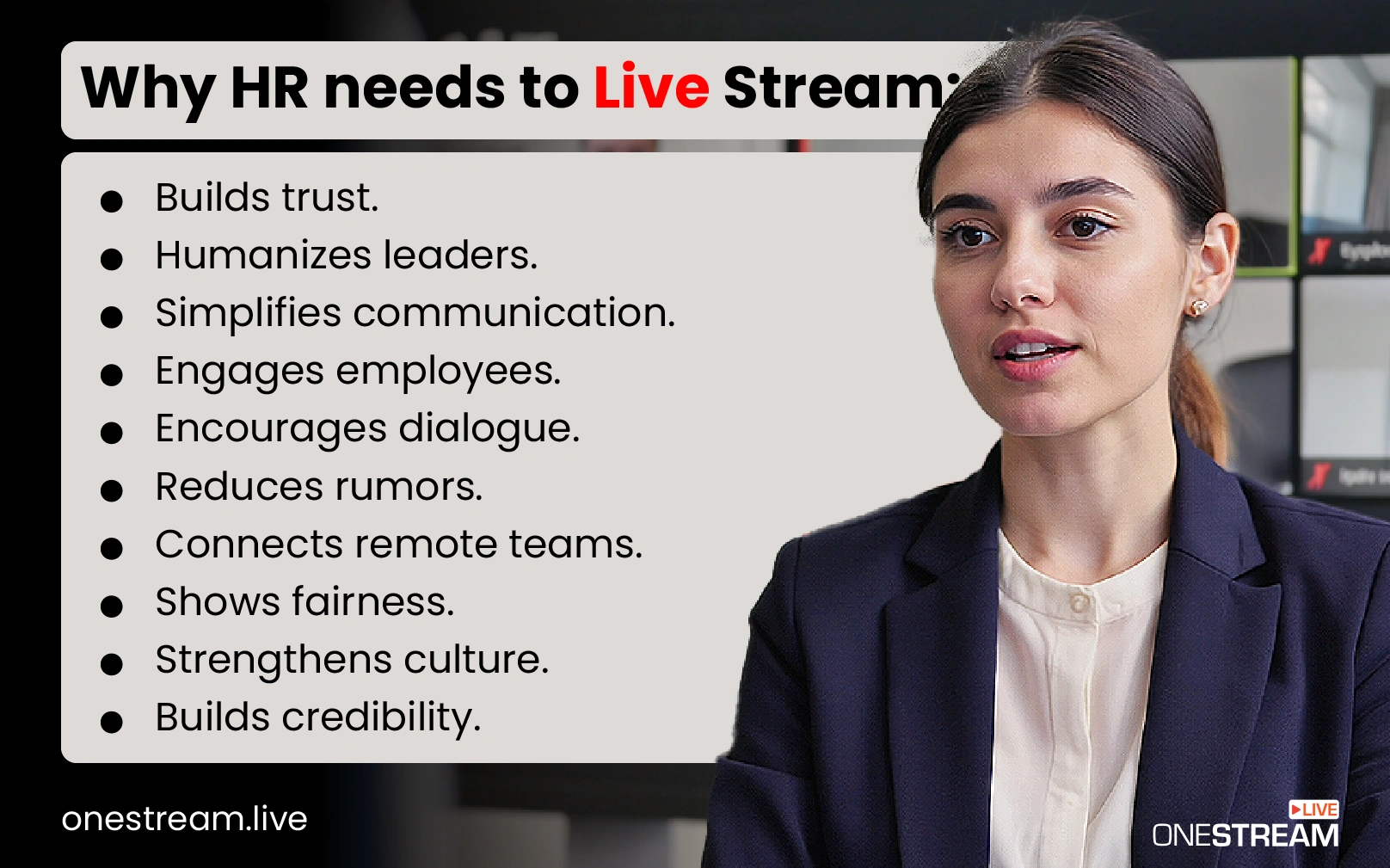
1. Builds trust
When employees can witness the review framework being discussed openly, it assures them that evaluations are handled objectively. Transparency in process translates to greater trust in outcomes.
2. Humanizes leaders
Seeing leaders speak directly on a live feed – acknowledging challenges and explaining decisions – makes leadership more relatable. It puts faces to the process, not just names on an email.
3. Simplifies communication
A live broadcast delivers a single, consistent message straight from HR, reducing the “telephone game” effect of rumors. Complex review criteria can be explained clearly in plain language.
4. Engages employees
The interactive nature of live video (especially with chat and Q&A) holds employees’ attention better than text memos. Using an interactive live streaming platform with polling or chat features encourages employees to actively listen and participate.
5. Encourages dialogue
Rather than grumbling in private, staff can pose questions in real time. This two-way dialogue helps clarify misconceptions immediately and makes employees feel heard in the moment.
6. Reduces rumors
When information is shared openly, there’s less void for misinformation to fill. A live explanation of how promotions were decided leaves little room for the whisper network to invent stories.
7. Connects remote teams
In a hybrid world, a webcast online lets distributed employees all receive the same message simultaneously. Live streaming bridges geographic gaps, ensuring remote workers aren’t left out of important conversations. Many companies also pair their HR system with staff scheduling software to keep workloads balanced, which supports a fairer context for performance evaluations.
8. Shows fairness
Explaining the criteria and calibration process publicly demonstrates that decisions aren’t arbitrary. Employees can see that each person was measured by the same standards, which reinforces perceptions of fairness.
9. Strengthens culture
Openness during tough processes reinforces a culture of transparency. Over time, consistently streaming these sessions signals that “this is how we do things here” – with honesty and clarity – which becomes part of your cultural DNA.
10. Builds credibility
Finally, leadership credibility grows when you’re willing to “show your work.” Admitting the process isn’t perfect, but still openly walking everyone through it earns far more respect than a polished-but-secretive approach ever could.
Corporate Live Video Streaming Guide for HR
There’s a misconception that transparency means revealing every individual’s performance review to the whole company. It doesn’t. Going live with your talent review process is more about showing the recipe, not each person’s specific dish.
In practice, live webcasting solutions allow HR to broadcast the framework and criteria behind reviews without exposing any private details about individuals. You maintain confidentiality and demonstrate fairness simultaneously.
The medium itself makes a difference. People today watch an average of 18 hours of online video per week, and 59% of executives say that if text and video are on the same topic, they prefer to watch the video.
We’re all wired to absorb information through video. So why not use that for internal communication? Employees are already accustomed to livestreams and webinars in other contexts. Bringing that format into HR communications meets staff where they are.
So, what should you actually stream during a talent review cycle? The framework, not the files: focus on the process and data in aggregate, not individual cases.
For example, you might broadcast elements like:
- Pre-review explainer: Before managers begin evaluations, host a short livestream to walk through the performance criteria and competencies. Show the 9-box grid or rubrics managers will use. Explain how a “meets expectations” vs. “exceeds expectations” rating is defined, using anonymized examples.
- Post-review insights: After completing talent reviews, share an anonymized summary of outcomes. For instance, broadcast a few slides with the distribution of performance ratings across the company, the percentage of employees in line for promotions, and common development themes identified. Employees get to see the big-picture results and know that there was a method behind them.
- “How We Decide” sessions: Each quarter, live-stream a town hall where HR leadership discusses how talent decisions (promotions, succession planning, raises, etc.) are made. This could be a recurring internal live streaming corporate event focused on decision-making transparency. Leadership can reiterate the frameworks and address common questions or concerns that came up.
- Live Q&A forums: Perhaps most powerfully, open the floor to questions. Hold a livestreamed Q&A where any employee can anonymously submit questions about the process (“Does tenure factor into promotions?”) and get an immediate answer. It’s not about discussing individual cases, but rather policies and practices. Real-time answers, with the whole organization listening, prevent misconceptions from festering.
The beauty of going live is that interactive chat and Q&A. For instance, if someone asks whether a certain department’s goals are weighted more heavily in reviews, HR can address it on the spot for everyone’s benefit.
Compare that to the old way: concerns would swirl quietly, or an individual might email HR and wait days for an answer, by which time half the office may have formed the wrong impression. Live streaming for business turns that dynamic around by squashing misinformation in real time.
Importantly, none of this exposes private performance data. You’re showcasing how decisions are made, not airing anyone’s personal review.
Companies that have started using internal live streams in this way report improved transparency and a stronger sense of inclusion, especially among remote employees who often felt “in the dark” before. When leadership regularly faces the workforce via live video, it sends a clear message that there’s nothing to hide.
What Do You Need for Corporate Live Streaming Setup
So, how to live stream an event like a talent review meeting? It’s simpler than ever. The resources to implement all of the above already exist, and are usually in two layers. With the right tools in each layer, even a small HR team can pull off a polished internal webcast.
- First, you need a solid foundation for data management (your HR system where performance data lives).
- Second, you need a communication layer for broadcasting the message (your streaming platform).
1st Layer: Data Management
On the data side, your HR management system (e.g., performance management software such as Factorial) provides a credible foundation. You can’t be transparent about your process if you don’t have a consistent process to begin with!
A system like Factorial HR helps standardize everything behind the scenes. It tracks competencies, consolidates 360° feedback, and generates objective performance analytics.
It does the cumbersome task of translating subjective manager assessments into reliable data. That means when you go to explain a promotion decision, you can point to objective metrics and charts rather than gut feelings.
2nd Layer: Communicating the Message
Now, the second layer is the broadcasting tool. To truly open up your process, you’ll use a live streaming platform to reach your workforce. This is where OneStream Live comes in.
OneStream Live is a feature-rich live streaming video platform built for corporate communications. You don’t need any fancy AV crew, just schedule your session, and OneStream Live handles the rest.
Here’s a practical way to integrate the pieces:
- Create data visuals: Pull reports and analytics from Factorial to design clear slides or charts (e.g., rating distributions, performance summaries).
- Schedule your webcast: Use OneStream Live’s event scheduler to plan a quarterly transparency session.
- Go live professionally: Host the session via OneStream Live’s web-based Studio, which supports:
- Live video production
- Screen-sharing
- Guest invitations
- Multistreaming across multiple destinations (e.g., intranet + private YouTube or Teams channel)
- Record and archive: Save the broadcast and upload it to Factorial’s employee portal or your internal HR hub for on-demand viewing.
- Close the feedback loop: Review questions raised during the live Q&A, address them in your next session, and keep improving clarity and trust each quarter.

With the right tech stack in place, the question becomes: if your talent review process is truly fair and data-driven, what’s the risk in explaining it? There is none. By pairing a data-rich HR system with a reliable corporate live video streaming platform, you make transparency scalable.
Conclusion
As live streaming platforms and livestream software become embedded in workplace infrastructure, early adopters of corporate live video streaming for HR processes build trust reserves that weather future challenges. The gap between what leadership knows about fairness efforts and what employees perceive widens without active transparency.
Your talent review decisions impact careers, livelihoods, and team dynamics. When 72% of workers already doubt the process, why not show them how it actually works?

Frequently Asked Questions
Stream the process and framework, not the individual outcomes. Focus on competency definitions, rating distributions anonymized by department, promotion criteria, and decision-making methodology. This approach proves fairness without privacy violations.
Video webcast solutions and corporate live streaming platforms are often used interchangeably today. True live streaming platforms like OneStream Live offer interactive features like guest invitations, real-time chat, polling, that transform passive video broadcasts into participatory experiences.
Quarterly transparency sessions work well—one pre-review orientation, one mid-cycle update, one post-review data session, and one annual process audit. This cadence keeps transparency visible without overwhelming employees.
No. Corporate streaming services should complement official documentation, not replace it. Recorded sessions serve as reference materials and onboarding resources, but written policies remain the authoritative record.
OneStream Live offers branded live studio capabilities, guest features for multi-speaker sessions, real-time audience engagement tools, and multistreaming to internal platforms. For corporate video streaming, these features create professional, participatory experiences that build credibility.
Live streaming for business sessions is broadcast to internal channels and can be accessed via a link. Recording them means remote teams in different time zones can participate asynchronously without missing the dialogue.
OneStream Live is a cloud-based live streaming solution to create, schedule, and multistream professional-looking live streams across 45+ social media platforms and the web simultaneously. For content-related queries and feedback, write to us at [email protected]. You’re also welcome to Write for Us!