
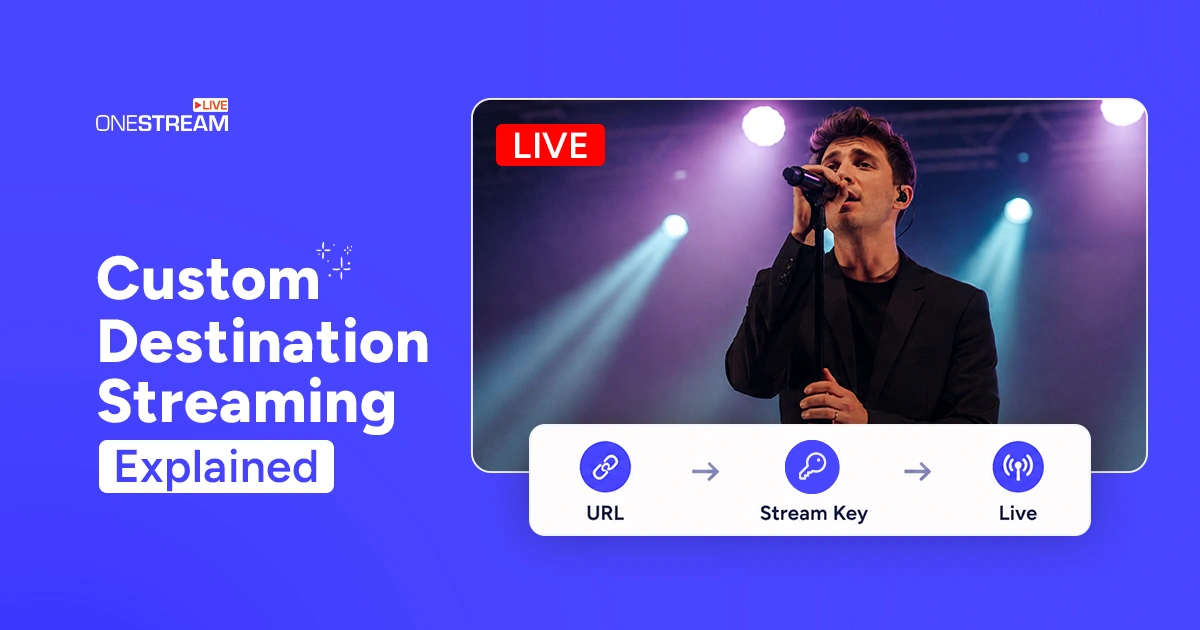
Most streaming tools give you a list of platforms to connect to. Custom destination streaming is what you use when the platform you want isn’t on that list.
It works because almost every platform that accepts live video accepts it the same way, through a server URL and a stream key. Give OneStream Live those two values and it will send your broadcast there, exactly as it does to a native integration.
That counts most when something new arrives. A platform launches, everyone moves there, and the integrations take months to follow. Custom destination streaming means you’re there on day one.
- Custom destination streaming sends your broadcast to any platform that accepts a server URL and a stream key.
- It exists for the destinations that aren’t natively integrated, which is where most private and specialist platforms sit.
- You add a custom destination once, and it then works with every kind of stream you run.
- Both values always come from the destination platform, never from OneStream Live.
- Your stream key is a password, so anyone holding it can broadcast to your channel.
What is Custom Destination Streaming?
Custom destination streaming lets you broadcast live video to any platform or server that accepts an RTMP or RTMPS URL and stream key.
A native integration handles the connection for you. You sign in, approve access, and your channel appears in your destination list. A custom destination puts you in charge of the connection instead. You collect two values from the platform, paste them in once, and it behaves like every other destination from that point on.
RTMPS is the encrypted version of RTMP. If your destination offers both, use RTMPS. Some platforms now require it and will reject a plain RTMP connection outright.
When You Need a Custom Destination
If a platform is already in the Add Platform list, connect it there. A native integration gives you more than a custom one does, and there’s nothing to gain from doing it by hand.
Custom destinations are for everything else:
- Anything new. A platform that launched recently and supports RTMP or RTMPS. You can go live there straight away instead of waiting for an integration.
- Private and self-hosted servers. An internal video platform, a company intranet, or your own RTMP server. These will never be a native integration, because they only exist for you.
- Specialist and regional platforms. Industry-specific services, community platforms, and platforms serving a single market.
How to Add a Custom Destination in OneStream Live
- In the left sidebar, under Destinations, click Social Platforms.
- Click + Add Platform.
- Select Custom RTMP.
- In Account Name, give the destination a name you’ll recognize later.
- Paste the Server URL from your destination platform. It starts with rtmp:// or rtmps://.
- Paste the Stream Key, also from your destination platform. It needs to be at least 10 characters.
- Click Connect.
A custom destination only needs setting up once. OneStream Live keeps the connection, so the credential hunt is a one-time job even if you stream there every week.
What You Can Send to a Custom Destination in OneStream Live
A custom destination isn’t a limited version of a native one. Once it’s connected in OneStream Live, every way of streaming works:
- Studio. Go live in real time with scenes, overlays, banners and guests, and send it straight to your custom destination.
- Pre-recorded streams. Upload a video or build a playlist and schedule it to go live at a set time, up to 60 days ahead.
- Encoder Stream. Bring a feed in from OBS, vMix, Wirecast, XSplit or a hardware encoder, and push it back out to your custom destination.
- Multistreaming. Custom destinations sit alongside your native ones. A single broadcast can reach your YouTube channel, your Facebook page and your custom destination at the same time.
Finding Your Server URL and Stream Key
Both values live on the destination platform, in whatever it calls its broadcast or encoder settings. The wording varies more than the concept does.
Watch for these differences:
- The names change. Server URL might be called Stream URL, RTMP URL, Ingest URL or FMS URL. Stream Key might be called Stream Name, Stream ID or Broadcast Key. If a platform gives you one long value and one short one, the long one is almost always the URL.
- Some keys expire. A permanent key stays the same forever. A session key is generated per broadcast and has to be recopied each time. If your stream worked last week and fails today, check this first.
- Some platforms need an event first. They won’t issue credentials until you’ve created and started a broadcast on their side. If the stream key page looks empty, that’s usually why.
- Some add a username and password. Less common, but a few platforms secure their ingest with credentials on top of the URL and key.
A Worked Example: TikTok
- Log in to TikTok on desktop and click Go LIVE in the left sidebar.
- Open Live Producer at livecenter.tiktok.com/producer. If you can’t find it, our TikTok stream key guide covers the full process.
- Pick a category, add a title, and click Save & Go LIVE to generate your credentials.
- Scroll to Stream Settings and copy the Server URL and Stream Key.
- Paste both into OneStream Live and click Connect.
When a Custom Destination Won't Connect
Most failures come down to four things, roughly in order of how often they happen:
- The key is wrong or expired. Recopy it from the source rather than retyping it, and check whether that platform issues session keys.
- Something got copied with it. A trailing space or a line break will break a connection that otherwise looks correct.
- The platform needs RTMPS. If you’re using an rtmp:// URL on a platform that requires encryption, it will refuse the connection. Look for an rtmps:// version of the URL.
- The destination isn’t ready. Some platforms need their own broadcast started before they’ll accept an incoming stream. Your side can be perfect and still show nothing.
Conclusion
Somebody else’s integration list shouldn’t decide where your stream goes. Custom destination streaming means it doesn’t have to.
Once you find where a platform keeps its server URL and stream key, everything else is the same job every time. Paste two values into OneStream Live, connect once, and that destination sits alongside your native ones for good. A private server, a client’s platform, something that launched last month your stream gets there.
Frequently Asked Questions
What is custom destination streaming?
It’s a way to stream to a platform that isn’t natively integrated. You paste in the platform’s server URL and stream key, and your broadcast reaches it like any other destination.
Is it safe to share my stream key?
No. Treat it like a password, since anyone holding it can broadcast to your channel. Most platforms let you reset it if you think it’s been exposed.
Can I stream to a custom destination from my phone?
Yes. Destinations are set on your account rather than on a device, so anything you connect on the web is ready to use in the OneStream Live mobile app too.
What's the difference between RTMP and RTMPS?
RTMPS is the encrypted version. Use it whenever your destination offers it, and note that some platforms no longer accept plain RTMP at all.
Can I stream to a custom destination and my social platforms at the same time?
Yes. In OneStream Live, custom destinations behave like any other destination, so one broadcast can go to your native platforms and your custom ones together.
OneStream Live is a cloud-based live streaming solution to create, schedule, and multistream professional-looking live streams across 45+ social media platforms and the web simultaneously. For content-related queries and feedback, write to us at [email protected]. If you have a story to share about your live streaming experience with OneStream Live, we would be glad to feature it. You’re also welcome to Write for Us!