

There was a time when “Microsoft Office” on a résumé signaled workplace competence. Today, AI skills are becoming the new baseline. AI has embedded itself into businesses in just a few years. We now regularly see ads about how an AI tool can help your business, and thousands of AI tools have already been launched. The number keeps increasing. This guide highlights the best AI tools for businesses. These are the top options to try in 2026. Each tool can help businesses run operations more efficiently or improve their marketing efforts in practical ways.
- The best AI tools for businesses focus on solving specific problems rather than trying to do everything.
- Businesses get the most value from AI by using a combination of tools across marketing, sales, and operations.
- Small and midsize businesses use AI tools mainly to reduce manual work and improve day-to-day efficiency.
- Content creation, marketing, and sales are among the most common areas where AI tools deliver quick results.
- AI tools also support operations management by automating processes and improving decision-making.

AI in Business 2026: Key Statistics and Trends
Recent data from 2025–2026 shows a rapid acceleration in AI adoption, investment, and workforce usage across organizations of all sizes.
- Widespread Adoption: Approximately 78% of organizations now use AI in at least one business function, a sharp rise from 55% just a year earlier. Moreover, 83% of companies say AI is a top priority in their business strategy, which highlights how critical AI has become for competitive advantage.
- Growing investment in AI: The vast majority of companies are ramping up AI investments. In fact, 92% of organizations plan to invest in generative AI technologies within the next three years. This investment rush is fueled by the promise of high returns and early studies report an average $3.70 return for every $1 invested in AI initiatives.
- Small Business Uptake: AI isn’t just for big corporations. 57% of U.S. small businesses are now investing in AI technology (up from 36% in 2023) and nearly one-third of their employees use AI tools daily. The average small business worker saves 5.6 hours per week by using AI.
- Rapid Growth of Generative AI: The use of generative AI (like AI chatbots and content generators) exploded recently. It jumped from 33% of organizations using it in 2023 to 71% in 2024 as companies experiment with AI for writing, image generation, and coding.
Best AI Tools for Businesses in 2026
Businesses often ask this question: What is the Best AI for Business? There is no single “best” AI for every business. Different tools excel at different tasks. An AI that is great for marketing may not help with operations management. The smartest approach is to use a mix of AI tools tailored to your needs.
Below are some of the top options in 2026.
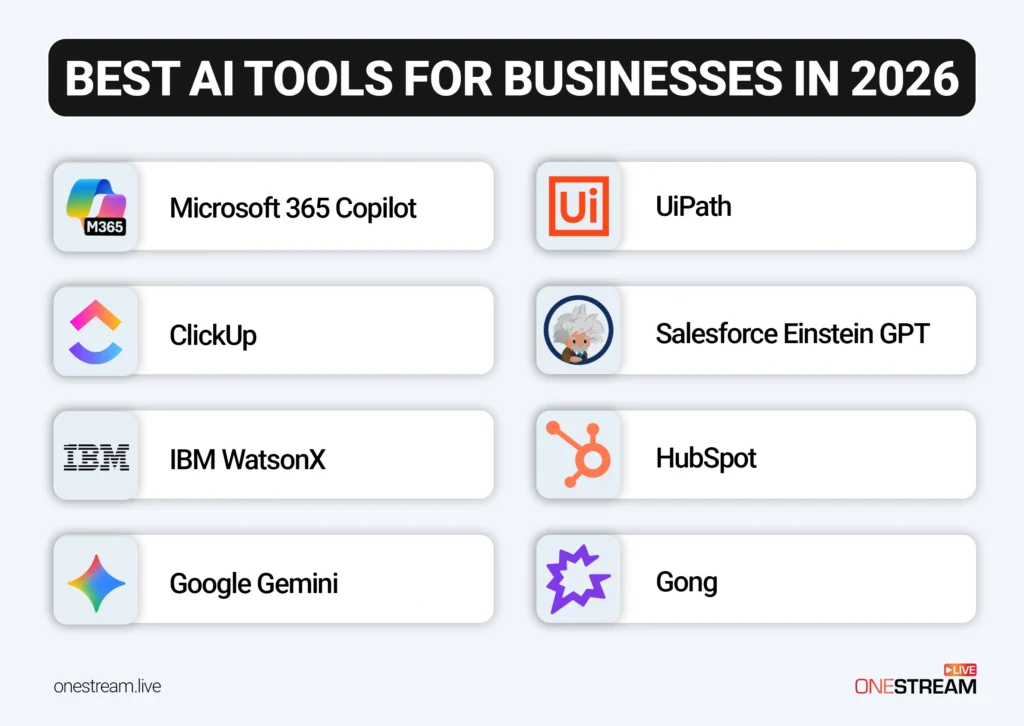
Microsoft 365 Copilot
Microsoft 365 Copilot brings AI assistance into everyday office work. It is built into Word, Excel, PowerPoint, Outlook, Teams, and more. Copilot can summarize long emails, draft documents, analyze spreadsheets, and generate meeting notes from conversations. It acts like an intelligent assistant that understands your business context via Microsoft Graph data.
For example, you can ask Copilot to create a project plan from a Word outline or highlight action items from a Teams meeting. Copilot also goes beyond single tasks. It offers AI “agents” that automate workflows like onboarding or inventory updates.
All this happens securely within your Microsoft 365 ecosystem, so your data stays protected. If your company runs on Microsoft tools, Copilot is a powerful AI for business operations and productivity.
Marlee
Marlee is an AI-powered collaboration and performance platform designed to improve team performance by helping organizations understand what drives people at work. It uses a science-backed motivation assessment to analyze individual work styles, communication preferences, and behavioral patterns, allowing teams to make more informed hiring and management decisions.
With its AI coaching capabilities, Marlee goes beyond assessment by providing personalized guidance for individuals and teams. For example, managers can use Marlee to better align team roles with each person’s strengths, while employees receive actionable suggestions to improve collaboration and productivity.
Marlee also supports talent development by turning behavioral insights into practical actions. Instead of relying on guesswork, organizations can use its data-driven recommendations to nurture growth, improve engagement, and build high-performing teams over time.
By focusing on human motivation and team dynamics, Marlee helps businesses create more effective, collaborative, and resilient workplaces.
Salesforce Einstein GPT
Salesforce Einstein GPT is an AI built into the Salesforce CRM platform. It uses your customer and sales data to generate content and insights across sales, service, and marketing. For example, Einstein can auto-write personalized sales emails or draft answers for customer support chats.
It can also create tailored marketing content for different audiences across email, web, and ads. By connecting to real-time CRM data, Einstein GPT adapts its outputs to each customer’s context. Sales teams use it to get next-step suggestions and deal insights. Marketers use it to generate campaign copy and even HTML code for emails.
In short, Einstein GPT delivers tailored AI marketing solutions and sales assistance inside the tools businesses already use. It’s an enterprise-grade AI that can save time and deepen customer engagement.
Read More: Top AI Tools to Repurpose Your Live Streams
IBM WatsonX
IBM WatsonX is an enterprise AI platform for business developed by IBM. It enables companies to build custom AI models, deploy AI solutions, and govern AI workflows all in one place. Businesses use WatsonX (the evolution of IBM Watson) to automate processes and support data-driven decisions across AI in operations management.
For instance, banks use it to detect fraud patterns, and manufacturers use it to predict equipment failures. WatsonX is known for its focus on AI governance, which makes sure that the AI decisions are explainable and compliant with regulations (important in industries like finance).
According to IBM, about 42% of enterprises are actively using AI in their business, and another 40% are experimenting with it. WatsonX addresses the needs of these enterprises by providing a secure, scalable environment for AI projects. It is one of the leading AI tools for enterprises, especially for those who require robust data management and trust in their AI systems.
Google Gemini
Google Gemini is an all-in-one AI platform for business tasks. It works like a chatbot (similar to ChatGPT) but offers much more. Gemini can generate images, write code, and summarize documents quickly. It deeply integrates with Google Workspace apps like Docs, Sheets, and Gmail.
This means it can suggest edits in a Google Doc or help build formulas in Sheets in real time. For teams already using Google tools, Gemini provides a huge productivity boost. You can start with Gemini for free (with some limits), and upgrade to access its most advanced models. In short, Gemini combines creative and analytical AI skills in one platform, which makes it a top choice for businesses in 2026.
UiPath
UiPath is a popular platform for automation that combines RPA (robotic process automation) with AI. It works well for automating repetitive tasks in everyday business operations and is widely used as one of the AI tools suitable for small business operations. UiPath’s bots can click, type, and interact with software just like a person, but much faster.
With AI features, these bots can also understand unstructured data (like reading PDFs or scanning invoices) and make simple decisions. For example, a company can use UiPath to automatically process invoices: the AI extracts relevant fields, and the bot enters them into the accounting system. UiPath also offers AI Computer Vision, which lets bots “see” the screen to work with applications that don’t have an API.
This tool is suitable for small business operations as well as large-scale enterprise processes. By automating routine work (data entry, form processing, etc.), UiPath helps businesses save time and reduce errors. Employees are freed from boring tasks and can focus on more strategic work.
Read More: Best AI-Based Video Editing Tools for Content Creators
ClickUp AI
ClickUp is a work management tool, and its built-in AI assistant makes project workflows even smoother. ClickUp AI can generate task lists, draft content, and summarize information right inside your tasks. For example, if you have meeting notes, the AI can instantly pull out action items and assign them to team members.
It can also help write things like project updates or blog outlines when you prompt it. Small teams find ClickUp AI handy for speeding up documentation and planning. The AI can analyze a long chat or document and give you a brief summary, which is great for busy managers.
ClickUp’s AI is suitable for small business operations because it’s easy to use and integrates with the platform’s dashboards and reminders. Instead of juggling multiple apps, teams can rely on ClickUp to handle scheduling, to-do lists, and now some writing and research via AI.
By automating these administrative chores, ClickUp AI helps teams stay productive and organized without extra effort.
HubSpot (ChatSpot & Breeze AI)
HubSpot has integrated AI across its CRM and marketing platform, with a focus on AI for sales and marketing. One of its tools is ChatSpot, an AI chatbot assistant that lets you use natural language to interact with your CRM. You can ask it to pull up contact info, draft a follow-up email, or generate a quick report, all by chatting instead of clicking through menus.
HubSpot has also introduced Breeze AI, which includes AI agents and features throughout the platform. These capabilities make HubSpot one of the most practical AI tools for marketing teams that want to scale outreach without losing brand consistency.
For example, a Prospecting AI Agent can research leads and craft personalized outreach emails using your brand tone and CRM data. A Content AI can write blog posts or social media updates based on prompts, and an AI Email Writer helps create marketing emails quickly. HubSpot even offers a Personalization Agent that builds tailored website content and CTAs for different customer segments.
Many of these AI features are available to HubSpot users at no extra cost (or included in its plans). This makes HubSpot’s AI a powerful platform for business growth, especially for small and midsize businesses. It automates repetitive marketing and sales tasks and provides data-driven insights, all while keeping a personal touch with prospects and customers.
Pro Tip: Use AI to create content faster, then multistream that content through live or scheduled streams using OneStream Live to reach more people across platforms.

Gong
Gong is an AI-powered tool for sales teams, known as a “revenue intelligence” platform. It listens to sales calls, reads emails, and analyzes meetings to give salespeople actionable insights.
Gong’s AI transcribes calls and uses NLP to gauge customer sentiment and topics discussed. After a call, it might tell a rep which product features resonated with the client or if the rep did not discuss pricing when they should have.
Managers use Gong to spot coaching opportunities. For instance, seeing that top performers talk less and listen more, or use certain phrases that win deals. Gong essentially turns AI for sales into a data-driven coach.
It can also forecast sales by analyzing deal progression and communication patterns. Studies have shown that sales teams using AI insights like Gong often see higher win rates and more revenue per rep.
In fact, teams that deeply use AI in their sales process generate 77% more revenue per representative than those that don’t. By highlighting what works (and warning about what doesn’t) in sales interactions, Gong helps businesses refine their sales tactics. It’s like having an AI sales analyst that makes every rep in the team more effective.
Final Thoughts
Businesses that start using AI tools now are better prepared to grow. The tools covered above support different needs, from marketing to daily operations, and help teams get more done with less manual work. What matters most is how these tools are used together.
If your business creates content or runs live sessions, OneStream Live helps make better use of that content. It allows teams to schedule or multistream live and pre-recorded videos across multiple platforms from one place. This makes it easier to stay consistent and reach people where they already spend time.
In the end, the right mix of AI tools for businesses can help teams work more efficiently and communicate more clearly in 2026 and beyond. Starting early gives businesses time to understand what works and apply it in practical ways.

Frequently Asked Questions
Why should businesses actively invest in AI tools in 2026?
AI in 2026 is no longer experimental and now directly saves time, reduces costs, and improves decision-making across teams.
Are AI tools only useful for large enterprises?
No, many AI tools are designed for small and mid-sized businesses and deliver value without requiring big budgets or technical teams.
How do businesses choose the right AI tool for their needs?
The right AI tool is the one that solves a specific workflow problem rather than adding another layer of complexity.
Do AI tools replace employees or support them?
Most AI tools support employees by automating repetitive work so humans can focus on strategy, creativity, and judgment.
What is the biggest mistake businesses make when adopting AI tools?
The biggest mistake is adopting AI for hype instead of aligning it with clear business goals and measurable outcomes.
OneStream Live is a cloud-based live streaming solution to create, schedule, and multistream professional-looking live streams across 45+ social media platforms and the web simultaneously. For content-related queries and feedback, write to us at [email protected]. You’re also welcome to Write for Us!