
In 2026, many content creators are exploring YouTube alternatives for live streaming to broaden their reach and take control of their content. This is mostly due to YouTube’s strict policies.
However, the desire for a more niche community is also turning streamers to other platforms like YouTube that offer different audiences, monetization models, and features. In this guide, we evaluate five of the best alternatives to YouTube for live streaming: Facebook Live, Twitch, Rumble, Kick, and Vimeo.
We’ll look at each through a consistent lens. We’ll examine who each platform is best for, how they handle monetization, their unique features, and any limitations.
By the end, you’ll know which alternative streaming platforms might suit your needs and how to use them (including a bonus tip on using OneStream Live to multistream on all these sites similar to YouTube). Let’s dive in!
- Explore 5 top YouTube alternatives for live streaming in 2025.
- Compare platforms like YouTube: Twitch, Facebook, Rumble, Kick, and Vimeo.
- Find the best video streaming services like YouTube for monetization, reach, and freedom.
- Use OneStream Live to multistream on all major sites similar to YouTube.
Why is Facebook Live a Good YouTube Alternative?
Is Facebook Live a viable YouTube alternative for live streaming? In many cases, yes. especially if you already have an audience on Facebook.
Facebook Live is the live broadcasting feature of Facebook, the world’s largest social network with over 3 billion monthly active users. This massive user base means your streams have the potential to reach a broad demographic.
If you have followers on a Facebook Page or friends on your profile, going live notifies your network instantly, which can drive immediate viewership.
1. Key Features
Facebook Live allows streaming from mobile or desktop, and you can go live on a personal profile, a Page you manage, or even within Facebook Groups for more targeted audiences. The platform integrates real-time comments and reactions that let your viewers interact instantly.
Streams can be saved to your timeline for later viewing, and basic analytics are provided (view counts, engagement metrics). Facebook also offers some monetization options: for gaming streamers, the Level Up program and Stars (a viewer donation feature) allow fans to tip creators.
Read the Ultimate Guide on How to Start Live Streaming on Facebook
Some pages can also insert in-stream ads, but Facebook’s monetization for live video has restrictions and typically requires you to meet eligibility criteria (e.g., follower count, hours watched).
2. Audience & Niche
Facebook Live appeals to a wide range of content. It’s ideal for creators who want to use an existing Facebook following or who produce content suited to mainstream social media viewers (like lifestyle streams, Q&As, educational talks, etc., often aimed at friends, family, or a brand’s customers).
The audience skews toward adult users (a majority are millennials, boomers and Gen X), and the vibe is more general-audience than the gaming-centric culture on Twitch
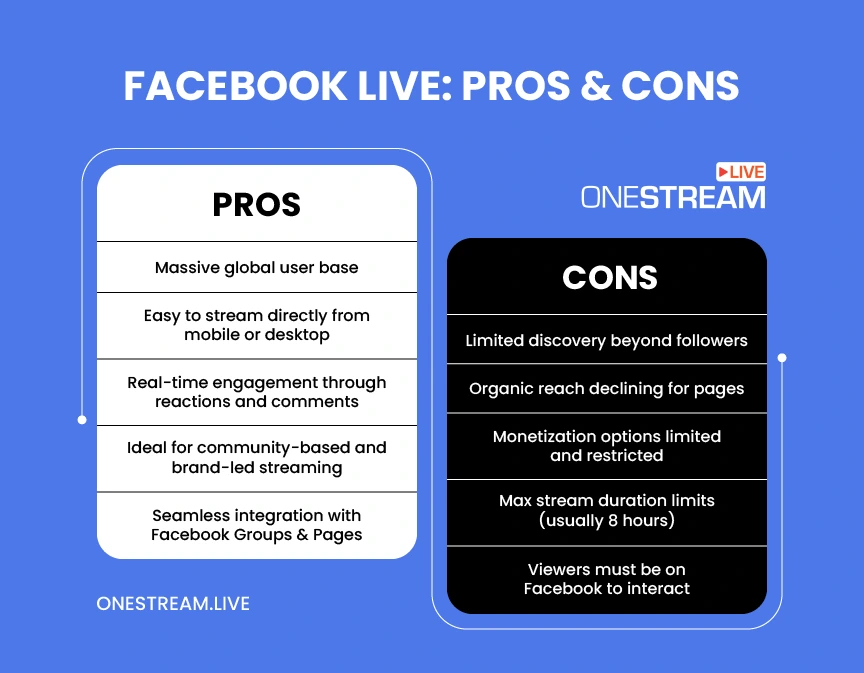
3. Pros & Cons
4. Monetization Options
Finally, monetization on Facebook Live is not as straightforward or profitable for most creators. Only certain countries and pages can earn ad revenue, and while fans sending Stars is nice, it usually yields modest income unless you have a very large, supportive viewership.
In fact, Facebook’s share of total live-stream watch hours is under 1%, indicating it’s not a primary destination for live stream fans on a global scale. Privacy concerns are another con often mentioned, as some viewers are hesitant to engage with live videos on Facebook because their names and profiles are visible to others when they comment or react.
Why is Twitch a Good YouTube Alternative?
When it comes to video platforms like YouTube focused purely on live content, Twitch is the king of the hill. Twitch is often the first name that comes up from the list of YouTube alternatives, and for good reason.
It’s a platform built from the ground up for live broadcasting, with an emphasis on gaming, esports, and creative content.
1. Key Features
Twitch’s community engagement tools really differentiate it from others. Live chat on Twitch is central to the experience, as it’s fast-moving and deeply integrated into the show, often with custom emojis (emotes) that become part of a streamer’s brand.
Moderation tools and bots help manage the chat at scale. Viewers can follow for free or subscribe for perks, and the platform has features like raids (sending your viewers to another channel after your stream), which foster a collaborative community spirit.
Read Blog on How to Start Live Streaming on Twitch
Discoverability on Twitch is based around categories (usually games or themes) and viewer count rankings; while it’s tough for newcomers in a big category, viewers specifically looking for, say, “Valorant” streams will be browsing in that section and might find a new channel. This category system means Twitch is very good for gamers who can slot themselves into the game directory of their choice.
Another feature is Twitch Clips, allowing viewers to capture short highlights from streams, which can go viral and attract new fans. Twitch also lets streamers save past broadcasts (VODs) for a limited time (60 days for Partners, 14 for others) and create highlight reels.
2. Audience & Niche
Twitch started with gamers and to this day is heavily gaming-centric. In recent years, it has diversified somewhat (“Just Chatting”, music, art, talk shows, and other categories are popular), but the culture and core audience remain young and gaming-savvy.
In 2023, Twitch averaged around 2.3 million viewers concurrently at any given moment, and it accounted for about 60% of all live-stream watch hours in a recent quarter, making it the single largest live streaming platform by engagement. This dominant position shows that dedicated streaming fans tend to flock to Twitch over other services.
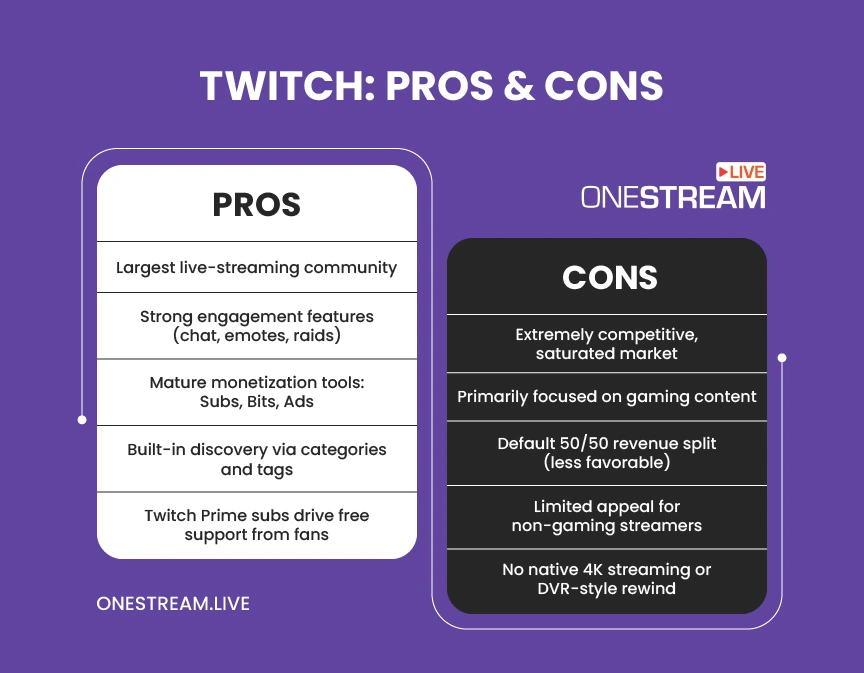
3. Pros and Cons
4. Monetization Options
Twitch offers a robust (though competitive) path to monetization. Anyone can start streaming on Twitch, but to earn money, you need to reach Affiliate level (50 followers and a small amount of watch time) or Partner level for more perks.
Monetization tools include channel subscriptions (paid monthly by fans for perks like emotes and badges), Bits (a virtual tipping currency), and advertising. Notably, Twitch’s revenue split has been a point of contention: most streamers get a 50/50 split on subscriptions (Twitch takes half) and roughly a similar share on ad revenue after certain deductions.
Read Blog on How to Become a Twitch Affiliate: A Complete Guide
Top partners can get a 70/30 split for subs, but this is not common. Compared to YouTube’s 70/30 split on channel memberships (and ~55/45 on ads), Twitch isn’t more generous, and indeed Kick and Rumble have forced competition by offering creators much better deals.
That said, Twitch’s monetization ecosystem (Twitch Prime subs via Amazon, hype trains, gifting subs, etc.) is very mature and can be lucrative if you build a dedicated fanbase. Many streamers also receive direct donations via third-party integrations and make money through sponsorships due to Twitch’s influencer culture.
Read Blog on How to Set Up Donations on Twitch?
Finally, Twitch’s content policies and moderation have been known to be strict in some areas (e.g. ,DMCA music rules are heavily enforced, certain on-stream behaviors can lead to bans). While not as often labeled “censorship” in the political sense, Twitch does have a lot of rules streamers must follow to avoid suspensions.
Why is Rumble a Good YouTube Alternative
If you’re interested in sites like YouTube without restrictions on content or political commentary, Rumble may be the platform for you. Rumble is a video sharing platform that emerged as a “free speech” alternative to YouTube.
It initially focused on allowing creators who felt stifled by YouTube’s policies to share videos (especially in news, politics, and other contentious arenas) without fear of demonetization or removal, as long as the content is legal. In recent years, Rumble has also expanded its live streaming capabilities, aiming to compete with YouTube and Twitch by attracting live streamers.
1. Key Features
Rumble’s interface and features are simpler than YouTube’s or Twitch’s, reflecting its newer status. You can stream in HD, and there’s a live chat for interaction.
Rumble has a discovery feed and trending section that sometimes promotes viral content or big streams, which can funnel viewers to your stream if it gains traction. They also have a unique offering: Rumble allows creators to choose how to license their content.
You can keep full rights, or allow Rumble to distribute your videos (even to third parties) for a higher revenue share. This is more relevant to uploaded videos than live streams, but it shows Rumble’s focus on helping creators monetize content widely.
The site and apps are still evolving, as some users find Rumble’s streaming tech a bit behind (for instance, fewer options on stream quality or DVR features, and the site UI is not as polished). However, viewers can follow channels and get notified of new streams, and Rumble’s community features are improving as the platform matures.
2. Audience & Niche
Rumble’s user base is smaller than YouTube’s, but it’s growing fast. By late 2024, Rumble reported about 68 million monthly active users, and the platform saw a surge of new viewers, particularly during major political events (for example, it hit over 1 million concurrent viewers during the 2024 U.S. presidential debate streaming).
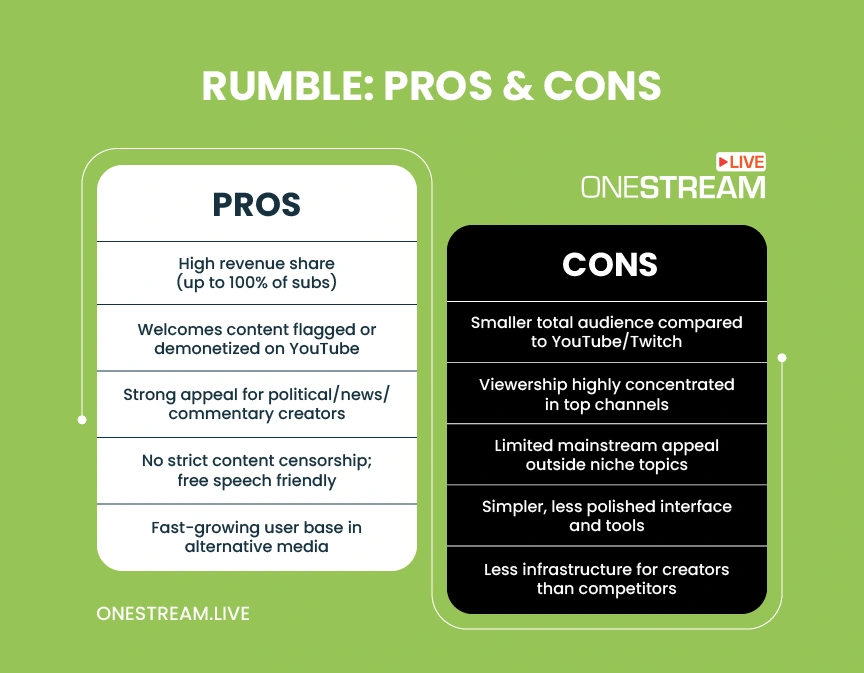
The audience on Rumble tends to lean toward news, politics, and talk content. In fact, the top 10 channels on Rumble (which account for over half of all viewership) are mostly talk shows or political commentators. This reflects Rumble’s reputation as a haven for content that might be controversial elsewhere.
Beyond politics, Rumble is trying to broaden its appeal. It has categories for gaming, sports, and general entertainment and has started signing or attracting well-known streamers. In late 2024, the famously banned Twitch streamer Dr Disrespect began streaming on Rumble, bringing his large fanbase over and signaling that Rumble wants to court gaming viewers too.
So while the core user community is still niche compared to YouTube, the horizons are expanding. If you’re a small creator, Rumble might have fewer total viewers than YouTube, but it also has far fewer creators, so you could find it easier to stand out, especially in non-gaming categories where Twitch is too saturated.
3. Pros and Cons
4. Monetization Options
Rumble’s monetization approach differs from others. It started as a platform that would actually pay creators for video content based on views and licensing.
For live streaming, Rumble introduced programs allowing viewers to subscribe to channels (similar to Twitch subs or YouTube memberships) and to donate via a mechanism called “Rants” during live chats.
Notably, Rumble has offered very generous revenue splits to entice creators. In 2023, they ran a promotion giving 100% of subscription revenue to creators (no cut to Rumble) for a limited time. Going forward, Rumble’s exact rev share isn’t clearly published, but it’s believed to be quite high (perhaps 80/20 or better) in favor of streamers, especially compared to YouTube’s roughly 70/30 or Twitch’s 50/50.
On the advertising side, Rumble shares ad revenue and often touts that its creators can earn more per view than on YouTube because it’s courting advertisers who want to reach Rumble’s audience specifically. Another way Rumble stands out is no minimum requirements to monetize.
Why is Kick is a Good YouTube Alternative
Kick is the newest entrant on our list: a rising star among alternative streaming platforms. If you haven’t heard of it yet, Kick launched in early 2023 as a direct competitor to Twitch, positioning itself as a more creator-friendly streaming service.
In a short time, Kick made headlines by luring some high-profile Twitch streamers and offering unprecedented revenue shares. By 2024, Kick had already carved out about 5.5% of the live streaming market share in terms of watch hours, making it the third-largest live platform virtually overnight. It’s particularly appealing to gaming and IRL streamers who want a fresh start or better monetization than Twitch offers.
1. Key Features
At launch, Kick’s website and interface looked very much like Twitch’s. This familiarity is good because streamers and viewers can jump in with little learning curve.
Kick offers livestreams at high quality (1080p 60fps), a chat with mod tools, and they’ve been rolling out improvements quickly. They support creating clips, and recently added a group streaming feature where multiple streamers can co-stream together (somewhat like Twitch’s Squad Stream, but Kick has been open to more innovative social features).
Read Blog on How to Live Stream on Kick
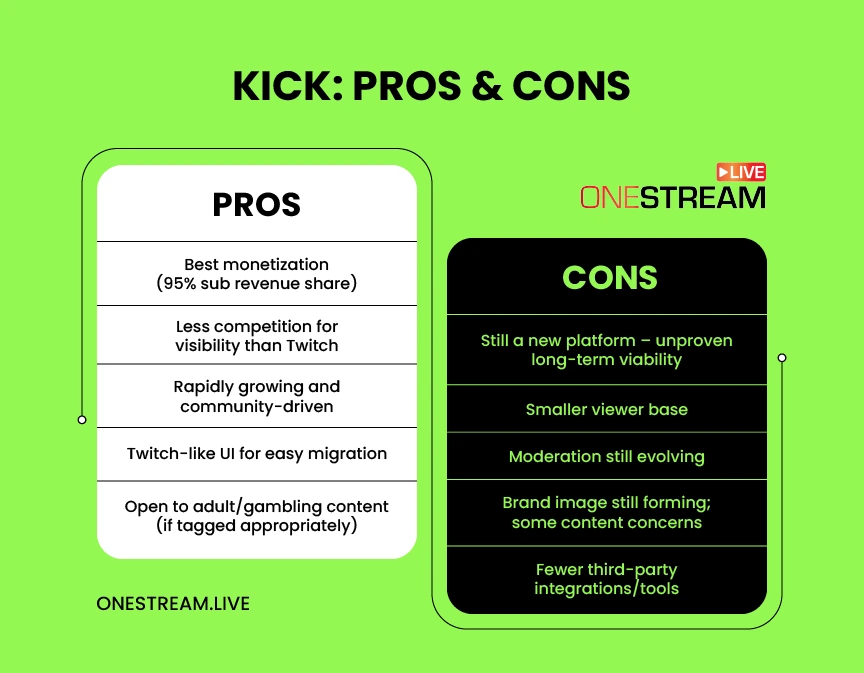
The moderation policy is a bit more lenient than Twitch’s, but they do have rules and active mods. Notably, Kick allows adult content with proper tagging and some limits, which Twitch does not. This has been controversial but also attracted a segment of streamers.
Kick’s mobile app is available, and they continue to refine discoverability. Right now, being new, the community is smaller, so you might find a more tight-knit vibe. Kick also openly courts viewer engagement by being present on social media and listening to community feedback to add features rapidly.
2. Audience & Niche
Kick’s audience and content are very similar to Twitch’s. It’s largely gamers, esports fans, plus some “Just Chatting” and adult entertainment streamers.
Because Kick is new, its absolute viewer counts are still smaller than Twitch’s, but the audience is growing. One advantage for streamers is that competition is lower: while Twitch has millions of channels, Kick in its early days has far fewer streamers vying for attention.
The demographic on Kick also skews young and male (typical gaming crowd), and some communities that felt disaffected by Twitch’s rules (for example, gambling stream enthusiasts or certain edgy personalities) have migrated to Kick.
It’s worth noting that Kick’s brand is still forming. It doesn’t yet have the broad recognition of Twitch or YouTube, but among the gaming community it’s becoming famous for “the place with the crazy good payouts.”
It’s backed by stakeholders in the online gambling industry (the co-founders include a prominent streamer and a casino platform), which influenced some of its early content. So Kick positioned itself as more permissive on content like gambling, within legal bounds.
3. Pros and Cons
4. Monetization Options
Here’s where Kick shines brilliantly. Kick offers creators 95% of subscription revenue, meaning if a viewer subscribes for $5, the streamer gets $4.75, and Kick takes a mere $0.25. This 95/5 split is unheard of on major platforms.
The generosity doesn’t stop there: for donations or “Kick’s currency” (they have a donation system similar to Bits called “Gems” or similar), creators also keep the vast majority. Essentially, Kick is operating on razor-thin margins or perhaps even at a loss to attract streamers with money.
In addition to subs, Kick has a Creator Program that reportedly guarantees some income based on hours streamed and viewers (similar to how YouTube pays from an ad pool). Advertising on Kick is still nascent but they plan to implement it in ways that also favor creators.
Why is Vimeo Live a Good YouTube Alternative
Our final pick is quite different from the others: Vimeo Live. While Facebook, Twitch, Rumble, and Kick are oriented toward public social streaming, Vimeo is known as a professional video platform.
It’s not a social network like the others; instead, Vimeo provides video hosting and streaming services that prioritize quality, control, and branding for creators. Vimeo acquired Livestream.com in 2017, integrating live streaming into its offerings. If you’re looking for YouTube alternatives without the clutter or ads, especially for business or creative projects, Vimeo Live is a compelling choice.
1. Key Features
Vimeo is renowned for video quality. Adaptive bitrate streaming means viewers always get the best quality their connection supports.
Learn More About Adaptive Bitrate Streaming via OneStream Live
Vimeo supports up to 1080p HD live (YouTube, by contrast, supports 4K now, but 1080p is still more than sufficient for most). The platform also offers embed controls, you can easily embed your live player on your own website with no YouTube logo or external distractions, which is great for branding.
You can add custom registration forms for your event to collect emails or other info from viewers. There are interaction features like live chat, polls, and Q&A that you can enable for your viewers, giving a professional webinar-like experience.
Find Out: Vimeo Live vs YouTube Live: Which One is the Best?
Vimeo also provides detailed analytics for your streams (view counts, geographical data, engagement, etc.), and it allows you to archive the live streams for on-demand viewing later. Another pro feature: you can use hardware and software encoders beyond just a webcam. Vimeo integrates well with professional streaming setups and even has its own hardware (like the Mevo camera) to streamline pro broadcasts.
2. Audience & Niche
Unlike YouTube or Twitch, Vimeo is not a destination where millions of random viewers browse for something to watch. In fact, Vimeo’s community is relatively small and tends to consist of creative professionals, filmmakers, and businesses.
The typical use case for Vimeo Live is a company streaming a conference or product launch to clients, a filmmaker streaming a premiere or Q&A to a private audience, or perhaps a church or school streaming an event to members. Viewers usually come to a Vimeo stream via an invite or an embedded video on a website, rather than discovering it on Vimeo’s site.
As such, Vimeo Live is best for professional or niche audiences that you can reach directly. It’s an ideal platform if you want a clean, customizable streaming experience with no ads, and you’re less concerned with spontaneous discovery by the general public.
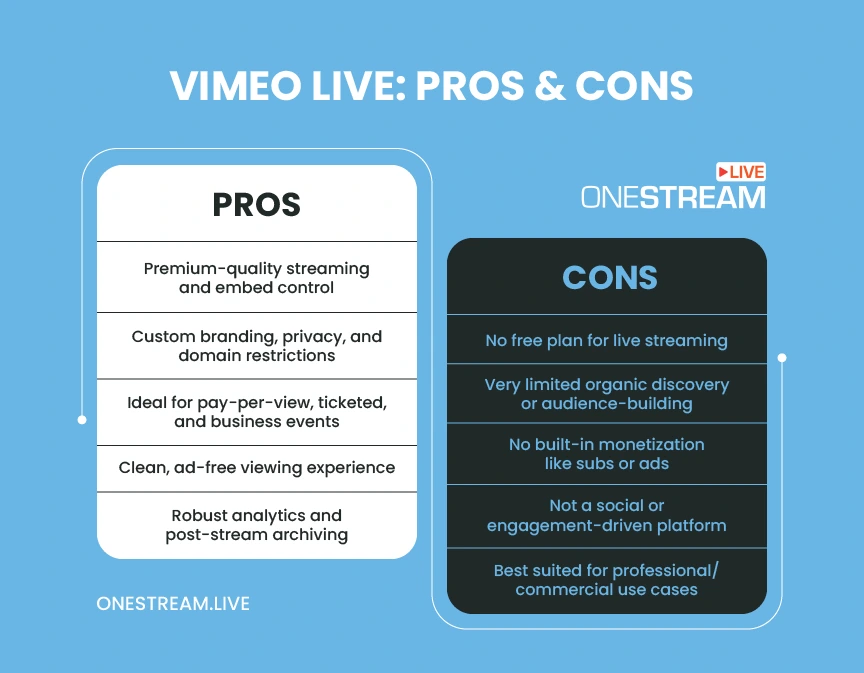
3. Pros & Cons
4. Monetization Options
Vimeo itself doesn’t insert ads or pay you for views. Instead, it offers tools for you to monetize your stream on your own terms.
For example, you can create a pay-per-view event, sell tickets to a live stream, or set up a password-protected stream for paying members. Vimeo has a service called Vimeo OTT (Over-The-Top), which allows creators to build their own subscription video services.
It’s important to note that Vimeo Live is not free: you must have a paid Vimeo plan (Premium or Enterprise) to host live streams. This is a big difference from all the other platforms discussed, which are free to use.
Lastly, stream quality limits at 1080p might be a con for a few people. YouTube offering 4K live streaming can be nice for those with the setup to utilize it, but Vimeo has stayed at 1080p for live (though 4K is available for uploaded vids). Depending on your needs, this may not matter.
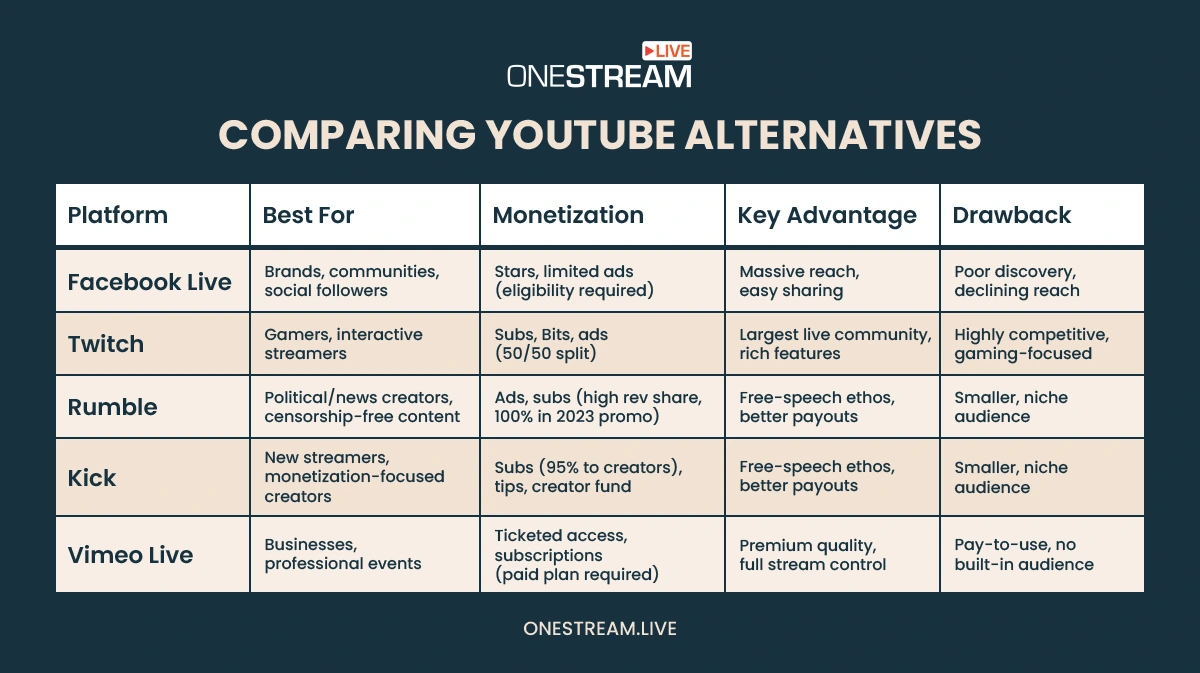
Final Comparison of Top YouTube Alternatives
Bonus Tip: Stream to Multiple Platforms with OneStream Live
Choosing a single platform from all the YouTube alternatives can be tough as each platform has its own audience and perks. What if you could tap into all these platforms at once and see which one gains traction for you?
That’s where OneStream Live comes in. OneStream Live is an all-in-one, cloud-based streaming solution that lets you multistream your content to 45+ social media platforms and the web simultaneously. In other words, with one OneStream Live broadcast, you can go live on Facebook, Twitch, YouTube, Rumble, Kick, and more at the same time.
Final Word
Live streaming in 2025 offers more choices than ever before. While YouTube remains a major player, these YouTube alternatives each provide something unique:
- Facebook Live taps into a colossal social network for immediate, personal connections.
- Twitch promotes a dedicated live community, particularly for gaming and interactive content.
- Rumble promises creative freedom and higher earnings, catering to those seeking fewer restrictions.
- Kick shakes up the status quo with creator-first revenue sharing and opportunities for newcomers.
- Vimeo Live delivers professional-grade streaming for those who need quality and control over reach.
Take a moment to evaluate your needs as a streamer.
Are you after the largest audience (try Twitch or Facebook)? The best payouts (hello Kick and Rumble)? A safe professional space (Vimeo)? Or a blend of each?
Pick one alternative platform from this list and explore it this week. And, go live, even if just to test.
Finally, stay adaptable and keep an eye on trends. If you build a presence on a couple of strong platforms (and utilize tools like OneStream Live to simplify multi-platform management), you’ll be well-positioned to ride the next wave!

Frequently Asked Questions
What is the best YouTube alternative without censorship?
Twitch is the best YouTube alternative for live content if you’re a gamer. Rumble is ideal for creators seeking fewer restrictions. Kick offers the highest monetization. Your choice depends on your content and goals.
Which platforms are like YouTube but without restrictions?
Rumble is the top YouTube alternative without censorship, known for free-speech policies. Kick is also more lenient than YouTube and Twitch on content rules.
Can I stream on Facebook and YouTube at the same time?
Yes. Use a tool like OneStream Live to multistream on both platforms and more. It’s perfect for reaching audiences across video platforms like YouTube.
What’s the best streaming service like YouTube for making money?
Kick offers a 95% sub revenue share, the highest among streaming services like YouTube. Rumble also has generous monetization for live creators.
Which platforms are set to rival YouTube in the future?
Twitch, Rumble, and OneStream Live are increasingly seen as strong contenders to challenge YouTube’s hold on live video in 2025 and beyond.
OneStream Live is a cloud-based live streaming solution to create, schedule, and multistream professional-looking live streams across 45+ social media platforms and the web simultaneously. For content-related queries and feedback, write to us at [email protected]. You’re also welcome to Write for Us!