
Video marketing for SaaS sounds like a growth strategy, but for most teams, it exposes a much deeper problem.
Nobody talks about it, but every SaaS team has one.
A folder, or a Notion page, or a shared Drive full of product explainers, feature walkthroughs, and onboarding decks. Hours of work. Thoughtfully written. Professionally designed. And largely ignored.
Users don’t read them. They poke around the product for ten minutes, hit a wall, and churn. Not because the product is bad. Because they never got far enough to see why it wasn’t.
This is the real conversion problem in SaaS, and it has been there longer than most teams realize. Static content, no matter how polished, can describe a workflow. It cannot show one. That difference matters.
Video marketing closes that gap. It does not add more content to the pile. It replaces the kind of content that does not work with something people actually watch and understand.
Live video helps users understand your product faster
Users convert when they see the product working
Live streaming turns product complexity into clarity
Real time demos build trust and drive adoption
Better understanding leads to higher SaaS conversions
Why Recorded Demos Stop Working
Here is the thing about pre recorded product videos. They are useful. They feel comfortable because you control every frame and every word. But that comfort comes at a cost.
A scripted walkthrough answers the questions you expect. The questions users actually have go somewhere else. They end up in support tickets or stay unanswered, which is worse.
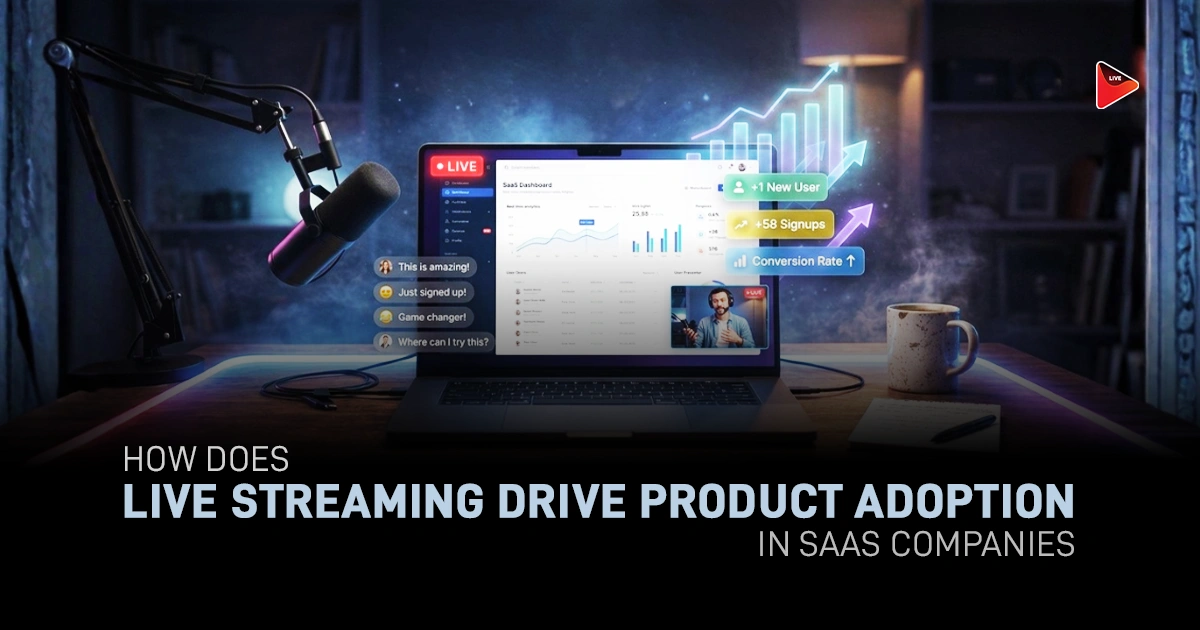
Live streaming changes this. A prospect joins a real session inside the product and asks a question in real time. The host answers it on the spot in front of everyone. That moment may seem small, but it does something a polished video cannot. It shows the product working on a real problem right when it matters.
According to Wyzowl’s State of Video Marketing report, 89% of people say video has convinced them to buy a product or service. In B2B SaaS, where multiple stakeholders are involved, a single live session can build shared understanding much faster than long back and forth communication.
Live content feels more real because it happens in the moment. Buyers can see how the product behaves without edits or cuts. Many have already seen polished demos that did not match the actual experience.
What This Looks Like When It Actually Works
The best SaaS live streams do not feel like broadcasts. They feel like office hours. Structured enough to be useful. Open enough to be honest.
Consider the industries where product complexity is highest. Energy design platforms. Logistics infrastructure tools. A saas solution for solar providers managing thousands of PV installations across 35+ countries – where a single misconfigured parameter can throw off an entire project calculation. Documentation helps. Training videos help. But a live walkthrough, where an engineer can ask “what happens if the roof slope changes mid-project?” and watch the answer unfold in real time? That’s a different category of useful entirely.
The formats that work consistently:
- Live onboarding sessions
Weekly group demos for new signups. Cut support volume, improve early activation and build a user community before it is even asked for. - Feature deep dives
20 to 30 minutes, one workflow, nothing else. Especially sharp after a major release, when users need the why as much as the how. - Customer Q and A streams
Power users ask questions live. Prospects watch real-world use cases they would never have thought to request. That is social proof with actual texture. - Multi streaming
The same session runs on LinkedIn, YouTube, and a hosted page at the same time. One production effort, five audiences. A live streaming platform with strong multi-streaming capability makes this easy. - Post stream repurposing
The recording becomes a help doc, a short clip, or a module in the onboarding flow. One 40-minute stream can feed a month of video marketing content. Most teams leave this entirely on the table.
That last point is worth sitting with. A live stream isn’t an event. It’s raw material.
Read More: How to Repurpose Live Streams
The Technical Setup (Less Scary Than It Sounds)
A lot of marketers hear “live streaming” and immediately picture a production team, a lighting rig and a dedicated studio. That’s… not what this is.
The actual requirement is RTMP streaming – a protocol that pushes video from your setup (laptop, decent webcam, passable microphone) to multiple platforms at once. OneStream Live handles encoding, routing, and delivery. The marketer’s job is to run a good session, not to understand the infrastructure underneath it.
What genuinely matters, though:
Audio over everything. Slightly soft video is forgettable. Choppy audio kills the session. A $60 USB microphone changes the entire perception of a stream, probably more than any visual upgrade.
Structure, not script. The best sessions follow an arc: here is the problem we are tackling today, here it is in the actual product, questions, objections, edge cases, and here is where you go next. Scripted streams feel like webinars nobody asked to attend. Structured ones feel like conversations worth having.
Promotion before, not after. Schedule the stream in advance. Send an email. Post about it. Use a platform that lets you embed the live session directly on a landing page, one that can capture signups before the session even starts. Streaming into a void and hoping people show up is, unfortunately, a strategy a lot of teams try exactly once.
Final Thoughts
The SaaS teams quietly winning with video marketing for SaaS right now are not the ones with the biggest budgets. They are the ones who stopped trying to explain their product and started letting people watch it work.
Complex software, the kind that handles real operational weight across clean energy, finance, logistics, and more, does not sell through feature lists. It sells through understanding. Live streaming helps create that understanding at scale.
Getting started is simpler than it looks. A consistent rhythm, a reliable multi streaming setup, and a session structure that respects the audience’s time make all the difference. Teams that start early often see it build momentum. What begins as an experiment quickly becomes a channel they rely on.
Start using OneStream Live to turn your product into something people can see, explore, and understand in real time.

FAQs About Video Marketing for SaaS
Video marketing for SaaS is the use of video content to explain, promote, and support a software product across the customer journey. It helps simplify complex features, improve onboarding, and drive conversions.
SaaS products are often complex, and video makes them easier to understand. It improves user comprehension, builds trust faster, and can directly influence buying decisions.
The most effective formats include product demos, onboarding videos, customer testimonials, webinars, and short educational clips. Each format supports a different stage of the buyer journey.
Success is measured through metrics like user activation, engagement, conversion rates, and revenue impact. Many teams also track how video influences the sales pipeline and reduces churn.
OneStream Live is a cloud-based live streaming solution to create, schedule, and multistream professional-looking live streams across 45+ social media platforms and the web simultaneously. For content-related queries and feedback, write to us at [email protected]. You’re also welcome to Write for Us!