
Streaming has turned from a casual activity to a full-time career for many content creators out there. Specifically, platforms like Twitch, made specifically for streamers, are turning the tide for content creators. In the final quarter of 2025, Twitch recorded over 6.9 million monthly broadcasters. Considering all this, “how much do Twitch streamers make?” still remains the most asked question even in 2026.
In 2026, the gap between ‘affiliate’ and ‘partner’ is wider than ever. While the top 0.1% of streamers are pulling in seven figures through diverse revenue streams, the average affiliate is fighting for discoverability. If you’re asking how much Twitch streamers make, the answer depends entirely on one thing: The Plus Program.
How Twitch Streamers Make Money in 2026
Live streamer income on Twitch doesn’t only depend on the number of subscriptions anymore. Now we have ads, sponsorships, bits, affiliate links, and repurposed Twitch content, which play a major role in Twitch streaming income.
Plus Program
A major shift in recent years is the Twitch Partner Plus Program. This program actually decides how much streamers take in their pockets. With this program, streamers are no longer limited to a flat revenue split. Now streamers aim to unlock the different split levels by maintaining a number of plus points. Each time a recurring subscription purchase is made towards a streamer’s channel. They earn plus points. Here’s a table to understand this better:
Partner Plus Levels Overview
| Partner Plus Level | Subscription Revenue Split | Plus Points Requirement | Requirement Duration |
|---|---|---|---|
| Level 1 Plus | 60 / 40 (Streamer / Twitch) | Maintain 100 Plus Points | 3 consecutive months |
| Level 2 Plus | 70 / 30 (Streamer / Twitch) | Maintain 300 Plus Points | 3 consecutive months |
Twitch DJ Program
For music-focused streamers, the monetization works differently. Twitch applies a 50/50 split for these creators to compensate music rights holders and labels. This “DJ Tax” has become a critical consideration for DJs on Twitch because it decreases their earning potential compared to standard gaming or IRL channels.
The Ad Incentive Program (AIP)
While streamers strive to hit the plus program goals, they also explore additional monetization options on the platform, like The Ad Incentive Program (AIP). Under this, streamers who run 3 minutes of ads per hour unlock a 55% ad revenue split. For channels with consistent viewership, the AIP helps them secure a predictable monthly income.
Along with the AIP streamers, they also earn by:
- Securing a sponsor with a small but engaged audience.
- Earning through affiliate links and product recommendations.
- Combining subscriptions with ads and bits for recurring income.
- Repurpose Twitch streams into reels for other platforms like YouTube Shorts, Instagram Reels, X(Twitter), and many others.
Also Read: How to Become a Twitch Affiliate?
The Average Twitch Streamer Income: A Tier-by-Tier Breakdown
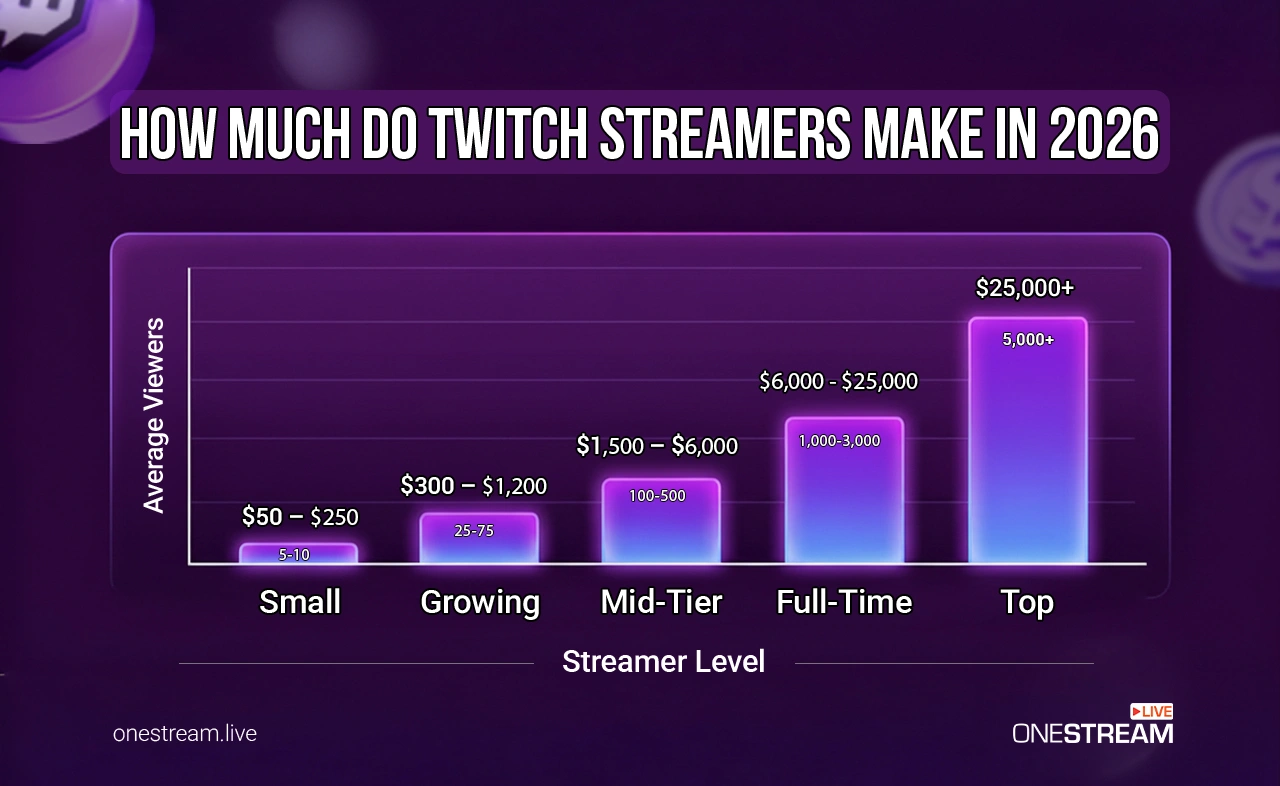
To make it simple for you, we’ll break down the Twitch pay rate based on channel size and average viewership. Here’s a table with data to understand:
1. Small Streamer (10 - 50 Viewers)
These are the new streamers on the platform and are striving to build consistent viewership. With Twitch’s “Monetization for All” initiative, the requirements for affiliates were lowered to 25 followers. At this stage, earnings are modest, and many small streamers earn through:
- Subscriptions
- Bits
- Limited ad impressions
However, if they don’t reach Twitch’s $50 payout threshold, they get a spendable balance for Amazon store credit rather than a cash payout.
Typical monthly earnings at this stage range from $50 to $300 and can fluctuate heavily from month to month. Discoverability remains the biggest challenge in this bracket.
2. Growing Streamer
Growing streamers have made it through the discovery barrier and now maintain a consistent audience. At this level, monetization becomes more predictable. Subscriptions, bits, and ads become more meaningful, specifically when paired with the Twitch Ad Incentive Program (AIP).
By running 3 minutes of ads per hour, streamers get a 55% ad revenue split. For example;
- A streamer averaging 75 viewers can earnan additional $100 – $200 per month purely from ads, depending on the CPM and audience region.
Total monthly income can go from $300 to $1,000. Some lucky streamers are also able to attract small sponsorships and affiliate deals, which turn their hobby streaming into a solid side income.
3. Mid-Tier Streamer
Mid-tier streamers have built something recognizable by now. They’ve got a brand and a community that actually shows up. This is where the Twitch Partner Plus program becomes the
primary focus. Streamers aim for:
- Level 1 (100 Plus Points) → 60/40 subscription split
- Level 2 (300 Plus Points) → 70/30 subscription split
Most mid-tier streamers actively work toward Level 2 because the improved split increases the take-home revenue.
Combining this with the AIP ad revenue, bits, sponsorships, and off-platform (YouTube shorts, Instagram Reels and TikTok), all this increases the monthly income range from $3,000 to $10,000+.
4. Full-Time Streamer
When a streamer starts maintaining the channel with 1,000 average viewers, Twitch becomes a full-time career. These are the creators who are now taking the most out of the platform with the Partner Plus Level 2 (70/30) and maximizing their ad revenue through AIP.
Monthly income potential in this bracket is from $10,000 to $25,000+, influenced by:
- Large subscription bases
- High-volume inventory
- Recurring sponsorships
- Sponsored streams and campaigns
- Multi-platform monetization
5. Top Streamer
Top streamers represent a very small percentage of Twitch creators but earn the largest share of revenue on the platform. These are the ones pulling 5,000+; the average twitch streamer makes at this point hits $25,000 and beyond. They’re now using all the possible ways to generate revenue, including brand partnerships, exclusive sponsorship deals, merchandise, and multi-platform presence.
For these creators, sponsorships are huge, but the uncapped 70/30 split means subscription revenue is the foundation of their empire. Earnings at this level can scale dramatically, especially during events, launches, or major collaborations.
How Much Do Streamers Make on Twitch Per View?
Twitch streamers are not paid for organic views alone, but views do generate money when ads are run. These are calculated with the CPM (Cost Per Mille), which means you will be able to earn per 1,000 ad views, not per individual stream view.
Streamers from North America typically earn around $3.50 – $5.00 per 1,000 ad impressions, depending on the region and advertiser demand. So basically, high viewership translates to high ad revenue if you’re running the 3 minutes of ads per hour.
Regional Differences: How Location Affects Twitch Income
How much people make on Twitch is also influenced by regional differences. Twitch streamer income in 2026 is not the same everywhere. Where you stream from affects different earning factors on Twitch, like advertising rates, how much money your audience has, payment systems and local brand interest.
While all the factors are equally important for creators, the main one is the advertising rate. Twitch ads are paid based on CPM, and these rates change depending on the region. A creator from the United States, Canada, the United Kingdom and parts of Western Europe experiences higher CPMs than other developing countries.
Another key factor here is the Prime Subscriptions, which now have fixed rates based on the viewer’s country. For example, you’ll get more from the subscription bought by someone in the U.S compared to if someone buys from a lower-income region.
Beyond ad revenue and Prime Subscriptions, location affects Twitch income in several other ways:
- Audience purchasing power: Viewers in higher-income areas are more likely to pay for your channel subscriptions and donations, and this increases overall monetization potential.
- Subscription conversion rates: A streamer from a lower-income region will often see fewer paid subscriptions.
- Payment infrastructure: In some regions where payment methods are limited or complicated , itcan negatively impact the streamer’s total earnings.
- Currency conversion: Exchange rate still remains the major factor for income generated through platforms like Twitch.
- Sponsorship availability: If you’re active in a higher-income region, you will be able to attract more sponsors, which increases your income.
- Language and market reach: Streamers who broadcast in English or target international audiences always outperform those who choose to focus on their local language and market only.
- Tax and regulatory differences: Local tax laws and reporting are different everywhere; countries with low tax rates favor streamers.
It’s true that these factors can make a difference in how much money you can make using Twitch, but it doesn’t mean they don’t let you succeed. There are countless streamers in lower-CPM regions, but they are still competing with global streamers by just focusing on the quality of content and consistency.
Final Verdict on How Much Do Twitch Streamers Make
The math is clear: Twitch is a great place to build a community, but a risky place to build a bank account if you rely on it 100%. The creators winning in 2026 aren’t just on Twitch. They are multistreaming to YouTube (for searchability) and TikTok (for virality) using OneStream Live. You can stream to 45+ other platforms and build an engaged audience everywhere that increases your earning potential.

FAQs
Twitch does not pay for regular VOD views. Instead, the revenue is generated through the live ad impressions, which are paid on a CPM (Cost Per Mille).
With 10,000 subscribers, you’re likely in the Twitch Partner Plus Level 2 Program, which gives a 70/30 revenue split. Considering the standard $4.99 per subscription, 10,000 subs generate roughly $50,000 gross per month, after the 70% cut, that comes out to approximately $35,000 per month before taxes.
No, Twitch does not pay you daily. Payouts are processed monthly, provided that you have reached the minimum $50 cash threshold. Earnings below this amount are held as spendable (Amazon Store Credit) until you reach the threshold.
At such a small scale, earnings are essentially negligible. With these views, you can’t generate meaningful subscription, bits or ad revenue. Even if ads are run, this small audience might only be able to produce a few cents.
Yes. You need roughly 300 Tier 1 subscribers (on a 60/40 split) or 400 subscribers (on a 50/50 split), plus moderate ad revenue.
OneStream Live is a cloud-based live streaming solution to create, schedule, and multistream professional-looking live streams across 45+ social media platforms and the web simultaneously. For content-related queries and feedback, write to us at [email protected]. You’re also welcome to Write for Us!