
The best CDN for video streaming is a specialized delivery network built to handle high-throughput, continuous traffic without buffering. In 2026, the top live streaming CDN providers—including IO River, AWS CloudFront, and Bunny.net—go beyond basic edge caching.
Video behaves badly under stress. It’s continuous, bandwidth-heavy, and brutally sensitive to latency, jitter, and packet loss. That’s why a video streaming content delivery network matters more than your player UI, your codec choices, or whatever your team argued about on Slack all week.
And the stakes are measurable. Research commonly cited across streaming analytics shows that every extra second of delay increases abandonment meaningfully; one widely referenced figure is ~5.8% higher abandonment per second of delay.
TL;DR: What makes a CDN “best” for video in 2026?
A strong streaming CDN does four things consistently:
- Starts playback fast (low start time, low start failures).
- Stays stable under spikes (live events, premieres, viral moments).
- Plays nicely with ABR (adaptive bitrate so quality steps down gracefully).
- Gives you control (routing, geo behavior, cost controls, failover options).
Single-CDN strategies are fragile. We need to talk about why they fail, and more importantly, which providers actually have the infrastructure to keep your stream alive when the network inevitably chokes.
How I Evaluated These Top Live Streaming CDNs
Before the list, here’s a quick checklist you can actually use:
- Where are your viewers? (one “global” CDN can still be mediocre on specific ISPs/regions)
- Live vs VOD mix: live spikes punish weak routing and thin capacity planning.
- Do you need multi-CDN? If you run high-profile live events, assume “yes” and justify “no.”
- Pricing model: egress-heavy billing can turn “growth” into a financial jump scare.
- Operational burden: can your team run it without babysitting 24/7?
Now let’s get into the eight.
The Best CDNs for Video Streaming in 2026
We have evaluated the market based on actual performance, real-time routing capabilities, and video CDN pricing. Here is how the top providers stack up for heavy video workloads.
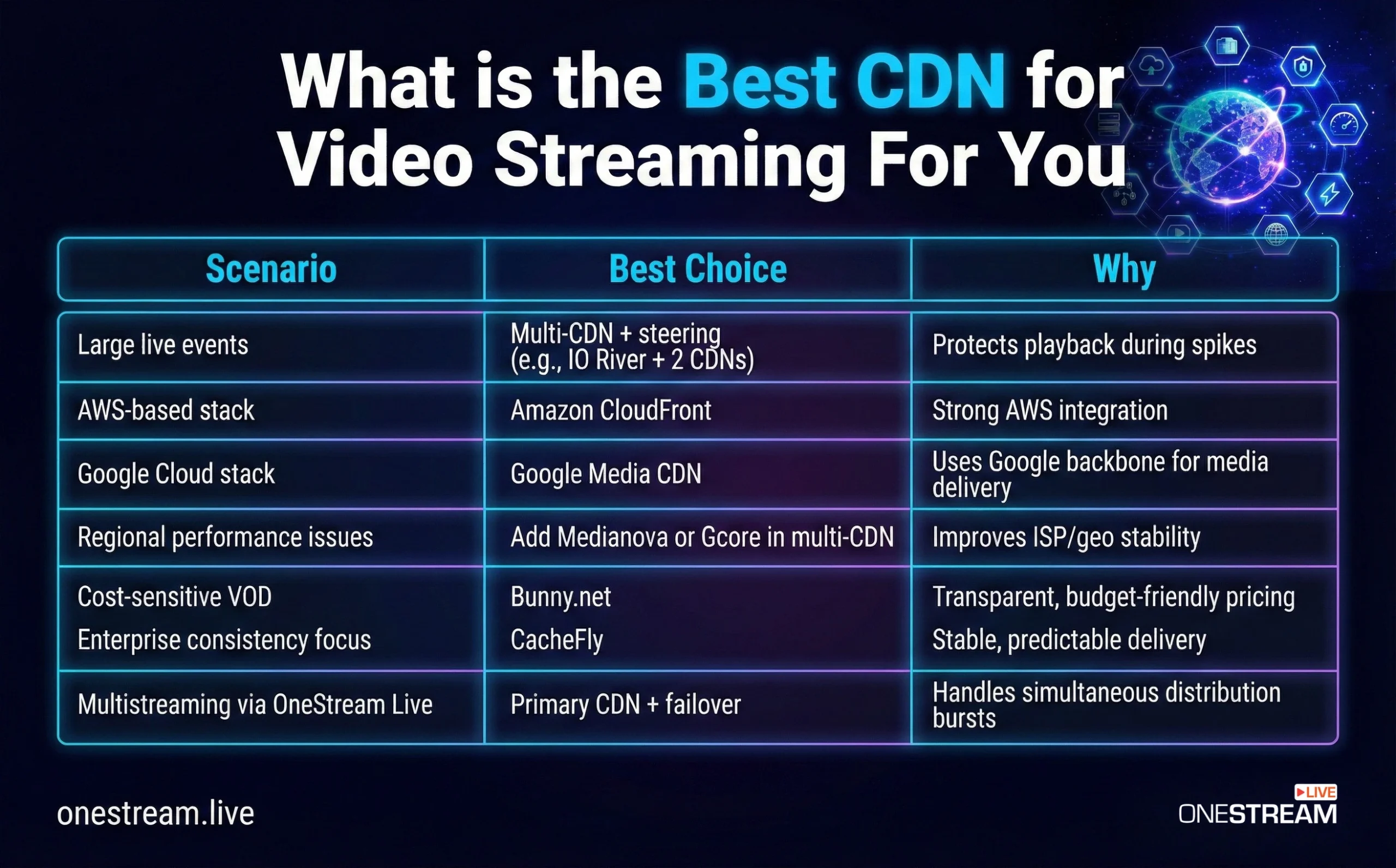
1) IO River (Control layer for multi-CDN performance steering)
If you’re serious about live events or unpredictable demand, the “best CDN” question often becomes “best way to control multiple CDNs.” That’s exactly where IO River sits.
Placed correctly, it belongs after you’ve felt the pain: a single provider doing fine… until it suddenly isn’t. IO River positions itself as a control layer that helps teams manage and steer traffic across providers using performance and policy signals.
Why it matters for live streaming: steering decisions during a live spike can protect playback quality without forcing viewers to reload or suffer long stalls, depending on how your stack is designed. IO River’s own materials focus heavily on performance steering for streaming and multi-CDN operations.
2) NS1 (DNS-level steering before playback starts)
NS1 is a strong pick when you want smarter routing decisions before a stream session begins. The idea is simple: choose the best delivery path at the DNS decision point, using real user performance telemetry and policy rules.
IBM’s NS1 documentation describes RUM-informed steering that feeds into DNS routing decisions. That’s useful for live events where a bad start experience kills engagement fast.
Best for:
- Live event “doors open” moments
- Geo-sensitive routing strategies
- Teams building a live streaming CDN strategy around control and observability
3) Amazon CloudFront (AWS-heavy stacks and predictable scaling)
CloudFront is often the default in AWS ecosystems for a reason: integration and reach. AWS’s own docs outline using CloudFront for both VOD and live streaming video workflows.
On pricing, CloudFront’s official pricing pages and docs explain the basic cost drivers and options like pricing plans.
Best for:
- AWS-first video stacks
- Teams already using AWS Media Services
- Large VOD libraries with regional distribution
4) Google Cloud CDN + Media CDN (Google edge network for web + media delivery)
Google is explicit that Cloud CDN and Media CDN are separate tools aimed at different workloads, with Media CDN positioned for high-throughput use cases such as streaming video.
For cost planning, Google provides Cloud CDN pricing guidance and mentions volume discount discussions at high monthly usage.
Best for:
- GCP-centric stacks
- Large video egress workloads that benefit from Media CDN
- Teams that want a clear split between web acceleration and media delivery
5) Gcore (strong reach + streaming platform options)
Gcore has been pushing a broader “streaming platform” approach alongside CDN delivery. Their docs describe a layered architecture including ingest, processing, packaging, storage, and CDN delivery.
They also publish streaming pricing with pay-as-you-go style options and per-minute components on the platform side.
Best for:
- Teams who want CDN + streaming components under one vendor
- International audiences where regional performance and cost matter
6) Medianova (regional/ISP-level tuning for video delivery)
Medianova markets specifically around video and streaming, including adaptive bitrate delivery and a focus on stable playback across devices and connections.
This is the sort of provider teams introduce when “global averages” look fine, but one region (or one ISP) keeps ruining your watch-time.
Best for:
- EMEA-heavy audiences
- Teams diagnosing ISP-level playback issues
- A multi-provider setup where each CDN covers its strongest regions
7) CacheFly (clear pricing tiers + video streaming focus)
CacheFly publishes straightforward pricing tiers and also describes adaptive bitrate streaming for video use cases.
If you want transparent plan structure and a vendor that speaks directly to media delivery, CacheFly is usually on the shortlist.
Best for:
- Businesses that want predictable billing tiers
- Video workloads where consistency matters more than fancy edge scripting
8) Bunny.net (cost-focused delivery for VOD-heavy libraries)
Bunny is frequently shortlisted when teams want a low cost CDN option, especially for VOD libraries and predictable traffic patterns. Their pricing pages publish region-based CDN rates and also pricing for Bunny Stream.
Best for:
- Cost-sensitive CDN for video hosting
- VOD libraries, training portals, creator archives
- Multi-provider stacks where Bunny absorbs lower-priority traffic
Why Single-CDN Strategies Fail for CDN Live Stream at Scale
Single-CDN setups feel tidy. One dashboard. One bill. One throat to choke. Then you do a major live stream and reality shows up uninvited.
1. Regional Performance Variability
No CDN performs perfectly across all geographies and networks. Differences in ISP routing, peering agreements, and last-mile conditions create completely uneven delivery behavior.
When all video traffic flows through a single pipe, localized congestion affects massive segments of your audience. If a regional issue occurs, you lack an immediate alternative path, and playback problems propagate instantly. Global averages mask these realities, tricking you into thinking your stream is healthy while a specific city watches a frozen screen.
2. Capacity Stress During Peak Events
Live events and major product releases generate sharp, sudden concurrency spikes that place heavy pressure on delivery infrastructure. A solitary CDN setup forces you into difficult trade-offs: you either overprovision capacity year-round (wasting money), accept higher risk during peak demand (risking your reputation), or tolerate degraded playback under load. None of these options make financial or operational sense.
3. Cost Exposure and Video CDN Pricing
Video traffic grows non-linearly, and the cost often increases faster than the return on investment. With only one delivery path, you have zero ability to rebalance traffic when costs spike. This lack of flexibility limits your ability to control regional spending or negotiate better rates. You are entirely at the mercy of one vendor’s pricing sheet.
4. Operational Rigidity
Finally, single-vendor architectures leave you stranded during incidents. When delivery behavior is tightly coupled to one provider, mitigation depends entirely on their engineering team resolving the issue upstream.
Manual intervention becomes common, and your response times slow down precisely when speed matters most. You trade short-term simplicity for long-term fragility.
Where OneStream Live Fits Into a Modern Live Video CDN Approach
OneStream Live is not trying to be a CDN. It’s the live streaming broadcasting layer that helps you distribute content across platforms and destinations without turning your life into a schedule spreadsheet.
What this really means is: you still need to respect delivery fundamentals, while using OneStream to run the workflow.
Here are a few feature tie-ins that matter for CDN conversations:
- Multistreaming to 45+ destinations: spikes happen when content hits multiple platforms at once, so planning for bursty traffic matters.
- External RTMP streaming + stream key options: clean ingest and stream key hygiene reduce “self-inflicted outages.”
- Hosted Live Pages: gives you a controlled web destination when you want viewers off-platform.
- Embed Player with ABR: ABR is one of the simplest ways to keep playback stable across uneven connections.
- Advanced Scheduling + pre-recorded streaming + 24/7 YouTube Live: predictable programming reduces operational risk and lets you plan capacity instead of reacting mid-show.
Final Word
Follow these tips: choose the best CDN for video streaming based on where your viewers are, how spiky your traffic gets, and how much control you need when things go wrong. For casual VOD libraries, one provider may be enough. For live events, assume multi-provider planning sooner than you’d like and build the muscle before your biggest broadcast.
If you want a distribution layer that makes how to stream live video across platforms less painful, explore OneStream Live’s Studio, External RTMP support, and Hosted Live Pages today!

Frequently Asked Questions
The best CDN for live streaming is a multi-CDN architecture. Trusting only Amazon CloudFront leaves broadcasters completely exposed to regional internet outages.
Steering tools like IO River actively route viewers to the fastest network, stopping the buffering wheel dead during high-stakes OneStream Live broadcasts.
Video CDN pricing swings from $0.005 to $0.08 per gigabyte based on geography. North American bandwidth remains cheap; South American transit drains budgets fast.
Providers like Bunny.net offer flat-rate video delivery, whereas AWS CloudFront bleeds corporate accounts with variable outbound data transfer fees if engineers leave it unmonitored.
Streams buffer because single-CDN setups inevitably hit local network jams. A broadcaster’s studio connection matters little if the delivery provider’s last-mile ISP peering breaks.
Yes, Amazon CloudFront absorbs vast video-on-demand libraries and traffic spikes easily. But treating it as an infallible live video solution is a mistake.
CloudFront lacks the split-second multi-network steering necessary for high-stakes broadcasts. Top engineering teams pair AWS with DNS routing layers like NS1 to dodge localized internet weather.
OneStream Live manages the ingest and distribution of video feeds to over 45+ social platforms simultaneously. While OneStream Live handles outbound RTMP connections flawlessly, broadcasters hosting native players on custom websites must still configure a dedicated video content delivery network, such as Gcore or CacheFly, for final audience playback.
OneStream Live is a cloud-based live streaming solution to create, schedule, and multistream professional-looking live streams across 45+ social media platforms and the web simultaneously. For content-related queries and feedback, write to us at [email protected]. You’re also welcome to Write for Us!