

Cybercrime caused $6 trillion in harm around the world in 2022, and this number is predicted to rise to $10.5 trillion by 2025. Cyber risks are getting worse, and attackers are now focusing on live streaming platforms because they want to take advantage of their valuable content, real-time user interactions, and quickly growing infrastructures. During live streams, streamers face numerous unique application security challenges that cannot be solved by traditional methods. The fact that streams go in real time, have high-level content and are supplied with monetization models, produces more risks for different attacks.
By putting in place strong cloud and application security measures, you can make sure that your live broadcast is protected from piracy, attacks, and breaches, which will preserve your revenue and intellectual property. Users must be able to trust the platform for it to expand in a sustainable way.
The kind of risks that come up when you stream live
Basics of cloud security
Effective methods that guarantee secure streaming
A comprehensive strategy for your live streaming security
Best practices to keep your streaming devices working well
Understanding the Live Streaming Threat Landscape
To know how to protect your live streaming platform, you are supposed to understand which specific threats it faces. Live streaming is more vulnerable than static websites or on-demand media since it happens in real time and uses high-value content.
Common Security Vulnerabilities in Live Streaming
Live streaming platforms face various weaknesses which attackers can use to steal content, compromise user data, or disrupt services. Let’s take a closer look at the most frequent security threats.
- Content Piracy and Unauthorized Access: Piracy is still one of the biggest problems for live streaming services. Being careless can cost them a lot of money and steal their intellectual property.
- Stream interception and redistribution via illegal services
- Screen recording and sharing on social media or torrent sites
- Direct revenue loss through illegal access and content theft
- Infrastructure Attacks: Attackers are not only interested in the content of live streams, but also in the infrastructure that supports them.
- DDoS attacks targeting streaming servers to disrupt availability
- Man-in-the-middle attacks exploiting public networks during live streaming
- CDN vulnerabilities enabling unauthorized cache access or edge attacks
- Data Breaches and Privacy Violations: If someone steals your login details, they could get into your account, make fake purchases, and degrade your privacy.
- Theft of user credentials leads to compromising the account
- In chats and live interactions exposures personal information
- Payment data are under the threat in monetized live streams
The Cost of Inadequate Security
If you don’t defend your live streaming platform, you could have big difficulties with money, the law, and your reputation. So it’s better to spend money on its defense ahead of time so you don’t lose money later.
- Financial Effect: Each year, video piracy inflicts a financial loss of $29.2 billion on the US economy.
- Damage to Reputation: Platforms that fail to secure streams risk user churn, brand damage, and loss of broadcasting rights.
- Regulatory Compliance Risks: GDPR and CCPA violations due to data breaches can lead to multi-million-dollar fines and legal actions, which makes implementing reliable database management software crucial for securing data and maintaining compliance.
The hazards in live streaming are many and varied, as you can see. Live streaming can be unsafe because of the risks of piracy, assaults on infrastructure, and data breaches. And knowing about these dangers is the first step toward making a streaming platform that is safe and strong.
Cloud Security Fundamentals for Live Streaming
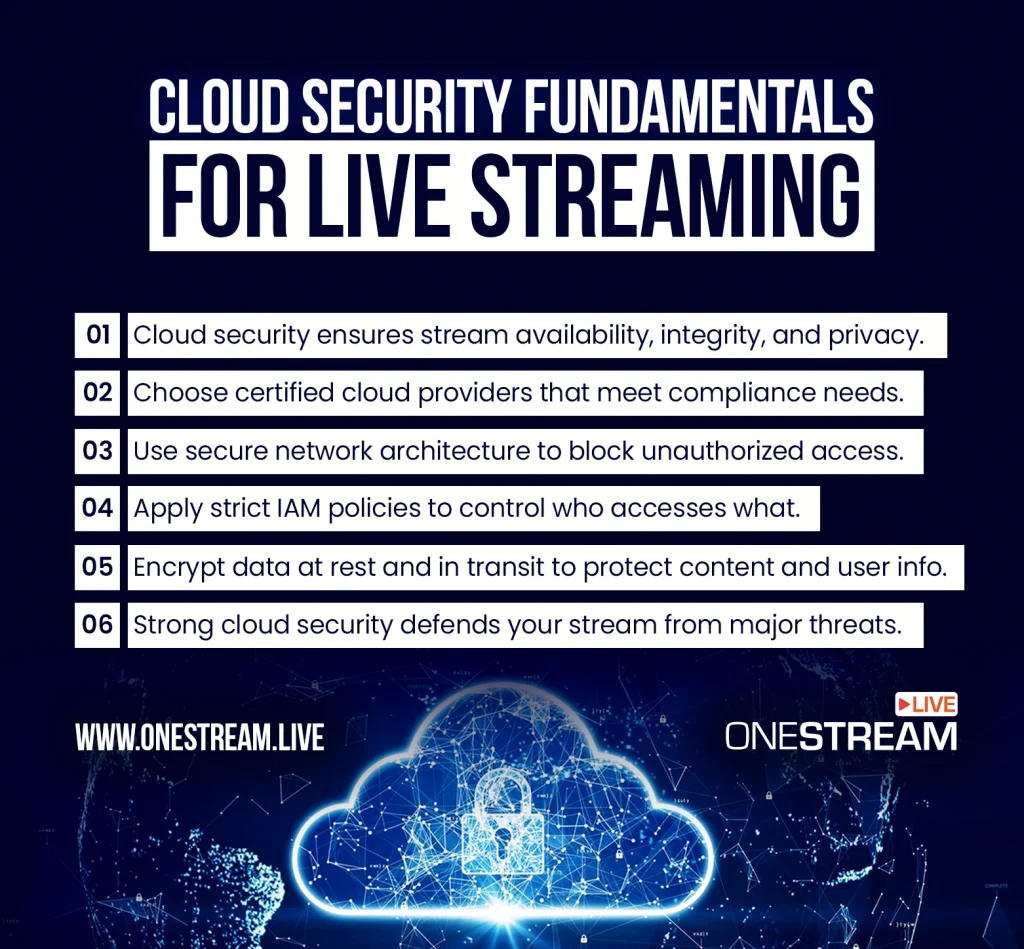
Cloud infrastructure makes it possible for live streaming services to work today. It’s very important to apply strong security measures that guarantee the availability, integrity, and privacy of your streams and user data in order to keep your live stream safe.
Secure Cloud Infrastructure Design
To make the live streaming services reliable, compliant, and protected, the cloud infrastructure is vital.
- Choosing a Cloud Service Provider: You should begin with choosing the right cloud provider to ensure your infrastructure meets the highest security and compliance standards.
- Look for providers with SOC 2, ISO 27001, and CSA STAR certifications
- Align services with regional compliance standards (GDPR, CCPA)
- Ensure data residency options for local regulations
Conducting a free AWS risk assessment, you can find out if your current cloud setup is under threat. Learn more about Wiz AWS Security Assessment process to identify improvements for your stream security posture.
- Network Security Architecture: A secure network architecture is a barrier from unauthorized access, mitigates risks, and assures a smooth live stream process. This is critical for stream security.
- Implement Virtual Private Clouds (VPCs) with properly configured subnets
- Set up security groups and network ACLs for strict network traffic management
- Integrate CDN security features such as token authentication and HTTPS enforcement
Identity and Access Management (IAM)
IAM rules limit who can use your resources and how they can do it. This is because your streaming platform has a security layer:
- Multi-Factor Authentication (MFA) for all administrative accounts.
- Role-Based Access Control (RBAC) to make sure that people only have the access they need.
- Single Sign-On (SSO) makes it easier for everyone to log in and verify their identity.
- Privileged Access Management (PAM) for critical system operations.
Data Protection in the Cloud
Data protection makes your content and user information safe, so you may share it or store it without worrying about it.
- Encryption at Rest
- Turn on encryption at the storage level (for example, AWS S3 SSE-KMS).
- Use strong key management systems that have rules for rotating keys.
- Use hardware security modules (HSMs) for keys that are sensitive.
- Encryption in Transit
- Make sure that TLS/SSL is used on all endpoints.
- Utilize VPNs or secure tunneling for backend services.
- Follow a rigid lifecycle for managing certificates.
Secure cloud infrastructure protects your live streaming operations from the majority of external and internal threats.
Application Security for Live Streaming Platforms
Cloud security keeps your infrastructure safe, but application security makes sure that the streaming platform doesn’t have any holes that attackers can use to get in or mess up the service.
Secure Development Practices
Adding security to the development process makes it easier to find and address issues before release.
- DevSecOps Integration
- Embed security testing into CI/CD pipelines.
- Conduct static (SAST) and dynamic (DAST) code analysis.
- Continuously scan container images for vulnerabilities.
- API Security
- Implement strong authentication and authorization mechanisms.
- Use rate limiting and throttling to prevent abuse.
- Apply strict input validation and sanitization to safeguard against injection exploits.
Runtime Application Protection
Even if you design your apps securely, you still need to safeguard them while they’re running to stop active attacks:
- Deploy Web Application Firewalls (WAF) to block malicious traffic.
- Implement Runtime Application Self-Protection (RASP) for in-app attack detection.
- Use behavioral monitoring to detect anomalies in user or system activity.
Content Protection Technologies
To keep your business going and stay in compliance, you need to protect your live stream content from being used without permission and piracy.
- Digital Rights Management (DRM)
- Integrate studio-approved DRM like Widevine, PlayReady, or FairPlay.
- Use multiple DRM implementations to make sure all devices work.
- Keep rotating your keys for better security.
- Advanced Encryption Standards (AES)
- Compare AES-128 vs. AES-256 for performance vs. security requirements.
- Secure key distribution mechanisms to players.
- Monitor performance impact on latency-sensitive live streams.
Application security is an ongoing process. Your platform is less likely to be hacked or pirated with each layer of defense.
Comprehensive Security Implementation Strategy
If you don’t take care of live streaming security, you leave serious holes. A full approach makes sure that every part of your stream security service is safe.
Multi-Layered Security Approach
By implementing multiple layers of security, you ensure comprehensive defence for your streaming platform. Even if one layer of security is broken or failed, another layer can stop an attack. This technique involves putting together several security mechanisms across the network, applications, data, and user access to make a system that can withstand a wide range of attacks that change over time.
Adopt Defense in Depth with layered controls.
Security Control Layering:
- Network Security: VPCs, VPNs, WAFs
- Application Security: secure code, RASP, API hardening
- Data Security: encryption, DRM
- User Security: IAM, MFA, PAM
Access Control and Authentication
You can protect your platform from unauthorized users and misuse using a strong access control and authentication mechanisms.
- Enforce strong password policies and breach monitoring.
- Apply geographic and IP restrictions for sensitive access.
- Implement token-based authentication for streams.
- Use referrer and domain restrictions to limit playback.
Monitoring and Incident Response
Monitoring for threats and having a plan to respond effectively is crucial to minimise damage.
- Deploy real-time security monitoring for your infrastructure.
- Use automated threat detection (SIEM, XDR).
- Maintain a tested incident response plan with escalation protocols.
- Enable forensic analysis capabilities for breach investigations.
Building a comprehensive application security strategy is not only about setting up barriers but also involves preparing to detect, respond to, and recover from attacks and protect your live streaming process.
Best Practices for Secure Live Streaming
Finally, applying effective methods for your live streaming best practice can significantly improve your security level beyond standard compliance, ensuring your streams remain protected against even the most advanced threats.
Content Security Measures
Robust content security protects your streams from piracy, unauthorized access, and revenue loss.
- Apply watermarking and fingerprinting to identify leaked content.
- Implement screen recording protection through DRM and obfuscation.
- Geo-blocking and proper content licensing can help keep people from getting to your site from places you don’t want them to.
- Ensure secure video player implementations with obfuscation and validation.
- Use password protection to limit access to your private streams. OneStream Live allows you to set a password on your hosted live page, so only people with the password can watch. This is helpful for internal content, training, or member-only sessions.

Infrastructure Hardening
Hardening your infrastructure makes sure that your servers, containers, and microservices can’t be used in a bad way.
- Make server settings more secure against attacks.
- Safeguard your containers with ongoing image scans and adherence to security policies.
- Apply Kubernetes application security best practices (RBAC, Pod Security Policies).
- Secure microservices architecture with mTLS and API gateways.
By using these best practices in your everyday operations and development pipelines, you make a live streaming process that is safe for your users, partners, and intellectual property for a long time.
Conclusion
You need to set up cloud infrastructure, develop apps, and protect your material well in order to stream live safely. You can be sure that your revenue, reputation, and user trust will be safe in a digital environment that is becoming more and more hostile by implementing multi-layered security measures, real-time monitoring, and proactive incident response.
Using a secure and reliable platform also matters in this process. OneStream Live supports your efforts by offering features that help control access and protect your content. It also lets you multistream to different platforms, which helps you grow your audience while keeping everything safe.

OneStream Live is a cloud-based live streaming solution to create, schedule, and multistream professional-looking live streams across 45+ social media platforms and the web simultaneously. For content-related queries and feedback, write to us at [email protected]. You’re also welcome to Write for Us!