
For small streaming companies, there are a number of unique security challenges in 2025 that require careful attention and regular assessment. Large platforms have the advantage of dedicated security teams, but smaller companies need to be strategic about their audit approach to protect user data and ensure compliance, all without breaking the budget. The streaming industry has seen incredible growth in recent years, which has led to a sharp increase in cybercrime – this means that security audits are more important than ever for streaming companies of all sizes.
Security audits help find and fix weak points before they cause damage.
Protecting customer data and payment info is key to trust and compliance.
Use simple tools and checklists to audit content delivery and infrastructure.
OneStream Live offers password-protected live pages to keep streams private.
Keep training your team and review your systems regularly for better security.
Why Security Audits Matter for Streaming Companies
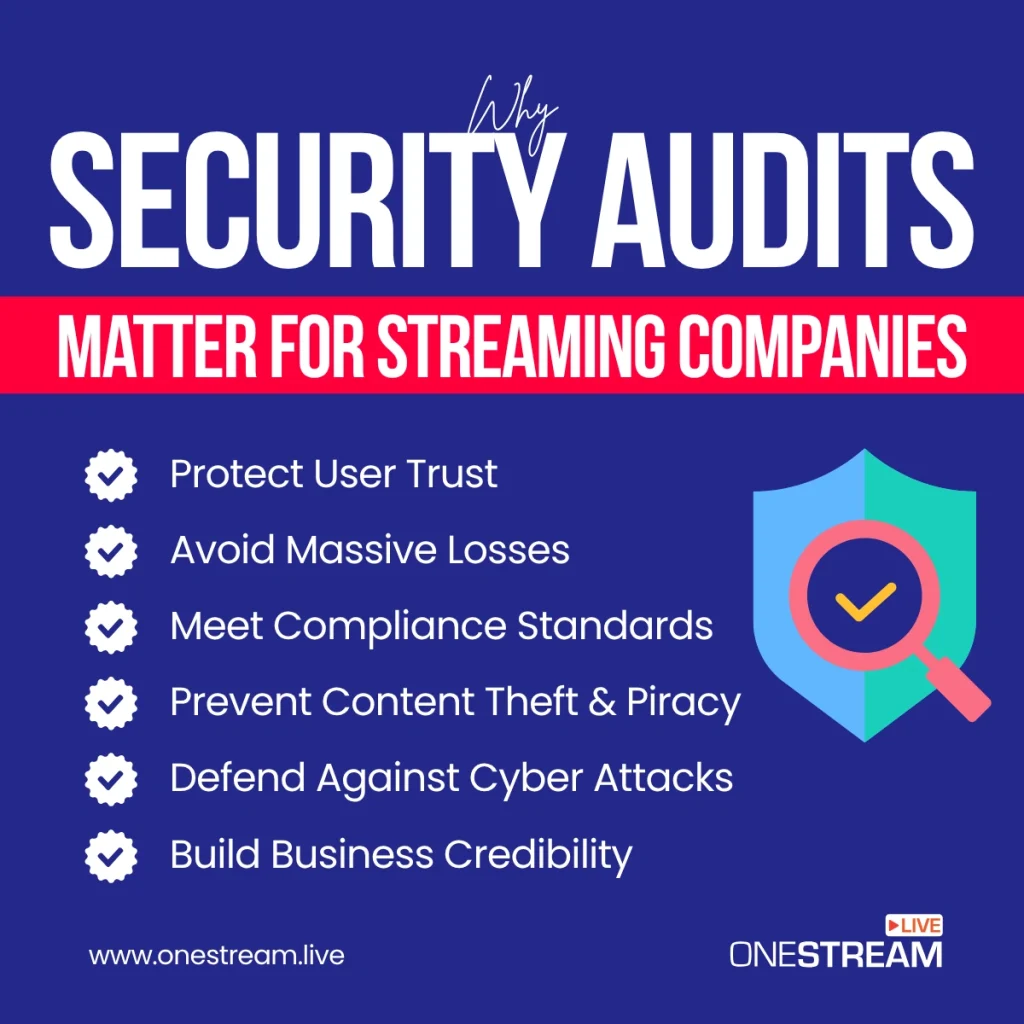
So, why are security audits important for streaming companies? Streaming companies of all sizes are required to handle sensitive user information, which can include payment information, viewing habits, personal preferences, and demographic data. Security breaches can lead to regulatory fines as well as customer loss and irreparable damage to brand reputation. The average cost of a data breach in the media and entertainment industry exceeds $4 million, which is a figure that could destroy a small streaming company.
Regular security audits are a proactive cybersecurity measure that enables streaming companies to identify vulnerabilities before they become costly problems. Regular audits also demonstrate your commitment to user privacy – something people are increasingly passionate about in 2025. These audits will also provide documentation that regulators and business partners increasingly require when assessing your trustworthiness.
There are a few specific cyber threats that the streaming industry faces. These include content piracy, credential stuffing, account takeovers, and distributed denial-of-service (DDoS) attacks. Additionally, content theft alone costs the industry billions of dollars annually, while disruptions to the service can lead customers to competitors (often the larger streaming companies.
Compliance with an increasingly complicated regulatory landscape is also essential. GDPR and other privacy laws create compliance obligations that require regular assessment and documentation. Failure to comply can lead to fines that represent a large percentage of annual revenue for smaller streaming businesses.
Essential Areas to Audit
Security audits should cover every part of your streaming setup. It’s a matter of protection and trust, so no area should be ignored.
Data Protection and Privacy
Streaming companies must focus on how customer data flows through the system, including collection, storage, and deletion. Data encryption methods in transit and at rest should be audited along with access controls and compliance with relevant privacy laws. Be sure to review your privacy policy to make sure it accurately reflects your data practices and is easy to understand.
You should also pay attention to data retention policies and deletion processes. Collecting more data than is needed or holding onto it for longer than required creates unnecessary risk and liability. Audit your third-party integrations to make sure the data sharing agreements align with privacy regulations and user expectations. Tools that provide business activity monitoring can help track file movement, monitor user access patterns, and log system activity. These functions are all useful for spotting irregularities and staying compliant.
Payment Security
Audit your payment processing system for PCI DSS compliance. This induces the secure transmission of credit card data, proper tokenization, and secure storage practices. Even if you use third-party processors, you still need to ensure compliance under PCI DSS requirements.
Additionally, be sure to review billing systems for vulnerabilities that could expose customer financial data. Audit subscription management processes to prevent unauthorized charges and ensure customers can easily cancel subscriptions, which is increasingly required by consumer protection laws.
Content Delivery Security
You must also examine your content delivery network security, including digital rights management systems and anti-piracy measures. Audit user authentication systems to prevent unauthorized access and account sharing that violates your terms of service. You must also review how you protect premium content from unauthorized distribution.
Assess your infrastructure’s resilience against DDoS attacks and other service disruption attempts. Many underestimate their vulnerability to attacks that are designed to overwhelm servers during peak viewing hours.
OneStream Live makes it easy to protect your content. You can add a password so only people with the password can watch your stream on your hosted live page. Anyone visiting your page to access private or restricted content must enter the password. This is useful for internal training, team updates or company-only events. It keeps your stream secure without any complex setup.

Infrastructure Security
Next, review your cloud infrastructure configuration, including server security, network segmentation, and backup procedures. Audit your incident response plan to make sure your team knows how to respond in a timely manner to security breaches. Many small companies do not have formal incident response procedures in place, which leaves them vulnerable to downtime and regulatory fines.
Check your development and deployment processes for security vulnerabilities. Audit code repositories, development environments, and deployment pipelines to make sure they do not add security weaknesses to your production systems.
Third-Party Risk Management
Third-party services are often used by small streaming companies for key services like content delivery, analytics, payment processing, and customer support. These relationships must all be audited to make sure vendors meet your security standards and provide appropriate contractual protections.
Review vendor access to your systems and data – breaches often occur through compromised third-party accounts, which makes a vendor security assessment essential for protecting your platform.
Conducting Cost-Effective Audits
Small streaming companies can start with self-assessments using security frameworks like the NIST Cybersecurity Framework or ISO 27001. Checklists based on industry best practices should be made, and each area of the operation should be systematically reviewed. These frameworks provide a structured approach that will ensure comprehensive coverage without extensive security expertise.
Consider using automated tools to scan for common vulnerabilities in your applications and infrastructure. Many cloud providers offer built-in security assessment tools that can help identify misconfigurations and potential risks. Open-source security scanning tools can provide additional coverage at minimal cost.
Automated tools can also be used to scan for common vulnerabilities in your applications and infrastructure. Many cloud providers offer built-in security assessment tools that can be used to identify misconfigurations and potential risks.
The Thoropass security compliance and audit portal offers streamlined solutions designed for growing companies that need to demonstrate security compliance.
Industry resources and online communities can also be useful. Many streaming industry associations provide guidance and best practices that are tailored to the unique challenges of the streaming industry while industry forums can provide insight into the latest challenges.
When to Seek Professional Help
Internal audits are valuable, but it is worth hiring external security professionals for comprehensive annual assessments. External audits bring fresh perspectives and specialized expertise that your internal team might miss. They can also provide credible third-party validation of your security posture for both partners and customers.
For steaming companies pursuing specific compliance certifications, such as SOC 2, professional auditors are usually required. Plan for these costs in your annual budget and choose auditors with experience in the streaming industry, as they will understand the unique challenges and requirements of your business model.
Additionally, consider penetration testing (PEN) to identify any vulnerabilities that automated tools might miss. PEN testing involves simulating a real-world cyber attack so that weaknesses can be identified and in-depth recommendations can be provided to strengthen your security posture.
Building an Ongoing Security Culture
Security audits should not be seen as one-time events. Establish quarterly reviews for critical systems and annual assessments. Create security metrics and key performance indicators (KPIs) so that you can monitor your security posture over time.
Staff training is also useful for identifying security issues – this should include both technical security measures and social engineering awareness. You should also create processes for easy reporting and addressing of vulnerabilities.
Security police and procedures must be documented clearly and make sure that all staff members understand their security responsibilities. Create incident response playbooks that outline specific steps for different security events.
Finally, implement continuous monitoring to identify security issues instantly. Many security problems compound over time, which makes early detection critical for minimizing impact.
Security audits help you build trust and avoid costly mistakes. If you want to stream safely and grow fast, try OneStream Live. You can secure your content and multistream to over 45 social platforms at once. Reach more people while keeping your content protected.

FAQs About Security Audits for Streaming Companies
Security audits help spot weaknesses before they turn into serious problems. They reduce the risk of data breaches, support legal compliance, and help protect your customers’ information. This builds trust and shows that your platform takes security seriously.
Key areas include data privacy, payment security, content delivery, infrastructure, and third-party services.
Yes, they can start with free tools, simple checklists, and follow industry frameworks like NIST or ISO 27001.
Platforms like OneStream Live let you password-protect your stream and host it on a secure live page. It’s easy to manage and helps keep your content safe.
OneStream Live is a cloud-based live streaming solution to create, schedule, and multistream professional-looking live streams across 45+ social media platforms and the web simultaneously. For content-related queries and feedback, write to us at [email protected]. You’re also welcome to Write for Us!