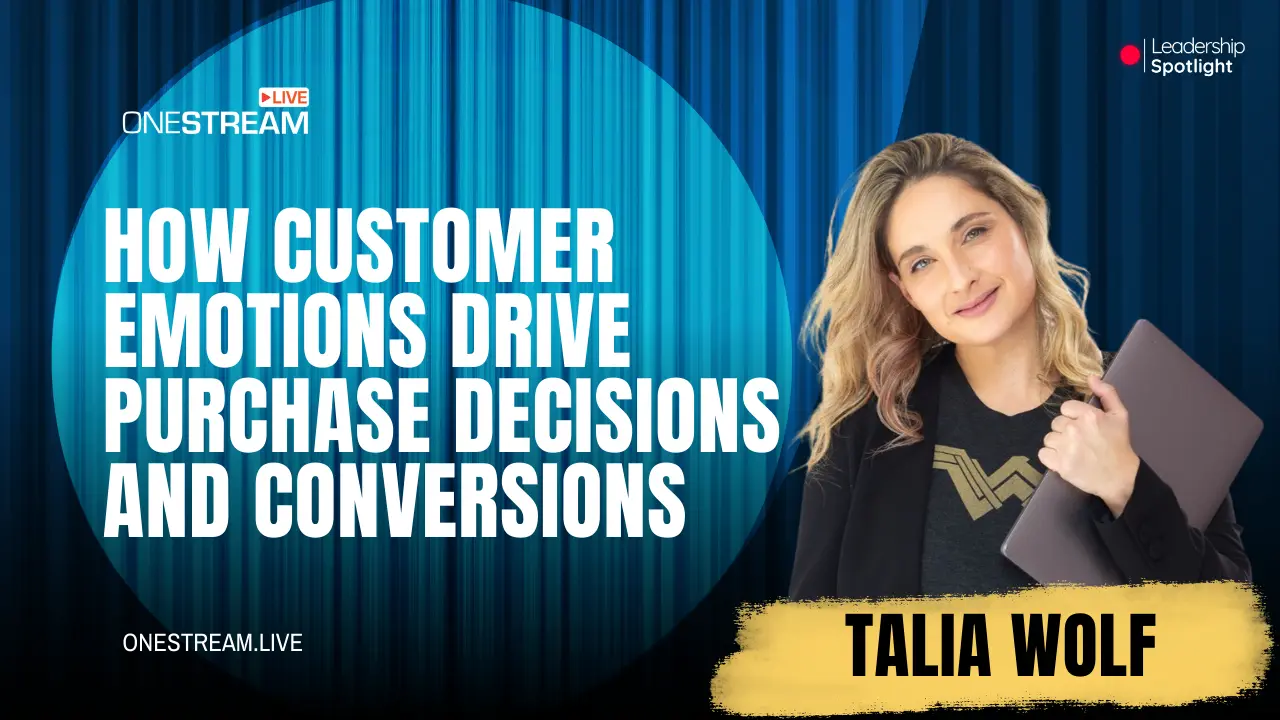

Your product is perfected, your website has the traffic you want, but people are hardly converting. A nightmare for every business owner. Having a flawless product and still no one is making that purchase decision? This is the kind of question Talia Wolf hears from frustrated business owners all the time. As founder of GetUplift and author of Emotional Targeting, Talia’s professional life is all about helping brands like Bitly transform their conversion rates.
With years of experience in the field, Talia finally understands that emotional branding is not just about changing button colors or testing headlines. Based on our latest Leadership Spotlight conversation, Talia shared how she finally understood the psychology of buying and built a framework that she calls “the hamster wheel of optimization.”
- Every conversion is an emotional decision, not a logical one.
- Behavioral data shows where the problem is, emotional research reveals why it happens.
- The hamster wheel of optimization happens when you change elements without understanding customer emotions.
- AI makes everyone look the same, but emotion-driven marketing helps you stand out.
- Stop making it about your product and start making it about how customers feel.
The Hamster Wheel of Optimization While Forgetting Emotional Marketing
Talia stepped into professional life by helping brands with social media and driving traffic. However, she quickly noticed a problem that most of us ignore: driving traffic but never checking if it’s actually worth any value, are people converting? She says when we started paying attention to this, we were no longer just changing the random stuff.
To track the shopping decision process, you go into Google Analytics, spot a conversion leak and start throwing solutions at it. You go start changing the headlines or removing the number of form fields. But this is just a loop you’re following every time with no changes in results. This behavioral data from GA4 can tell you where the problem is, but it won’t tell you why it’s happening, and that’s on you to find out.
How Do Consumers' Thoughts Affect Purchasing? – Talia’s Discovery
Talia’s breakthrough came when she asked herself the fundamental question: “What are the factors influencing purchase decisions?” The answer to this led her to something she didn’t expect: If I can understand how people make decisions… then what I can do is I can improve the customer journey based on those decision-making levers.”
The deeper she went into this, the more she realized:
This realization of her changed everything. She knew every conversion, whether it’s buying a product, leaving their email or signing up for a demo, is a decision based on customer emotions.
The 3-Step Strategy Targeting Emotional Buying Decisions
Talia’s team found out that over 223 emotional triggers were influencing consumer buying decisions. With these insights in hand, Talia developed an emotional targeting framework that changed the entire conversion optimization strategy from focusing on changing elements to solving specific emotional problems throughout the customer journey.
Step 1: Find Out Why People Buy (Customer Motivation)
Just like we discussed earlier, GA4 will tell you where the problem is, and your emotional research will tell you why it’s happening. So that’s the first step: you need to understand the emotions customers experience while considering your product.
Step 2: Audit Your Website
Once you understand how customers feel when considering your services, it’s time to look into your website accordingly. Based on your emotional research, you need to go beyond the traditional audit checks and ask strategic questions like:
- Am I making it about myself, or am I making it about the customer?
- Am I highlighting the pains people actually feel throughout the funnel?
- Am I focused on outcomes they care about?
- Am I using social proof and stories that resonate emotionally, or just generic testimonials?
- Are we addressing the concerns and hesitations we uncovered in research?
“Looking at the website, it’s so much easier to say, oh, my social proof is too generic, or the copy was speaking to everyone, but we should be speaking to these people,” Talia says. “Or everyone’s so concerned that this product is a gimmick… but we’re not even addressing this on the page.”
Step 3: Run Meaningful Tests
Traditional A/B testing changes an element like a headline, an image, or a button. Talia’s tests solve a problem.
If research shows that people can’t easily see that a solution was designed for them, the entire test focuses on solving that problem. It’s not about swapping one headline for another. It’s about strategically addressing emotional barriers to conversion.
How to Not Lose an Emotional Buyer Again (Futureproofing Your Business)
Talia’s message about this is clear: stop making it about your product.
Quote: “Most brands make it about themselves. They highlight the features, the pricing, the technology. They talk about themselves and their own products, and they don’t put the customer first,” she says.
According to her, this is the root of the hamster wheel. When your focus is on your features, and you completely ignore consumer science, then you’re just optimizing in the dark.
These both go hand-in-hand:
- Behavioral data shows you where the problem is
- Emotional research shows you why it’s happening
When all your strategies are based on these two important factors, you’re able to get the most out of your web traffic. You find a problem, and your understanding of customers helps you solve it immediately.
The Final Verdict: Think About People First
At the end of our conversation with Talia, she gave us a simple yet powerful reminder: “Just be kind and think about the people you serve, and that will make everything better.”
In 2026, AI makes generic marketing easier than ever, but brands that will continue to dominate the market will always be the ones that understand their customers on a human level. They speak to emotions, address the real pains, and design customer journeys that resonate, not just convert.
FAQs
Emotions shape how customers perceive value and trust, often guiding decisions faster than logical reasoning.
Positive emotions such as excitement and confidence reduce hesitation and increase the likelihood that customers will complete a purchase.
Yes, emotions such as urgency or fear of missing out can push customers to act quickly when used ethically.
Emotional branding builds deeper connections with customers, increasing loyalty and repeat purchases.
Businesses can analyze engagement metrics, customer feedback, behavioral data, and A/B testing results to assess emotional influence.
OneStream Live is a cloud-based live streaming solution to create, schedule, and multistream professional-looking live streams across 45+ social media platforms and the web simultaneously. For content-related queries and feedback, write to us at [email protected]. You’re also welcome to Write for Us!