
“This account has been terminated due to repeated or severe violations of our Community Guidelines and/or claims of copyright infringement.” This message is a nightmare for every streamer. To avoid falling victim to copyright strikes, using copyright-free music is crucial.
Right after spending days crafting your creativity into the perfect stream or video, you’re excited to welcome your audience’s reaction, engage with them, and monetize your hard work. But then, disaster strikes: your video gets removed, leaving you frustrated. The reason? The music for live streaming you used, unknowingly, was copyrighted.
This is the reality on platforms like YouTube, where copyright violations can result in your content being permanently removed. That said, one mistake could cost you everything: your hard work, your audience, and even your reputation.
So, how do you add copyright-safe music and make sure your streaming content stays live? Worry no more as we’ve got you sorted. Here’s your guide to escaping copyright strikes and other penalties for your live video streams.
Key Takeaways:
- Streaming background music sets the tone for your content.
- Follow DMCA policies related to music for your streaming to avoid bans and disruptions.
- Stream original music, royalty-free music, Creative Commons music, or music in the public domain for your streams.
- Check that your music license covers both the live stream and the saved replay (VODs and clips).
- Follow each platform’s music copyright guidelines, such as YouTube, Facebook Live, Twitch, and X.
Why is Background Music for Streaming Important?
Streaming background music sets the mood for your stream. Is it chilly? Is it poppy and fun? The background music will set the vibe and tone for your stream. An upbeat pop song can create excitement; a slow violin solo can evoke a sense of gloominess, and so forth.
Similarly, the music for streams communicates your brand and helps attract the desired audience who will relate to your content. And when it comes to professionalism, it becomes crucial to stream background music, as it also upgrades your production value.
Music for streamers also supports engagement. A 2024 study in Frontiers in Psychology surveyed 467 social media users and found that AI-modified background music shapes engagement through two responses: how the audience interprets the music and how strongly it resonates with them emotionally. These responses were driven by event relevance, lyric resonance, and AI-singer origins.
It's a challenging situation for any creator; those silent gaps can quickly cause viewers to lose interest. The solution? Stream background music. Music fills and eases any in-between spaces between the speech, keeping your audience from losing interest and bouncing.
What is Copyright-Free Music for Streaming?
Copyright-free music for streaming refers to tracks you can safely use in live streams or videos without copyright infringement or DMCA strikes. This usually means the music is either in the public domain or released under a license (like Creative Commons or royalty-free) that explicitly allows streaming use, so you don’t need additional licenses, subscriptions, or fees to use it.
DMCA Rules and Enforcement
The Digital Millennium Copyright Act (DMCA) is the U.S. law behind most takedowns. Rights holders can send notices to platforms, which must quickly remove or disable access to the allegedly infringing content; repeated violations can result in strikes, mutes, or bans. Keep your receipts and licenses, and be ready to file a counter-notice with proof if you are falsely flagged.
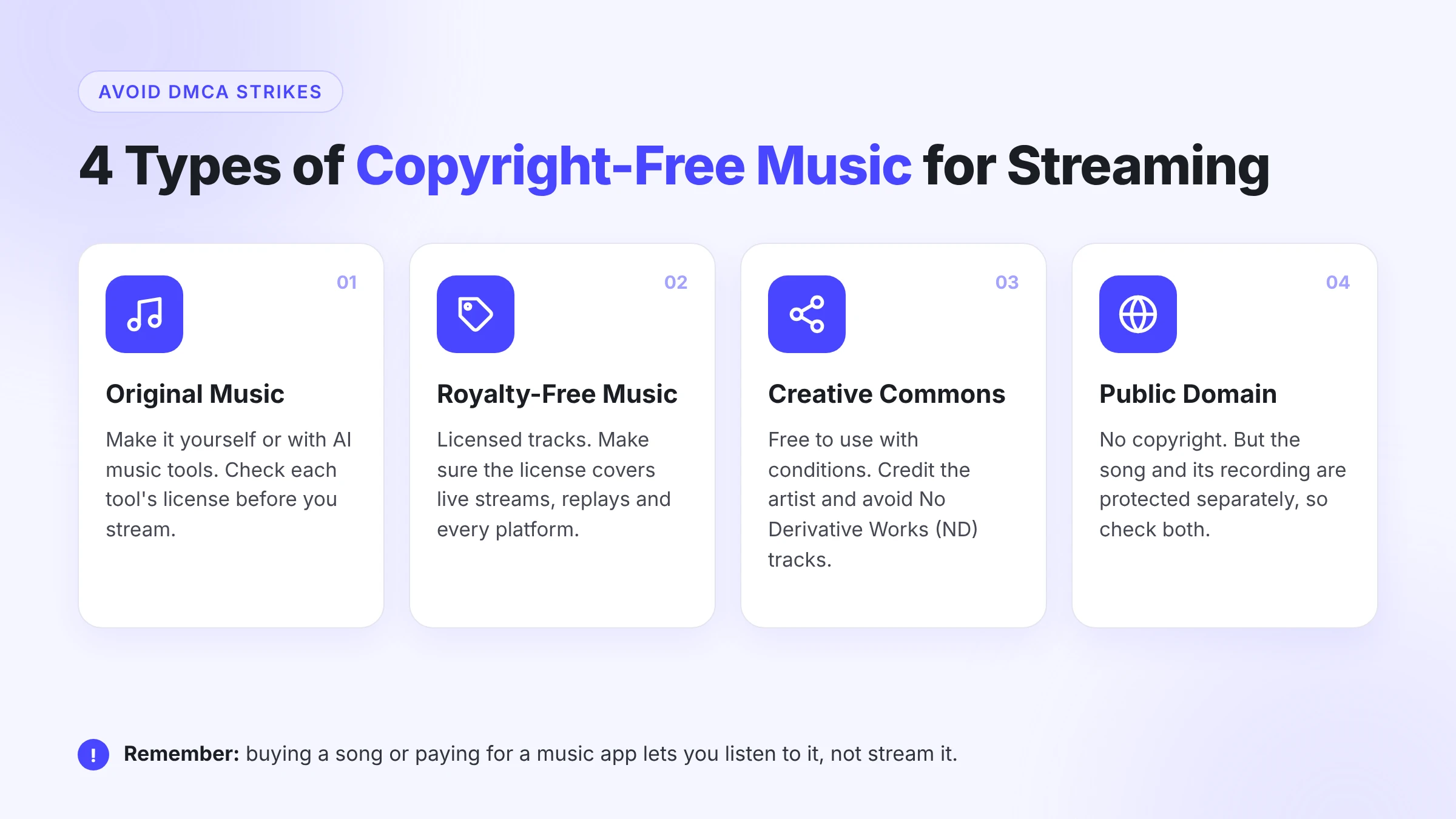
Keep in mind that buying a song, downloading it, or paying for a music streaming subscription only gives you the right to listen to it yourself. It does not give you the right to broadcast it to an audience. So even purchased music is not copyright-free music for streaming. With that in mind, let's explore the types of music you can use for live streaming:
- Original music
- Royalty-free music
- Music under Creative Commons licenses
- Music in the public domain
Original Music
If you're looking to stream background soundtracks or create music specifically for your content, you can make it yourself. It’s your original creation, and you’re free to use it as you like.
Don’t overthink! Creating copyright-free music doesn’t require heavy instruments or complicated software. AI tools like Soundraw and AIVA let you craft music and customize it based on mood, genre, and instrumentation, while BandLab’s free SongStarter generates royalty-free song ideas you can build on. Each tool has its own license terms. AIVA’s free plan, for example, is for non-commercial use with credit to AIVA, so pick a plan that allows monetized streams.
That said, you can also create a cover of another song, for instance, or a remix, and negotiate with the copyright holder for a license to use music for live streams without worry.
Royalty-Free Music
Royalty-free music is the best choice for streamers looking to use copyright-safe music in their streams. These tracks may not be chart hits, but their quality and variety are as good as those of the others.
Subscription libraries such as Envato and Epidemic Sound offer professionally composed tracks that come with a license, so you can use them in your streams with confidence. Before you go live, check that the license covers live streaming, the saved replay, and every platform you stream to.
Important information: Royalty-free Music and Creative Commons are distinct. Royalty-free is usually a paid license that sets the scope and platforms, while Creative Commons variants (BY, BY-NC, BY-SA, etc.) may require attribution or prohibit commercial use. Always confirm live streaming rights before use.
Music under Creative Commons Licenses
If you’ve downloaded music from a website that offers free music, there is a good chance it falls under one of the many Creative Commons licenses. Read each track’s license carefully to understand any restrictions. Credit the artist and the license as required, and avoid tracks with a No Derivative Works (ND) license, because Creative Commons treats syncing music to video as changing the work.
Music in the Public Domain
Music in the public domain is non-copyrighted music. The best part? It is legal and free for streamers to use. The popular Christmas carol ‘Jingle Bells’ is a perfect example: the song itself is in the public domain.
But be careful, as the song and the recording are protected separately. A new recording of ‘Jingle Bells’ can still be copyrighted, even though the song isn’t. In the U.S., as of January 1, 2026, musical compositions published in 1930 or earlier and sound recordings published in 1925 or earlier are in the public domain. Public domain rules and copyright terms also differ from country to country, so confirm the status of both the song and the specific recording before you use it.
Pro Tips
Now, your content reaches its full potential when every element, from the set design to the background music, works in perfect sync.
Read more: Music Distribution Rights for Live Streamers: A Guide for Independent Creators
How to Know that You Are Using Copyright-Free Music?
Streaming videos on social media with background audio can be a major headache owing to copyright soundtrack issues. You don't want to violate the DMCA with your music, as this could lead to being blocked, having your earnings go to someone else, or facing legal repercussions.
So, before you use music for your streams on any social media platform, make sure you familiarize yourself with the platform’s guidelines on using music.
YouTube
YouTube checks your video for copyright issues before you publish it. When you upload a video in YouTube Studio, the “Checks” step screens it for copyright claims, so you can fix problems before the video goes public. If Content ID finds copyrighted audio you don’t have rights to, the rights holder can block the video, run ads on it and take the revenue, or track its viewership. So, make sure you use copyright-free music for YouTube.
Also note that YouTube Creator Music stopped selling paid licenses on August 10, 2026. It now offers only no-cost and revenue-sharing tracks, mainly to U.S. creators in the YouTube Partner Program. These tracks are for long-form videos only, not Shorts or live streams. Review each license carefully before you use a track.
Pro Tips
Facebook Live
Facebook Live only allows music in streams if you have the rights or a license for it. Facebook may mute or block content that works as a music listening experience or uses unlicensed tracks. Meta also says there should always be a visual part to your video, and that recorded music should not be its main purpose. Platform licensing arrangements can change over time, which may affect previously published posts.
If Facebook flags your stream with a copyright claim, you’ll have to dispute it and show that you have the right to play those tracks.
Read More: Facebook Copyright Infringement: Latest Policy & How to Stay Safe
Twitch
Twitch started as a live gaming platform, but it has now evolved into a dynamic space for a wide range of content, including music, talk shows, and creative streams. With this evolution, Twitch has become a popular destination for music streaming.
However, Twitch allows playing background music on your live stream only if:
- It is your original creation
- You have the license for it
- You are a DJ enrolled in the Twitch DJ Program and play tracks from its music catalog
Twitch’s own music library, Soundtrack by Twitch, shut down in July 2023, so it is no longer an option. The Twitch DJ Program, launched in 2024, only covers DJs who opt in, and it does not cover VODs, clips, or highlights. Unauthorized music can lead to muted VODs, DMCA takedowns, and temporary or permanent bans.
Pro Tips
X
X responds to copyright complaints filed under the DMCA. If a rights holder reports your video, X may remove it or restrict access, mark it as withheld for viewers, and send you a copy of the complaint. Accounts with repeated complaints can be suspended, and re-posting removed material may lead to a permanent suspension.
You can, however, dispute the claim by filing a counter-notice if you believe the content was removed by mistake, or by asking the reporter to retract the complaint. Keep proof of your music license ready.
Pro Tips
Final Word: Copyright-Free Music Makes Content Smooth and Legally Secure
Live streams provide you with endless opportunities for adding background audio. To ensure your live stream remains smooth and uses uncopyrighted music, it's essential to use original, licensed, or royalty-free content for streaming. Because you don’t want your stream to shut down due to copyright infringement, do you?
To take your streaming experience one step further, consider using OneStream Live and start multistreaming to 45+ social platforms and the web at once.
Don’t wait! OneStream Live makes your stream content stay fresh and exciting. Start using OneStream Live today and take your content to the whole world.
Frequently Asked Questions
What music can I play on Twitch?
You can play music you own, music you have licensed for streaming on Twitch, or, if you are an enrolled DJ, tracks from the Twitch DJ Program catalog. Soundtrack by Twitch is no longer available.
How do streamers avoid copyright strikes with music?
Streamers avoid strikes by using royalty-free or platform-cleared tracks that come with a license for streaming, and by checking that the license also covers VODs and clips.
Is SoundCloud music free to use on streams?
No, not by default. Music on SoundCloud is still copyrighted unless the artist releases it under a license that allows streaming, such as a Creative Commons license, or gives you permission.
Can I play YouTube music during my Twitch stream?
No, unless the track is royalty-free or DMCA-safe music that you have the rights to stream.
Is royalty-free music the same as copyright-free music?
No. Royalty-free music is still copyrighted, but its license lets you use it without paying per use. Copyright-free music, such as public domain music, has no copyright at all.
OneStream Live is a cloud-based live streaming solution to create, schedule, and multistream professional-looking live streams across 45+ social media platforms and the web simultaneously. For content-related queries and feedback, write to us at [email protected]. If you have a story to share about your live streaming experience with OneStream Live, we would be glad to feature it. You're also welcome to Write for Us!