
If you have ever watched a sport from the stands, you know that following every moment can be difficult. The action moves quickly, attention shifts constantly, and when the seat is far from the pitch, it becomes harder to track every detail. That is why spectators often rely on the stadium screen. The experience feels smoother, not because the game changes, but because the delivery is clearer. The same contrast appears in live streaming, where the underlying technology determines how clearly the experience is delivered. You might be watching the thrilling finale of an esports tournament or a cozy cooking stream from your favorite blogger, and suddenly the broadcast freezes at the most exciting moment. The magic breaks instantly, and we are abruptly reminded of servers, bitrates, and channel bandwidth, even though just a second ago we were fully immersed in the content.
Perfect streaming is a paradox because live streaming technology reaches its peak only when the user stops noticing it. We are used to taking a stable picture for granted, but behind this simplicity lies the colossal work of engineers and an incredibly complex architecture. It is this invisible reliability that allows creators to focus on emotions rather than on a technical battle with the hardware.
Live streaming technology is effective when streams remain stable and uninterrupted.
Stream reliability depends on backend systems that operate continuously in the background.
Latency and buffering directly affect how viewers experience live content.
Adaptive bitrate systems allow streams to function across different devices and network conditions.
Reliable streaming tools reduce the technical effort required from creators.
Viewer trust decreases when technical issues appear during a broadcast.
Engineering decisions have a direct impact on the emotional quality of a live stream.
Engineering Mastery No One Sees
When we press the Go Live button, we expect a miracle to happen instantly. Yet behind this simplicity unfolds a real battle for milliseconds, where data is split into packets, flies across oceans, and reassembles into a complete image on the viewer’s screen.
Building such infrastructure requires not just coding skills but a deep understanding of high-load architecture, the kind typically handled by a specialized software development company capable of building a fault-tolerant system from scratch. Without a solid backend, any creative idea will crash against a wall of technical errors, turning a show into a slideshow.
The complexity of the modern streaming ecosystem lies in its variability. A viewer may watch a broadcast from a top-tier PC in New York or from a smartphone on unstable 4G somewhere in the suburbs, and both should have an identical experience.
Adaptive bitrate systems (ABR) act like invisible conductors, adjusting stream quality on the fly to match each user’s conditions. And although we rarely think about it, this flexibility is exactly what keeps the audience from leaving for another channel due to annoying buffering.
When Tools Don’t Get in the Way of Creativity
For a streamer, technology should feel like an extension of their thoughts, not an obstacle. Think back to the early days of the industry: to launch a stream on multiple platforms, you practically had to be a part-time system administrator, configuring complex RTMP servers and praying that your CPU wouldn’t melt under the load.
OneStream Live takes this “dirty work” off the creator’s shoulders. This lets creators think about lighting, sound, and chat interaction instead of stream routing. It is an example of true invisibility in action, where complex content distribution processes are wrapped in an intuitive interface.
Modern solutions free up the creator’s mental energy for what matters most: human connection. If a streamer glances at the monitoring panel every minute to check whether Facebook or YouTube has dropped and lost contact with the audience. A reliable platform should handle the following tasks:
- Automated bitrate adjustment depending on the source quality;
- Seamless multistreaming to dozens of destinations simultaneously;
- Cloud-based transcoding to reduce the load on the user’s hardware;
- Intelligent failover protection against network drops.
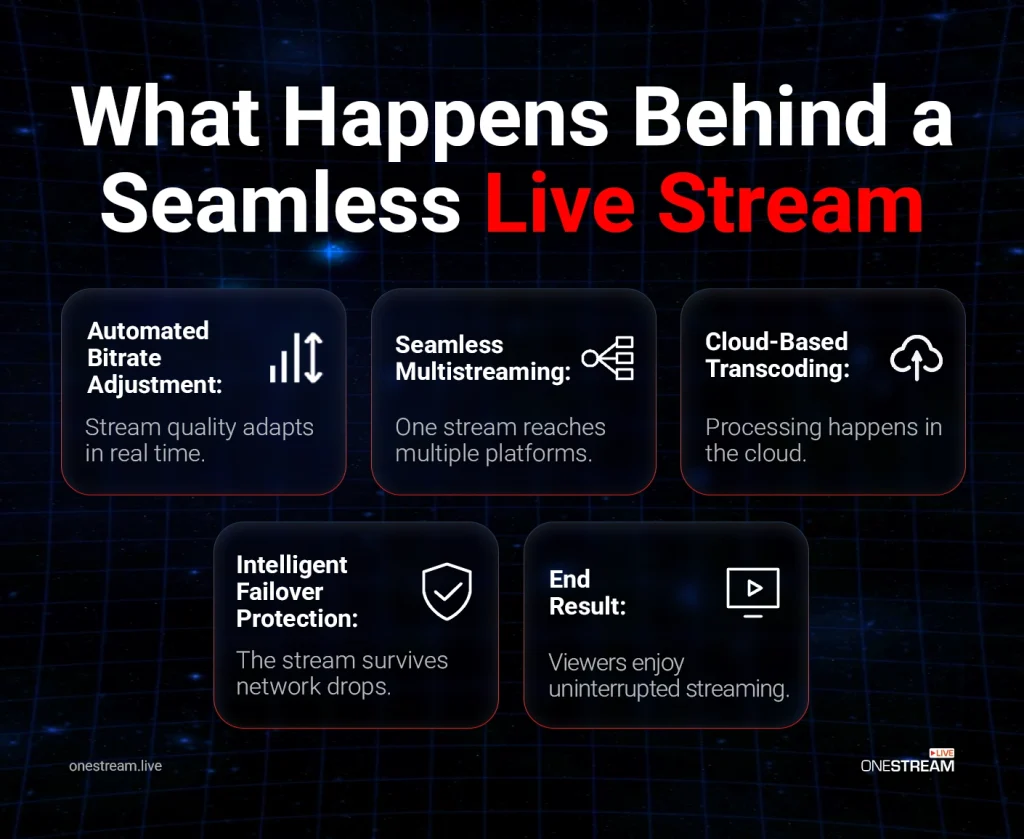
All of this happens in the background, and that is exactly why such tools become indispensable. The viewer senses the host’s confidence without realizing that this confidence is supported by cloud architecture processing gigabytes of data every second.
The cloud systems of OneStream Live handle all of this behind the scenes. This means the absence of technical hiccups often distinguishes a professional broadcast from an amateur attempt.

The Psychology of Perception: Trust Through Stability
The invisibility of live streaming technology directly affects the audience’s level of trust. We subconsciously associate technical failures with unprofessionalism, even if the internet provider is to blame rather than the streamer. When technology works flawlessly, it creates a sense of presence, blurring the line between the screen and reality. This is especially important for commercial streams and educational webinars, where the cost of an error is measured not only in dislikes but also in real financial losses.
Let’s take a look at how technical nuances transform into user experience, something often forgotten during platform development.
| Feature | Visible failure scenario | The “Invisible” ideal state | Viewer emotional response |
|---|---|---|---|
| Latency management | Chat reacts 30 seconds after the event | Real-time interaction with <3 sec delay | Feeling of belonging and active participation |
| Stream health monitoring | Error messages pop up on the screen | Background auto-recovery without a visual glitch | Unbroken immersion in the content narrative |
| Cross-platform sync | Audio desync on mobile devices | Perfect lip-sync across all endpoints | Perception of high production value and authority |
| Interface complexity | The streamer is struggling with the settings live | One-click setup and intuitive dashboard | Focus remains on the host’s charisma and message |
| Bandwidth fluctuating | Pixelated mess during high motion | Smooth degradation and quick recovery | Continued engagement without visual fatigue |
This table clearly shows that technical specifications are not just numbers in a report but the foundation of an emotional connection. If a viewer starts analyzing image quality instead of laughing at a joke, it means the technology has surfaced and ruined the moment.
The Future You Cannot See
We are toward an era where the line between physical presence and digital streaming will disappear completely. The development of neural networks and cloud computing promises to make the configuration and optimization processes fully autonomous These are systems that direct the broadcast themselves, switch cameras, and adjust sound based on audience reactions, all while remaining completely invisible to the creator.
Thus, the best live video streaming technology is the one that allows us to remain human, to make mistakes, laugh, argue, and share moments of life without being distracted by bitrate settings. The tools and engineering solutions behind them create that very seamless space where technology serves art rather than competing with it for attention.
In the end, we come to a stream for the story, and the task of engineers is to ensure that nothing gets in the way of telling it.

FAQs About Live Streaming Technology
Video streaming technology is a set of systems that deliver video content over the internet in real time or on demand. It works by compressing video files, breaking them into small data packets, transmitting them over a network, and reassembling them on the viewer’s device for continuous playback without downloading the entire file first.
Live streaming technology reduces latency and buffering through techniques such as adaptive bitrate streaming, efficient video codecs, and optimized content delivery networks. These systems adjust video quality in real time based on network conditions and minimize delays by balancing stream stability with transmission speed.
Streaming relies on a combination of video codecs, streaming protocols, cloud infrastructure, and content delivery networks. Common components include real-time protocols for transmission, cloud-based transcoding for format compatibility, and distributed servers that deliver content from locations closest to viewers.
Live streaming quality varies because viewers use different devices, internet speeds, and network conditions. Live streaming technology adapts to these differences by dynamically adjusting resolution and bitrate, which helps maintain playback but can result in different visual quality across viewers.
OneStream Live is a cloud-based live streaming solution to create, schedule, and multistream professional-looking live streams across 45+ social media platforms and the web simultaneously. For content-related queries and feedback, write to us at [email protected]. You’re also welcome to Write for Us!