
Live streamers are increasingly looking to accept crypto payments from their audiences in 2025. Both the streaming industry and cryptocurrency have hit a turning point: creators want faster, more global, and more creator-friendly ways to earn income, and Bitcoin provides a solution.
In fact, many streamers are adding Bitcoin and other cryptocurrencies as payment methods to capitalize on the benefits that traditional payment systems can’t offer. This trend is driven by tangible advantages like instant transactions, lower fees, borderless reach, and greater control over earnings.
Below, we lead with the top reasons content creators are switching to crypto, followed by how to get started and key considerations for streaming with Bitcoin.
Why Are Streamers Switching to Bitcoin and Crypto Payments in 2025?
Streamers are embracing Bitcoin and crypto payments because they offer faster transactions, lower fees, and a global reach, all while improving security and creator control. In short, cryptocurrency addresses many pain points of traditional payment systems.
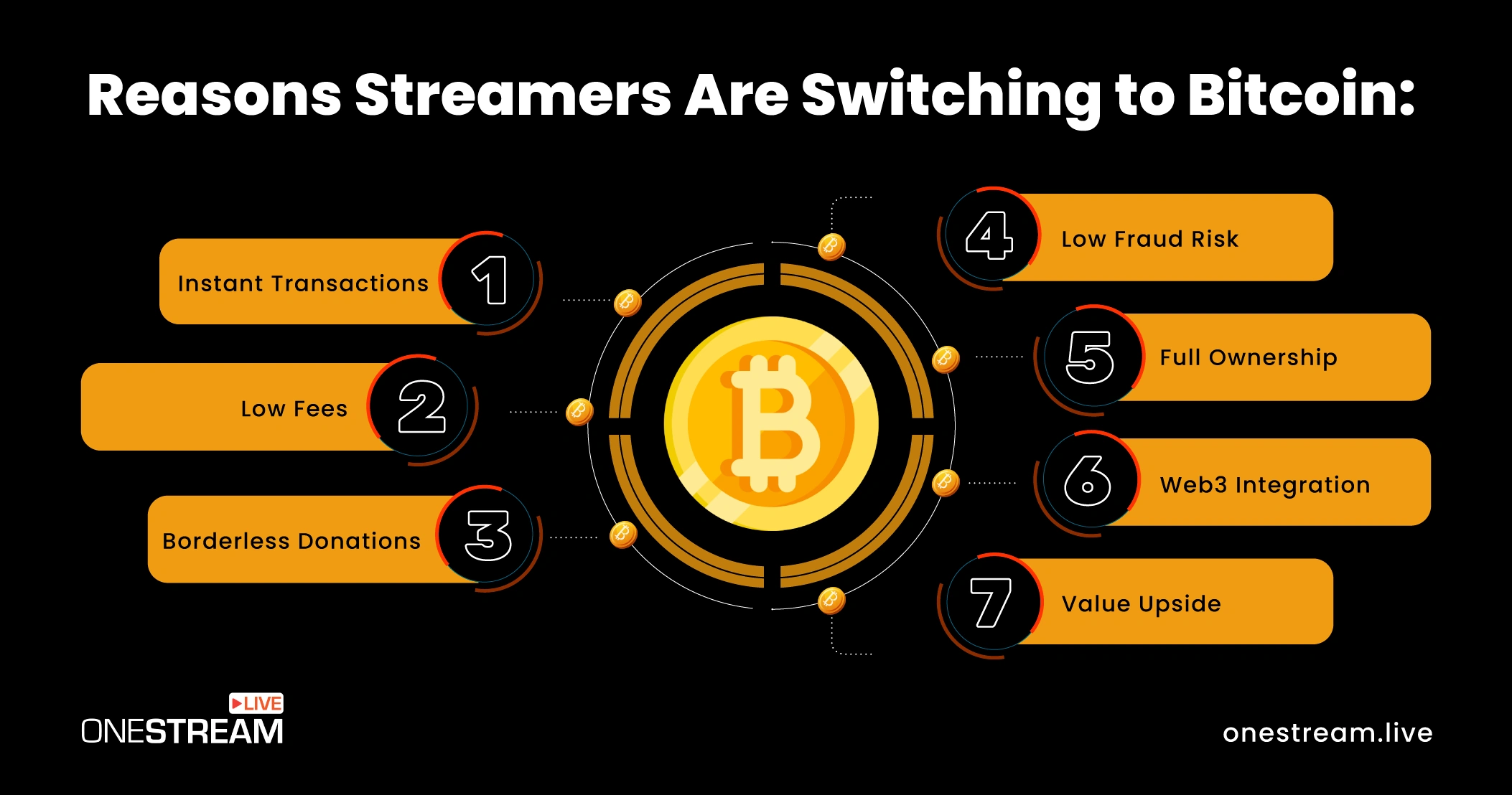
Here are the top seven reasons creators are making the switch:
- Near-Instant Transactions: Crypto tips process in real time, enhancing live interactions.
- Lower Fees: Bitcoin payments avoid the 2–5% fees of credit cards, letting streamers keep more income.
- Borderless Donations: Anyone worldwide can contribute in crypto without currency conversion hurdles.
- Reduced Fraud Risk: Blockchain payments are irreversible, eliminating chargebacks and protecting privacy.
- Creator Ownership: Streamers have full control of crypto funds, bypassing platform restrictions on monetization.
- Web3 Integration: Crypto ties into blockchain ecosystems (tokens, NFTs), unlocking new engagement and revenue models.
- Value Upside: Bitcoin earnings might appreciate over time, giving an investment angle to streaming income.
Next, we’ll dive into each of these benefits and explain how to accept crypto payments as a streamer to use them.
1. Are Bitcoin Payments Faster for Streamers?
Yes, Bitcoin and other crypto payments enable near real-time transactions, so streamers get tipped instantly during live broadcasts. In live streaming, timing is everything. Viewers often donate in the moment (for example, after a hype play or a shout-out), and cryptocurrency can transmit that tip within seconds or minutes, unlike traditional methods that might take days to clear.
For instance, credit card donations or bank transfers can take several business days to settle in a streamer’s account, especially if crossing borders or payout thresholds. By contrast, a crypto payment sent to the streamer’s wallet is available almost immediately once confirmed on the blockchain.
This real-time feedback loop enhances audience interaction, especially when a fan sends Bitcoin during a stream. The creator can see it and acknowledge it right away, keeping the excitement and engagement high.
Also, it’s worth noting that Bitcoin’s base network can sometimes take around 10 minutes for a block confirmation, but many streaming setups use faster solutions like the Lightning Network or other cryptocurrencies with instant finality.
2. Can Bitcoin Donations Appreciate in Value Over Time?
Yes, unlike fiat tips that stay the same, Bitcoin tips have the potential to grow in value over time (though this comes with volatility). This is a unique perk of accepting crypto payments: your streaming income isn’t just income, it can also be an investment.
If a fan sends you $50 worth of Bitcoin today, that Bitcoin might be worth $100 or $200 in the future if crypto prices rise. In recent years, Bitcoin’s value has trended upward significantly. By early 2025, Bitcoin was trading above $100,000 per coin for the first time.
We’ve even heard of extraordinary cases like a Twitch gamer who once received 20 BTC in donations during a single stream; that was worth about $70k at the time but would be over $2 million at 2025 prices! While such extreme generosity is rare, it illustrates how crypto earnings can turn into a significant asset.
Of course, it’s important to stress that this upside comes with risk. Cryptocurrencies are notorious for price volatility, as the value can also drop sharply.
If you’re new to handling cryptocurrency, it’s wise to familiarize yourself with the basics of buying, selling, and storing it. For example, you can learn how to buy Bitcoin on Kraken to understand the process of acquiring and safely managing Bitcoin. Educating yourself (and perhaps consulting financial advice) will help you make informed decisions about your crypto earnings.
3. Can Streamers Save on Transaction Fees by Accepting Crypto?
Absolutely. Accepting crypto payments lets streamers avoid the hefty cuts taken by traditional payment processors, meaning more money stays in their pockets.
For example, credit card processors or platforms like PayPal typically take around 2.9% plus $0.30 per transaction (which can equate to ~5% or more on small donations). Some streaming donation intermediaries charge even higher commission or platform fees (Twitch’s own Bits system effectively costs viewers much more than the streamer receives).
These fees add up quickly, especially when streamers rely on many small tips. A $1 donation might net only ~$0.48 after fees under some systems. Over time, creators see a big slice of their support eaten away by middlemen.
By contrast, Bitcoin and other cryptocurrencies often have minimal fees. There is no bank or card network taking a cut. In fact, the average processing fee for crypto payments ranges from 0% to 1%, significantly lower than the 3–5% common with credit cards.
Even when using a crypto payment gateway service, fees are modest. (For instance, one popular crypto donation provider charges about 0.5% per transaction.) This means if a viewer sends $10 worth of crypto, the streamer keeps almost that entire $10 (minus perhaps a few cents), rather than losing a dollar or more in fees.
4. Can Bitcoin Help Streamers Reach a Global Audience?
Yes, cryptocurrency provides a borderless payment method, allowing viewers from anywhere in the world to contribute without friction. Live streaming is a global medium; a fan in Brazil, India, or Germany might all be watching the same Twitch or YouTube stream.
But sending money across borders using traditional systems is often complicated or impossible, as credit cards might decline foreign transactions, and platforms may not support all local currencies. Bitcoin and other cryptos have no such limitations.
A viewer only needs the streamer’s crypto address or donation link to send support instantly, regardless of geography. There’s no worrying about exchange rates, international bank codes, or whether “X country can use Y payment app.”
As an added benefit, crypto’s peer-to-peer design avoids the extra fees or currency conversion costs that usually accompany international payments. A donation of 0.001 BTC reaches the streamer as 0.001 BTC, not 0.001 minus some foreign transaction fee.
5. How Do Crypto Payments Improve Security and Reduce Fraud for Streamers?
Crypto donations are more secure and private for streamers because they’re irreversible and don’t expose personal financial info, greatly reducing fraud and chargeback risks. One major headache with traditional payment methods is chargeback fraud.
With cryptocurrency, there are no chargebacks as transactions on the blockchain are final. Once a viewer sends Bitcoin and it’s confirmed, that payment cannot be reversed unilaterally.
Crypto payments also enhance security by minimizing the sensitive information involved. When a fan tips via crypto, they don’t need the streamer’s real name, bank details, or even email, just a wallet address.
Furthermore, blockchain transactions are transparent yet privacy-friendly. Anyone can see that a certain wallet sent 0.01 BTC to another, providing an open ledger trail (good for accountability), but if managed properly, neither the donor nor streamer has to reveal personal identifying details.
Some viewers even prefer sending crypto anonymously or pseudonymously to their favorite streamer for privacy reasons. And if a streamer wishes, they can publicly verify their crypto donations (building trust by showing an on-chain record of contributions) or keep it private, it’s their choice.
6. Do Crypto Payments Give Streamers More Control and New Monetization Options?
Definitely, using crypto allows streamers full ownership of their revenue and enables innovative monetization models outside the confines of traditional platforms. With conventional streaming platforms, creators often operate at the mercy of intermediaries.
For example, Twitch and YouTube have strict rules on payouts, take significant revenue cuts (Twitch takes 50% of subscriber revenue, for instance), and impose restrictions on how you can earn (certain links or sponsorships might be disallowed). In contrast, accepting cryptocurrency tips or payments puts the streamer in direct control of their income stream.
Additionally, crypto opens up new ways to monetize content that weren’t possible before. Streamers have begun exploring blockchain-based monetization: for example, issuing their own social tokens that fans can buy to unlock perks, or creating and selling NFTs (non-fungible tokens) of special moments, digital merch, or membership badges. These Web3 monetization models give creators alternative revenue beyond ads and donations, often with more generous economics and direct fan engagement.
We’re also seeing the rise of decentralized streaming platforms and tools that empower creators. Some newer platforms built on blockchain allow streamers to earn crypto for their content automatically, sometimes distributing reward tokens to both streamers and viewers for participating.
For instance, networks like Theta.tv reward creators and fans with native tokens for watching and streaming. Similarly, platforms such as DLive or Odysee (built on LBRY) have introduced revenue-sharing in cryptocurrency without the heavy cuts taken by mainstream sites.
7. How Are Streaming and Web3 Converging through Crypto Integration?
Streaming in 2025 is increasingly integrating with Web3, meaning blockchain technology and crypto communities are becoming part of the live streaming experience. For example, some live streamers now participate in tokenized communities. This is already happening on experimental platforms: Theta Network distributes a token (TFuel) to viewers who share bandwidth while watching streams, creating a circular economy of value.
There are also third-party services that integrate with streaming software to show crypto donations on-screen just like any other tip. The fact that developers are building tools like this indicates the demand. In one recent case, a developer created a system called “Blurt” to let viewers send crypto to Twitch streamers seamlessly via social media, reflecting the creativity around bringing Web3 functionality to established platforms.
Crucially, streamers don’t have to abandon the big platforms to use Web3 benefits, they can combine them. For instance, a creator might continue streaming on Twitch or YouTube for their massive audience, but also stream on a decentralized platform or incorporate token rewards for their community.
Using a multistreaming solution such as OneStream Live’s service allows creators to broadcast to their usual platforms and Web3 platforms simultaneously, reaching both audiences without extra effort.

Summary
| Benefit | Quick Answer | Why It Matters for Streamers |
|---|---|---|
| Faster Payments | Near real-time crypto tips | Keeps engagement high during live interactions; no multi-day bank delays |
| Value Growth | Bitcoin tips can appreciate | Donations double as income + potential investment, though volatile |
| Lower Fees | 0–1% vs 3–5% credit card fees | Streamers keep more of each tip, ideal for microtransactions |
| Global Reach | Borderless, no currency barriers | Fans worldwide can donate without banks, exchange rates, or declines |
| Security & Privacy | Irreversible, no chargebacks | Protects against fraud; tips need only a wallet address, not personal data |
| Ownership & New Models | Direct wallet control, Web3 options | Full revenue ownership + experiments with NFTs, social tokens, decentralized platforms |
| Web3 Integration | Streams connect with blockchain ecosystems | Unlocks token rewards, decentralized platforms, and multistreaming across Web2 + Web3 |
How to Accept Crypto Payments as a Streamer
Getting started with crypto payments may sound technical, but it’s becoming easier thanks to user-friendly tools. Here’s a quick step-by-step guide on how streamers can start accepting cryptocurrency payments:
1: Set Up a Crypto Wallet:
First, create a secure cryptocurrency wallet to receive funds. You might use a reputable mobile/web wallet or a hardware wallet for extra security.
Ensure you safeguard your private keys or recovery phrase, since this wallet will hold your tips. Many streamers choose wallets that support multiple cryptocurrencies (Bitcoin, Ethereum, stablecoins, etc.) so viewers have options.
2: Choose a Crypto Payment Processor or Platform:
You can accept crypto either directly or via a service. The simplest direct method is to share your wallet address or QR code for viewers to send crypto.
However, this offers no conversion or alert features. For a more seamless experience, consider a crypto payment gateway or donation service. There are platforms that specialize in allowing streamers to accept crypto donations.
These services often provide a donation link or button you can add to your stream page. They may also instantly convert the crypto to fiat or to a single currency of your choice, if you prefer to avoid volatility.
3: Add the Donation Link/Button to Your Stream or Website:
Once you have your wallet or payment gateway set up, make it easy for viewers to use. On Twitch, you can add a panel in your “About” section with a crypto donation button or link by simply uploading an image (like a Bitcoin or “Donate Crypto” icon) and hyperlinking it to your donation URL.
On YouTube or other platforms, you might put the link in your description or use overlay alerts. If you stream through a personal website or OneStream Live’s hosted live page, embed the payment widget or use the provided API to integrate a crypto payment gateway on your site. The key is to clearly signal to viewers that you accept crypto tips and provide a one-click (or one-scan) method to do so.

4: Inform and Encourage Your Audience:
Let your viewers know you’re set up for crypto. You might make an announcement or include a brief explainer in your panels (“Now accepting tips in Bitcoin, Ethereum, and more!”).
Sometimes viewers need guidance, so consider adding an FAQ for how to donate with crypto or mentioning during the stream that crypto donations are welcome. Given that not everyone is familiar with cryptocurrency, be ready to help a bit (for instance, suggesting easy ways they can acquire a small amount of crypto to tip, perhaps via a platform like CashApp or an exchange).
5: Manage Your Crypto Earnings Safely:
As the crypto starts coming in, practice good security and financial management. Keep your wallet secure (enable two-factor authentication, use strong passwords, and consider moving funds to cold storage if large amounts accrue).
Track the crypto amounts you receive and their value at the time of receipt, as this will help with accounting and tax reporting. You may also decide whether to hold the crypto or convert it.
Many payment processors offer automatic conversion to stablecoins or fiat to mitigate volatility, which you can use if you want a stable value. Alternatively, hold onto some coins as a long-term investment, as discussed earlier. Either way, treat your crypto earnings with the same seriousness as any income source.
Final Words
As I have outlined, streamers are switching to Bitcoin for faster payouts, lower costs, global accessibility, enhanced security, and greater autonomy over their earnings. There are certainly challenges to steer clear of, but with due diligence, those can be managed, as countless creators are already proving.
The result is a decentralized, creator-driven economy that is starting to take shape: one where a streamer in any part of the world can engage a global audience, receive support instantly and safely, experiment with new Web3 revenue streams, and even benefit from the growth of the digital assets they accumulate.
In the end, streaming has always been about pushing boundaries, and Bitcoin is another frontier on that journey. By making the shift to accept crypto payments, streamers are entering into a future where control lies more in the hands of creators and communities rather than middlemen.
Frequently Asked Questions
You can accept crypto donations by setting up a crypto wallet and then using a third-party service to facilitate tips. For Twitch, a common approach is to use a crypto payment gateway to create a donation link or button. You then add this link to your Twitch channel page.
On YouTube or other platforms, you can include the crypto donation link in your video description or use overlay alerts via your streaming software. Remember to provide instructions to your audience if needed (such as which coins you accept and how to get started with a small crypto amount).
It’s generally best to accept a handful of the most popular cryptocurrencies to reach the widest audience.
- Bitcoin (BTC) is the most recognized and often the first choice.
- Ethereum (ETH) is another common one, as many crypto users have some ETH.
- Beyond those, many streamers enable donations in stablecoins like USDT/USDC.
- Some also accept popular altcoins that have low fees or fast transactions, such as Litecoin (LTC), XRP, Solana (SOL), or Binance Coin (BNB).
Yes. In most countries, any income you earn, including tips or donations in cryptocurrency, is subject to taxes just like cash donations would be. Crypto is often treated as property or income for tax purposes.
Crypto doesn’t let you dodge taxes. It’s legally treated similarly to other earnings, so stay compliant to avoid issues.
Using crypto is safe if you follow good security practices and choose reputable services. The technology itself (blockchain) is very secure at a fundamental level, and the main risks come from user error or malicious actors (hackers/scammers).
It’s not completely foolproof – nothing is – but with smart practices, the risk can be managed to a very low level.
If handled properly, accepting crypto should be seen as an additional option, not a replacement for traditional support methods, so it shouldn’t alienate viewers. It’s important to communicate to your community that this is about giving more flexibility.
You can still emphasize that standard donations (via credit card, PayPal, subs, bits, etc.) are perfectly welcome.
OneStream Live is a cloud-based live streaming solution to create, schedule, and multistream professional-looking live streams across 45+ social media platforms and the web simultaneously. For content-related queries and feedback, write to us at [email protected]. You’re also welcome to Write for Us!